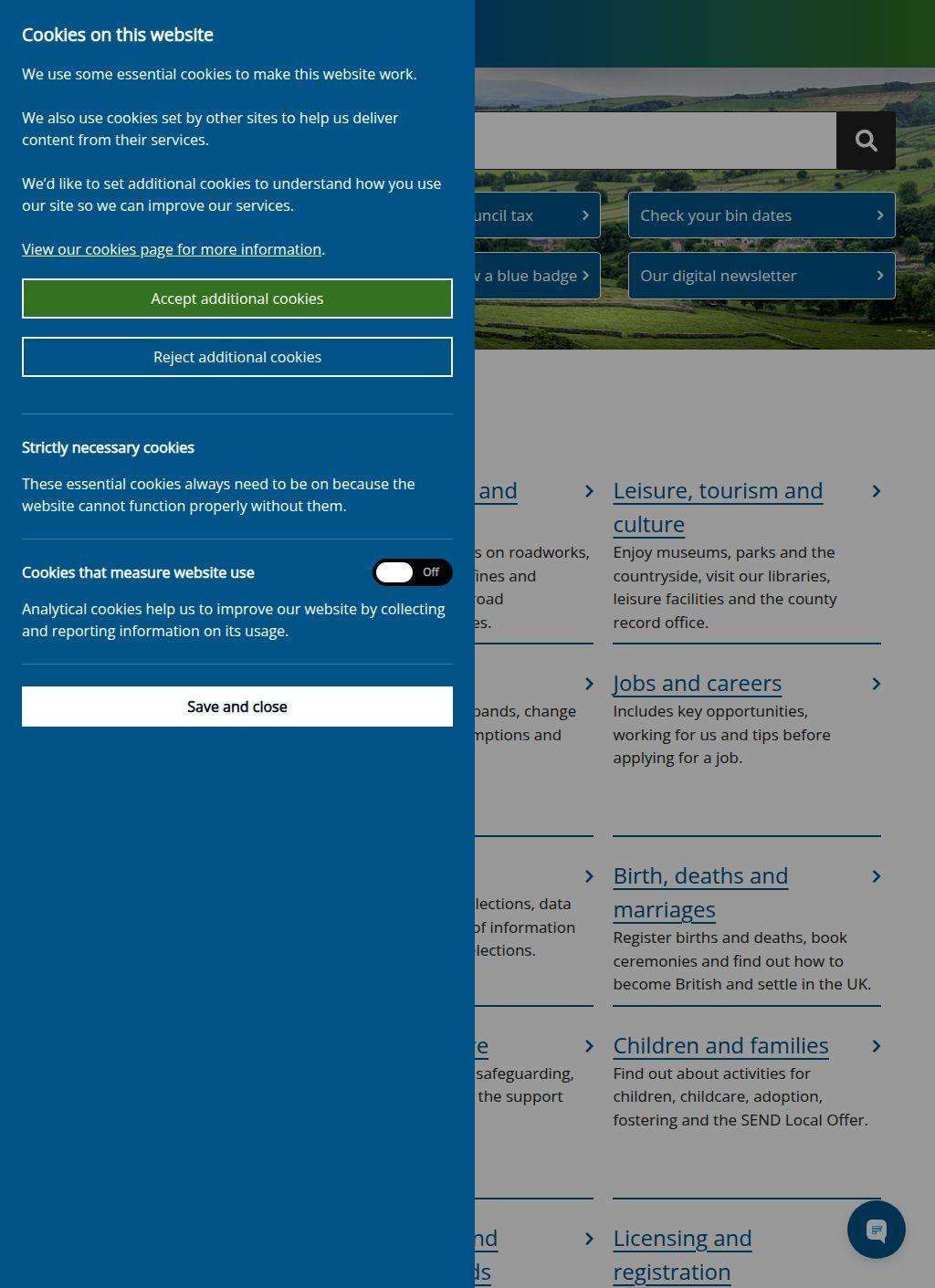
Running a unitary authority across one of England's largest counties is a different job from running a city council, and North Yorkshire Council's website reflects that difference at every turn. The geography the site has to serve is the first thing worth understanding. North Yorkshire Council covers towns as spread out as Harrogate, Scarborough, Whitby, Northallerton, Ripon, Selby, Thirsk, Malton, Pickering, Richmond and Skipton, places with little in common beyond the county boundary.
A coastal town like Whitby has different practical needs from a market town like Thirsk, and the site has to answer for both from one structure without letting either fall through the gaps. North Yorkshire Council came into being as a new unitary authority in April 2023, replacing seven district councils and the former county council, and that consolidation is one reason the website carries such a wide range of services under one roof.
Service categories organized by resident needs
On the North Yorkshire Council website, services are sorted into eighteen broad categories, and the labels are written the way ordinary people describe their problems rather than the way an internal department is named. Bins, recycling and waste sits at the top for most households, covering collection schedules, the recycling centres dotted across the county, and garden waste. Roads, parking and travel pulls together roadworks, Blue Badge permits, parking fines and cycling. The grouping is sensible: someone who has just received a parking fine lands in the same place as someone checking when a road will reopen, and that is genuinely how people think when they arrive at North Yorkshire Council's homepage rather than how the council organises itself internally.
Council tax, benefits, housing support
Council Tax has its own full category covering payments, the band system, exemptions and the various discounts. Sitting alongside it is a benefits section handling housing benefit, council tax support and crisis funds, which is the right neighbour for it. A resident who cannot pay their Council Tax is often the same resident who needs to know whether support exists, so keeping the two within reach of each other is a piece of design sense that pays off in practice. The same logic runs through housing and homelessness, which covers tenant services, landlord support and homelessness referrals in one place.
Care services for adults, children, carers
The care side of the offering is substantial and treated with the weight it deserves. Adult social care covers safeguarding, the different types of care available, and support for carers, who are easy to forget about and often the people most in need of clear information. Children and families runs in parallel, taking in childcare, adoption, foster care and SEND services, the last of which tends to be where families spend hours hunting for answers on poorly built sites. North Yorkshire Council has given each of these its own category instead of a single vague welfare heading, and that decision alone saves a worried parent considerable time. Healthy living and a community and volunteering section round out the social provision.
Planning, conservation, heritage protection
Planning is an area where North Yorkshire Council has had to think carefully, as a largely rural county demands. So much of North Yorkshire is protected landscape or historic fabric that the planning and conservation category could easily become a maze. Instead, North Yorkshire Council has kept it focused: planning permissions, building regulations and heritage protection are clearly separated, and the section connects to a planning application viewer that lets anyone look up what has been applied for in their area. That is genuinely useful in places like Richmond or Malton, where a neighbour's extension is a live concern and residents want to check the record themselves. Environment and neighbourhoods handles the day-to-day grievances, pest control and fly-tipping reports among them, with a highway fault reporter for potholes and broken streetlights.
Self-service tools that eliminate phone calls
Those self-service tools are where North Yorkshire Council's site makes its strongest case, because they remove the phone call entirely. Beyond the planning viewer and the fault reporter, there is a bin collection checker that gives the schedule from a postcode, and a Blue Badge application portal that takes the whole process online. A beta Digital Assistant has also been added for guided navigation, the kind of feature councils often launch and quietly abandon, so labelling it beta is at least honest about where it stands. None of these are flashy, and they should not be. A bin checker that works on the first try is worth more than any amount of polish on surrounding pages.
Civic functions from registration to licensing
The rest of the eighteen categories fill in the civic functions North Yorkshire Council has to perform whether or not they generate much traffic. Births, deaths and marriages covers registration, ceremonies and citizenship. Elections and councillor information gives residents a route to find who represents them and how to vote. Education and learning takes in school admissions, term dates and school transport, the last being a real headache in a county this large where children can live several miles from the nearest school. Licensing and registration deals with taxis, gambling and street trading. Jobs and careers, business and economy, and a leisure, tourism and culture section covering museums, parks, libraries and the record office complete the spread.
It is worth noting that North Yorkshire Council's site does not appear in any general business directory, which is appropriate: this is not a commercial listing but a statutory public authority publishing services it is legally required to provide. The measure is whether those services are findable and usable, not whether they have gathered external ratings, and North Yorkshire Council should be assessed on that basis alone.
Does the site serve its purpose well?
That breadth is the honest measure of what North Yorkshire Council has built. This is not a site you visit for pleasure; it is a tool you reach for when you have a specific problem, and on that test it performs well. The categories are named in plain language, the heaviest-traffic services sit where people find them fastest, and the genuinely transactional jobs that residents need to handle have been turned into tools that work without a phone call. A county stretched from the coast at Scarborough to the Dales above Skipton is hard to serve from one address, and North Yorkshire Council has chosen clarity over cleverness, which is the correct choice for this kind of resource.
Some sections are inevitably deeper than others, and the beta Digital Assistant is a work in progress by definition, but the core structure is sound. The coverage is thorough across all eighteen service areas, and North Yorkshire Council has given the most complex and sensitive categories, care, planning, benefits, enough depth that a resident in a difficult situation is not left staring at a dead end.
Business address
North Yorkshire Council
County Hall, Racecourse Lane,
Northallerton,
North Yorkshire
DL7 8AD
United Kingdom
Contact details
Phone: 01609 780780