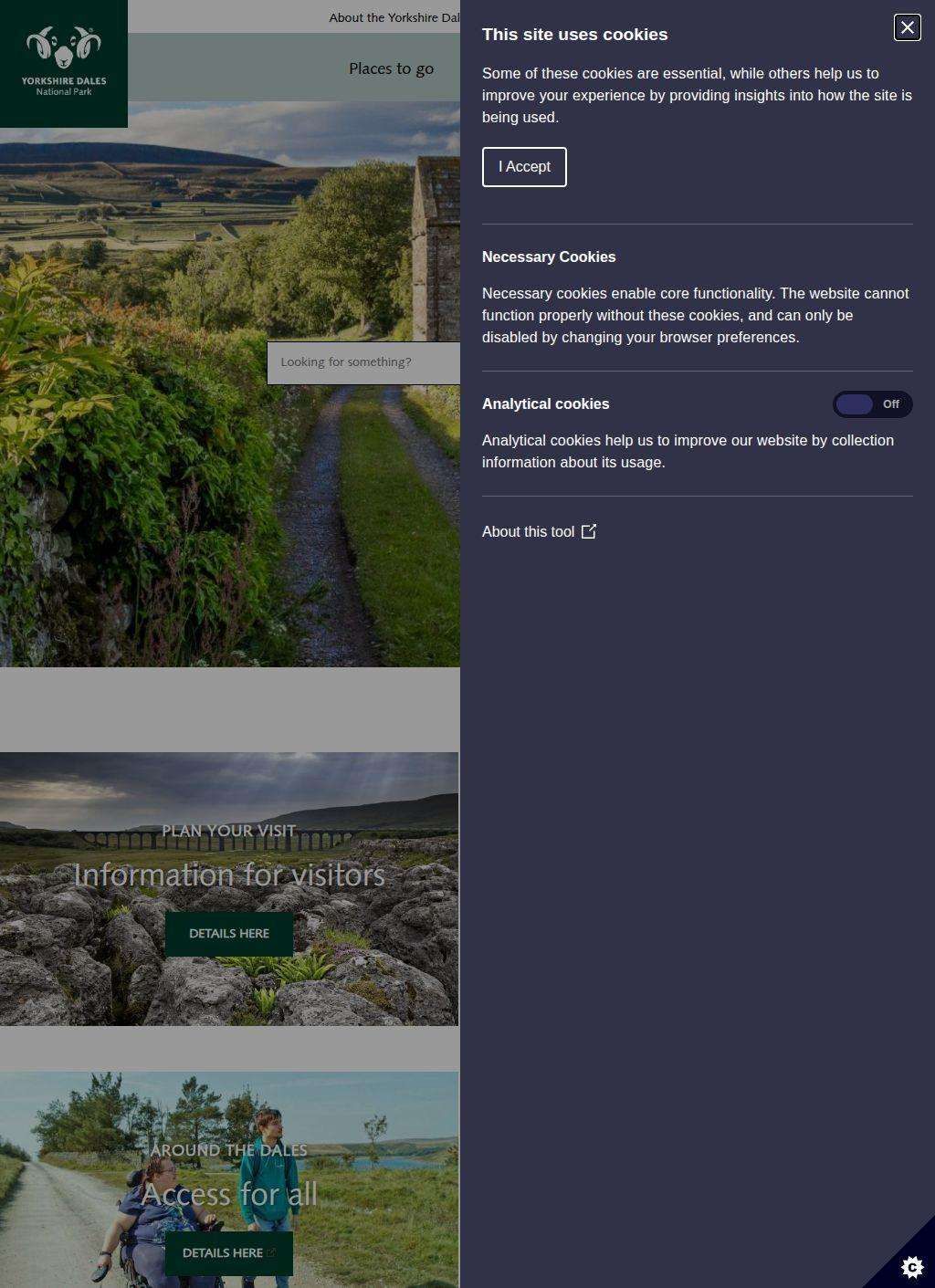
Pull up the calendar of ranger-led activities and within a minute you have a clear read on what kind of organisation you are dealing with. Dated, location-specific guided walks and events run by the people who actually look after the land sit alongside walking and cycling routes, maps, and guides to attractions spread across the park. That practical visitor layer rests on top of a much heavier set of statutory functions, and the Yorkshire Dales National Park Authority is candid about being both at once: a place to plan a day out and the government body that decides what gets built where.
Walking and cycling routes
Start with the visitor material and the routes are the strongest section. Walking and cycling suggestions come with maps, and the guides point to specific attractions instead of vaguely gesturing at scenery. There is a section devoted to the park's dark sky status, which will mean a lot to stargazers and astrophotographers who know what they are after, and a stream of news and events that gives the whole thing a current feel rather than the frozen-in-amber quality a lot of official sites have.
Planning applications and conservation
The planning and conservation pages are where the authority's legal role shows. You can read the national park management plans, look into planning applications, and follow the conservation programmes covering landscape and wildlife. This is the bureaucratic spine of the operation, and it is presented plainly: a developer checking what is permissible and a resident worried about a nearby proposal are both pointed to the same documents. The Yorkshire Dales National Park Authority does not soften the fact that it is a regulator, and the site is more useful for it.
Farming grants and land management
A part of the content that is easy to overlook serves farmers and landowners. There are pages on farming and land management, grants aimed at people who work the land, and agri-environment schemes. That is a constituency a casual visitor never thinks about, yet it is central to how the Dales actually look, and the Yorkshire Dales National Park Authority treats it as a primary audience rather than an afterthought. Sitting alongside this is the Sustainable Development Fund, which backs local community and environmental projects, so there is a route for residents and small organisations to get tangible support alongside information.
Educational resources for schools
Educational use is covered too. Schools and families get resources, and volunteer opportunities are laid out for people who want to give time to the park. The geology, history and cultural heritage sections add depth for researchers or anyone who wants to understand why the limestone country looks the way it does. None of these are throwaway pages; they read as content built for someone who will sit and use them.
Serving multiple audiences from one site
The breadth is the obvious strength and also the structural risk. The Yorkshire Dales National Park Authority is trying to talk to visitors, residents, farmers, landowners, developers, schools and researchers from one place, and those groups want very different things. A hiker after a circular route and a farmer hunting a specific grant scheme have almost nothing in common in how they navigate, so the burden falls on signposting to get each person to the right corner quickly. From what the offering describes, the major doors are all there, though a site this wide always lives or dies on how cleanly it splits its audiences once you are past the front page.
Regulatory content kept in public view
What the Yorkshire Dales National Park Authority gets right is keeping its scope honest. The conservation reporting, the management plans and the grant schemes are the substance of running a protected landscape, and putting them in public view, next to the route maps and the events calendar, is the accurate version of what this body does. Many comparable sites bury the regulatory material and lead with pretty photographs; this one keeps both in plain sight.
The verdict is solidly positive with a practical caveat. For trip planning, dark sky visits, school resources or following a live planning matter, the Yorkshire Dales National Park Authority site does the job and does it with genuine depth. Farmers and landowners chasing grants get more here than the casual reader would guess. The one thing to temper expectations on is the sheer spread: with this many audiences served under one roof, finding the precise page you want can take a few clicks more than it should, and a researcher or developer after a single document should be ready to dig.
That is a quibble about navigation, not about content. On what it offers, the Yorkshire Dales National Park Authority is a thorough, well-stocked resource, and one of the few official sites where someone planning a walk and someone checking a planning application are both genuinely served. The Yorkshire Dales National Park Authority covers its remit fully, and that is the point.
Business address
Yorkshire Dales National Park Authority
Yoredale, Bainbridge,
Leyburn,
North Yorkshire
DL8 3EL
United Kingdom
Contact details
Phone: 0300 456 0030