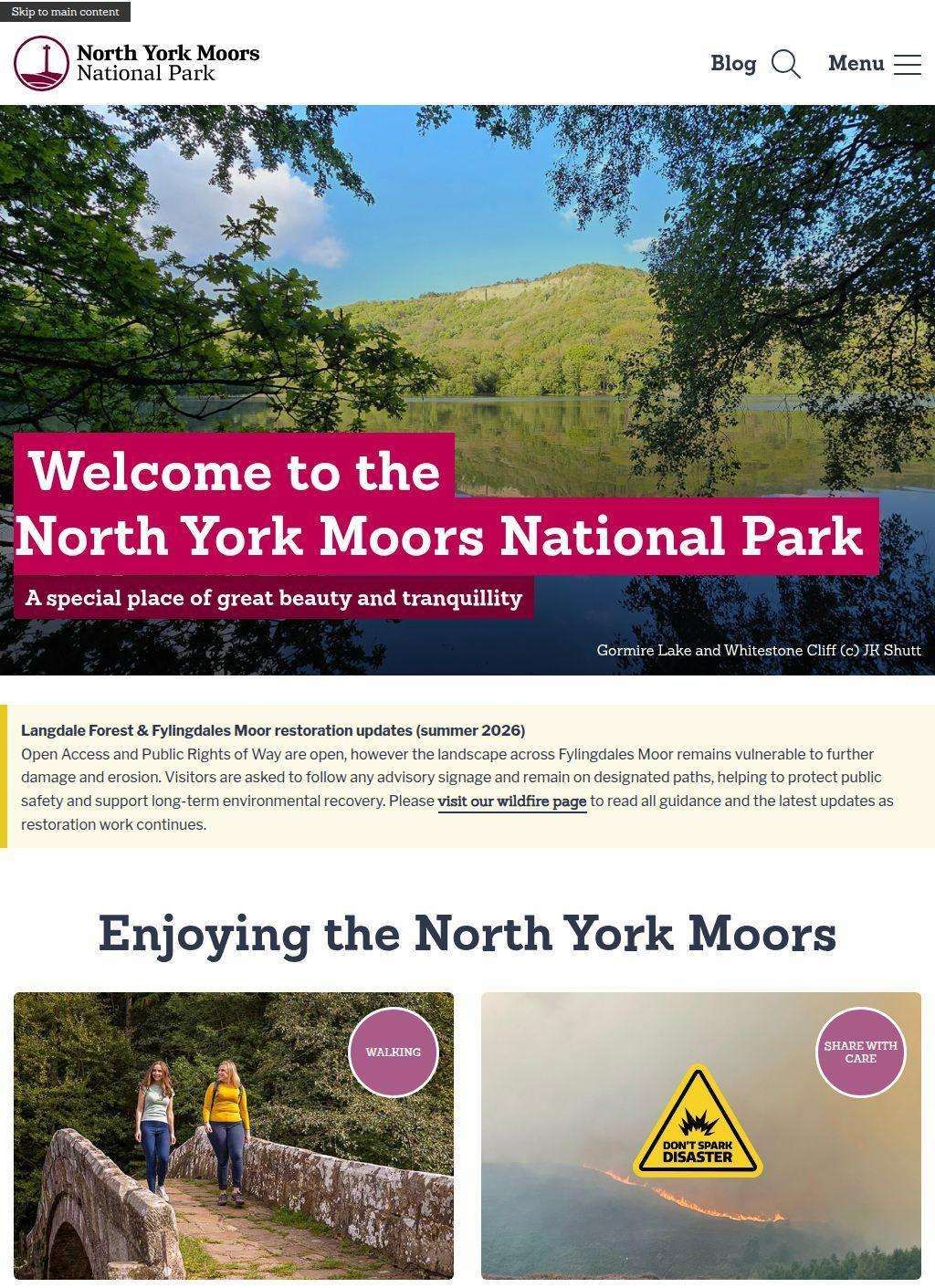
The North York Moors National Park Authority is the statutory body responsible for the North York Moors National Park, a protected area of around 1,434 square kilometres in the north-east of North Yorkshire. The park stretches from the Hambleton and Cleveland Hills in the west to the dramatic sea cliffs of the Yorkshire coast in the east, taking in one of the largest expanses of upland heather moorland in England along with deep wooded dales, farmland and a string of stone-built villages. The authority is based at The Old Vicarage on Bondgate in Helmsley, a market town on the park's southern edge, and operates as a single-purpose public body distinct from North Yorkshire Council, with its own planning powers and statutory responsibilities.
Statutory purposes and community wellbeing
Like the other English national park authorities, it has two statutory purposes: to conserve and enhance the natural beauty, wildlife and cultural heritage of the park, and to promote opportunities for public understanding and enjoyment of its special qualities. When those purposes pull against each other, conservation takes precedence under the Sandford Principle. The authority also has a duty to have regard for the social and economic wellbeing of local communities, which is significant because the moors are a lived-in, working landscape of farms, grouse moors, forestry and around 23,000 residents. The website at northyorkmoors.org.uk is where all of this work meets the public, and it is used by visitors, residents, landowners, businesses and planning applicants alike.
Planning authority for the park
Planning is among the authority's most consequential duties. Inside the park boundary, it is the local planning authority, so it decides applications for new homes, extensions, agricultural buildings, barn conversions, changes of use and works to listed buildings and within conservation areas. The website sets out how to apply, how to search the planning register, how to comment on a proposal and what the local plan policies require. Given the strong stone-built character of villages such as Hutton-le-Hole, Goathland and Robin Hood's Bay, and the openness of the moorland skyline, the planning team gives particular attention to design, materials and protecting long views. For anyone using a business directory to identify the correct planning authority for a property within the moors, this is the right destination, which heads off the frequent error of applying to the wrong body.
Conservation work is wide ranging. The site explains the authority's management of the heather moorland, which depends on careful balancing of grazing, controlled burning, peat protection and rewetting, and its work on the ancient and broadleaf woodlands that fill the dales. There is information on wildlife, including ground-nesting birds, ring ouzels and the reintroduced and recovering species the authority monitors, as well as projects on river restoration and nature recovery. A long-running and well-regarded strand of work concerns the park's dark skies; the North York Moors holds International Dark Sky Reserve status, and the website carries guidance on stargazing sites and on reducing light pollution. The authority works largely through advice, partnership and influence rather than direct land ownership, a distinction the site is reasonably clear about.
Heritage sites along the coast
The North York Moors carries an unusually rich layer of heritage, and the authority's pages reflect that. The park contains the ruins of Rievaulx Abbey nearby, numerous prehistoric and medieval remains, historic ironstone and alum industries along the coast, and the North Yorkshire Moors Railway running through Newtondale. The famous Whitby and the coastal towns of Staithes and Runswick Bay sit within or at the edge of the park, and the website helps visitors understand the cultural and industrial story alongside the natural one. Information on the historic environment, archaeology and the authority's conservation of traditional buildings is available for those who want depth.
For visitors, northyorkmoors.org.uk is a practical resource. It covers walking and cycling routes, including the Cleveland Way National Trail that loops along the moorland edge and the coast, family-friendly trails, and longer routes for experienced walkers. There are pages on the National Park Centres at Sutton Bank and Danby, on viewpoints such as the Sutton Bank escarpment, on the coast, and on the villages worth visiting. The authority promotes responsible access, with seasonal advice on wildfire risk during dry spells, on keeping dogs under control near livestock and ground-nesting birds, and on the countryside code. The honest caveat is the familiar one for upland areas: weather changes quickly, some routes are exposed, and public transport into the interior is limited, so the site's emphasis on preparation is sensible.
Access management and volunteering opportunities
Access management, rights of way, ranger services and volunteering all feature. The authority maintains paths, signage and access infrastructure within the park, working alongside the wider rights of way duties held by North Yorkshire Council, and it runs volunteer programmes covering practical conservation, surveys and visitor engagement. Education provision includes resources and activities for schools and learning material on the geology, ecology and history of the moors. These services give residents, schools and community groups good reason to reach the authority directly, which a regional directory listing makes easier. The authority has also agreed plans to move to a new purpose-built headquarters in Helmsley, so its operating address may change in due course, while Helmsley remains its base.
Housing and the local economy feature alongside the conservation work, because the moors are home to working communities as well as visitors. The website explains the authority's planning approach to affordable and local-needs housing, an issue felt keenly in villages where holiday lets and second homes have driven up prices, and it sets out support for rural businesses, farm diversification and sustainable tourism. There is guidance for anyone wanting to run a campsite, holiday accommodation or a visitor attraction within the park rules, and information on funding schemes that back projects benefiting both the environment and the people who live there. The authority is candid that reconciling conservation with the need for jobs, homes and viable farms is a constant balancing act, and the relevant pages avoid pretending the tensions do not exist.
Governance transparency practices
Governance is open. The authority is run by a board of members from local councils, parish representatives and Secretary of State appointees, and it publishes committee papers, meeting dates and decisions on its democratic pages. Funding comes chiefly from central government grant, topped up by car park income, the National Park Centres and project funding, with budgets and annual reports available to read. This transparency lets residents and businesses follow how planning and conservation decisions that affect their land and livelihoods are reached, which carries real weight in a working landscape.
Climate action for peatlands
Climate and nature work has grown into a defined strand of the authority's published output. The website covers targets for cutting carbon across the park, peatland restoration that rewets degraded blanket bog to store carbon and reduce flood risk downstream, and woodland creation that aims to expand tree cover in the dales without eroding the open moorland that defines the skyline. There is reporting on river and beck health, on recovering wildlife and on the partnerships with farmers, estates and conservation bodies that deliver this work on the ground.
The dark-skies programme connects to this too, since reducing light pollution benefits nocturnal wildlife as well as stargazers. For schools, students and researchers, the surveys, monitoring data and management plans published here are a useful evidence base, and a business directory entry that points straight to the authority helps people find this sourced material rather than the looser claims that circulate on commercial tourism and campaigning pages.
As a website, northyorkmoors.org.uk is well organised and clear, dividing cleanly between visiting, conservation, planning and learning. It meets public sector accessibility standards and reads in plain language, with the planning and policy sections naturally more technical than the visitor pages. The main contact number is 01439 772700, and the Helmsley address is given for written enquiries. For anyone wanting the genuine, official authority that cares for the North York Moors, whether to submit a planning application, plan a walk, report an access problem or understand moorland management, this site is the authoritative source. A business directory entry pointing here connects people to the statutory body rather than to commercial tourism pages, and the authority serves the residents, farmers, businesses and many visitors tied to this corner of North Yorkshire.
Business address
North York Moors National Park Authority
The Old Vicarage, Bondgate,
Helmsley,
North Yorkshire
YO62 5BP
United Kingdom
Contact details
Phone: 01439 772700