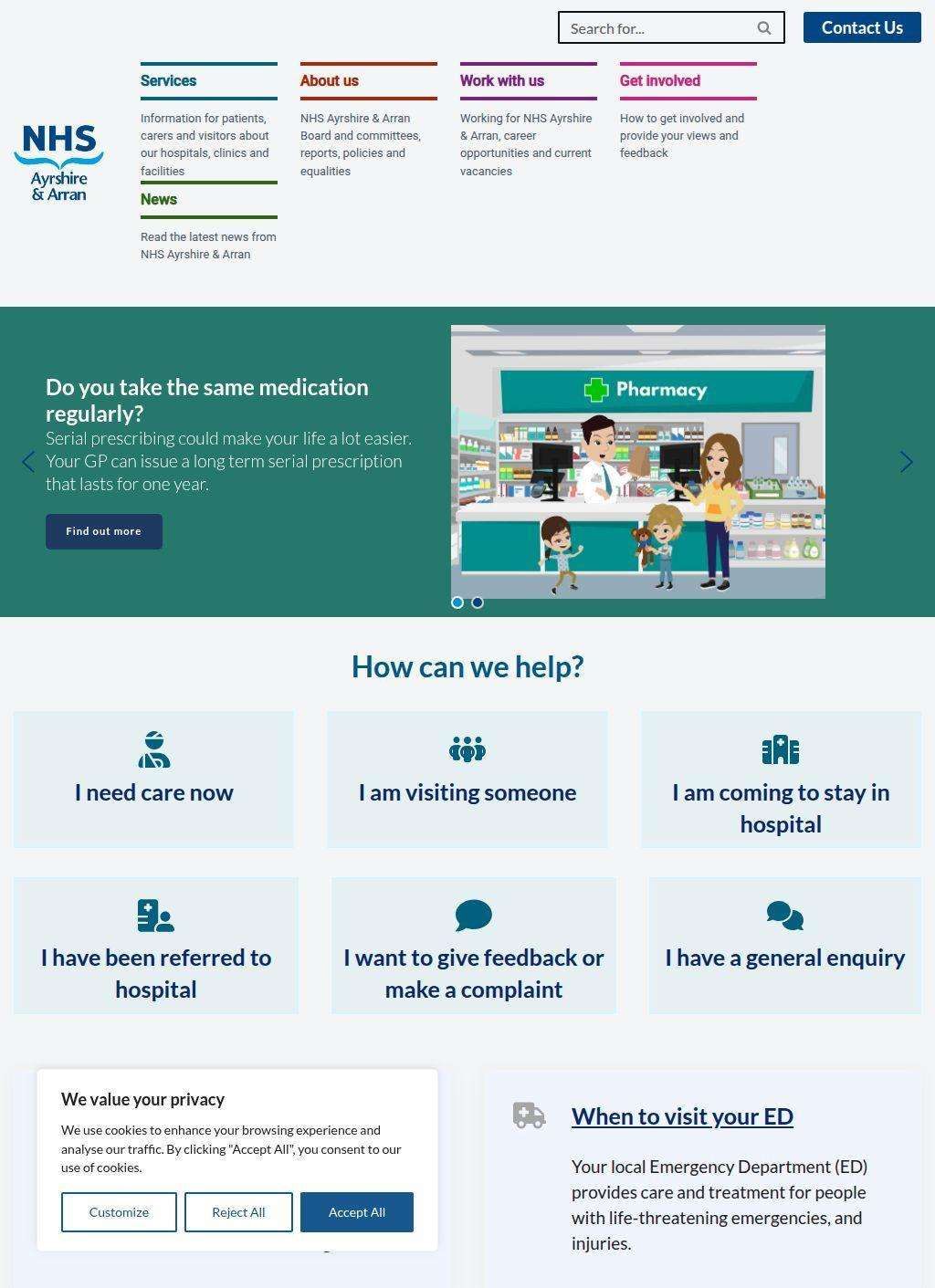
Someone in Kilmarnock at two in the morning, unsure whether a sudden chest pain warrants an ambulance or whether it can wait for a GP appointment, needs an answer fast and needs it to be trustworthy. That moment, when a person is frightened and trying to decide where to turn, is the test of a regional health website, and it is the situation NHS Ayrshire & Arran has built its site to address. The emergency and urgent care guidance sits near the front of the services navigation, separating what counts as a genuine 999 emergency from what a minor injuries unit or NHS Inform can handle, so the panicked late-night reader is steered toward the right door instead of clogging the wrong one.
Hospital sites and admissions
NHS Ayrshire & Arran is the territorial NHS authority for Ayrshire and Arran, responsible for publicly funded healthcare across a sizeable chunk of south-west Scotland, and the site mirrors that remit. Hospital care anchors the offering, with University Hospital Crosshouse and University Hospital Ayr named as the two main sites alongside the wider network of clinics and health facilities. A reader trying to find out where an outpatient clinic sits, or what to expect from an admission, gets dedicated sections on hospital visits and admissions. That is the sort of practical detail people hunt for when a relative has just been given a date for a procedure and nobody quite knows the visiting rules.
Serial prescribing at community pharmacies
Pharmacy services get their own space on the NHS Ayrshire & Arran site, and the inclusion of serial prescribing is a useful touch. That is the arrangement where a community pharmacy dispenses a repeated medicine over a set period without the patient having to chase a fresh prescription each time. Flagging it on the regional site, instead of leaving it buried in clinical jargon, means someone managing a long-term condition can see at a glance that the option exists locally. It is the kind of concrete detail that tells you NHS Ayrshire & Arran is writing for residents and filing something genuinely useful, not a corporate notice.
Self-help health advice runs through the site as well, linking out to NHS Inform, which is the national Scottish health information service. NHS Ayrshire & Arran does not try to rewrite every symptom guide and treatment explainer from scratch; it points to the authoritative national source while keeping the local layer, hospitals, clinics, and regional services, as its own contribution. For a user that hierarchy is easy to follow: general medical questions go to NHS Inform, while questions about where to be treated in Ayrshire stay on NHS Ayrshire & Arran's own pages.
Finding a GP dentist or optician
The service finder is probably the section that gets the most repeat use. People move house, a dentist stops taking NHS patients, a child needs registering with a GP, and the recurring practical need is simply a list of who is taking patients nearby. NHS Ayrshire & Arran folds GPs, dentists, and opticians into a single finder, which spares a resident from working out which separate registry holds which profession. That is unglamorous infrastructure, and it is exactly what a regional health board ought to provide.
Behind the clinical front door
Beyond the clinical front door, the NHS Ayrshire & Arran site carries the governance and civic machinery that comes with a public body. The About Us area holds board governance material, annual reports, and policies; a health board spends public money and the people it serves are entitled to see how decisions are made and where the money goes. Work With Us lists job vacancies, a real concern in a sector where staffing shortages directly shape how long a patient waits. Get Involved gathers patient feedback and community engagement routes, and a News section keeps regional updates flowing. None of this is decorative; each strand answers a different group, the prospective nurse, the worried patient, the local resident wanting a say.
British Sign Language and social media
Accessibility is treated as more than a checkbox. NHS Ayrshire & Arran offers British Sign Language services, which reflects that the board is thinking about deaf residents who would otherwise be shut out of phone-based or text-heavy health information. In a region with a wide age range and varied needs, a BSL route is a meaningful inclusion. It sits alongside the social presence on Facebook, Twitter, Instagram, LinkedIn, and YouTube, channels that let the board push urgent updates, such as winter pressures or service changes, to people who may never visit the main site directly.
On outside reputation, a search across Google reviews and NHS-focused feedback platforms turns up only a modest count of public ratings for the NHS Ayrshire & Arran website as a resource specifically, separate from the ratings individual hospitals attract on NHS Scotland feedback tools. The board-level web presence has no large independent review record attached to it. That is typical for a public-sector health authority rather than a commercial listing, and it means the quality of NHS Ayrshire & Arran's published content has to be judged from what the site actually contains rather than from aggregate scores.
What the site does well is keep its many functions legible. A health board has to be several things at once: an emergency triage guide, a hospital directory, a recruiter, a public-accountability archive, and a feedback channel. The structure here keeps those roles from colliding, so the person looking for a dentist is not dragged through annual reports, and the citizen reading governance papers is not interrupted by symptom advice. That separation is harder to achieve than it looks, and getting it right is most of what makes a public-sector site usable. A user arriving at NHS Ayrshire & Arran from a local business directory or a search engine result finds the same clear front page either way.
Keeping information up to date
The harder question is one a static description of sections cannot settle. A regional health board lives or dies on whether the information behind these headings is current: the GP list accurate this week, the visiting rules matching what the ward actually enforces, the service finder reflecting practices that have genuinely reopened their NHS books. NHS Ayrshire & Arran clearly has the right scaffolding, and the serial prescribing and BSL details point to real attention to how people use it.
But scaffolding is only as good as its upkeep, and a service finder that lists a dentist no longer accepting patients does more harm than no finder at all, because it sends a desperate person on a wasted call. Whether NHS Ayrshire & Arran sustains that freshness across hospitals, clinics, and registration lists, in a system under constant staffing and demand strain, is the thing this listing cannot promise and the thing a resident in a genuine bind will feel most sharply.
Business address
NHS Ayrshire & Arran
Eglinton House, Ailsa Hospital, Dalmellington Road,
Ayr,
North Ayrshire
KA6 6AB
United Kingdom
Contact details
Phone: 01292 513600