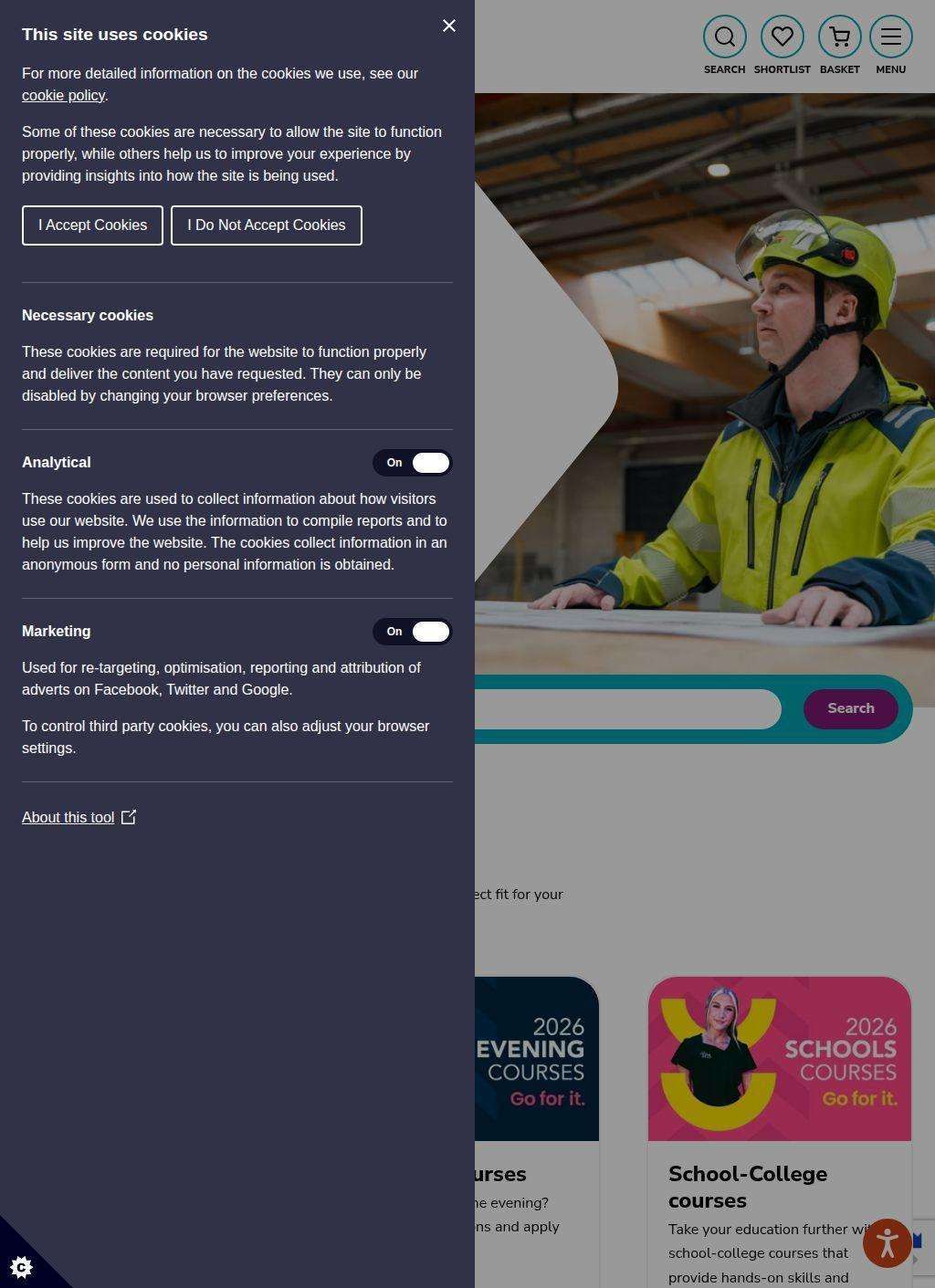
Ayrshire College has built its offer around the reality that learners in the west of Scotland come from very different starting points. A school leaver finishing their final year, an adult retraining after redundancy, an employer with a specific skills gap in the workshop: these are not the same person, and Ayrshire College does not pretend they are. Full-time, part-time, evening, and weekend courses run alongside each other, and that range is not accidental. Somebody holding down a job and studying after hours needs different timetabling from a sixteen-year-old moving straight from secondary school, and Ayrshire College plans visibly for both without folding one into the other.
Course types for school leavers and adults
The course structure is where the offering gets concrete. Foundation Apprenticeships let secondary pupils start picking up work-based skills before they have left school, while Modern Apprenticeships pair paid employment with study at a later stage. School-College partnership programmes sit alongside those, aimed squarely at pupils still in secondary. Professional Learning covers workplace training and continuing development for people already in employment, and SVQs, the Scottish Vocational Qualifications, map onto real trades and occupations recognised across the country. A teenager and a mid-career worker can both find a starting point, and the qualifications they walk away with come through Scottish awarding bodies, so Ayrshire College feeds into the national system and does not issue credentials of its own invention.
Comparing qualification levels through SCQF
One thing Ayrshire College does well is explaining the SCQF framework on its own pages. Qualification levels in Scotland can baffle anyone outside the education sector, and a prospective student trying to compare a college course against a school certificate or a workplace qualification often has no way to gauge where each one sits. The explanations on the site let a reader see how the pieces fit. For people who left formal education a long time ago, or whose reference point for the word "level" comes from somewhere else entirely, that removes a real barrier to applying. The online application portal then carries them from interest to enrolment without a paper chase, which is not a small thing for adults who associate applying to college with intimidating paperwork.
Campus amenities open to the public
Ayrshire College does not present itself as a place you only enter to sit a course. Several campus amenities are open to the public, including restaurants and hair and beauty salons. These serve a double purpose: locals get a service, and students in catering and beauty programmes get supervised practice on real customers rather than classmates. Venue hire is available too. These arrangements tie the college into the daily life of the towns around it, and they give vocational learners something a simulated environment never quite reproduces, namely the unpredictability of an actual client standing in front of them.
Radio station and community programs
There is a community-facing side that goes further. Ayrshire College runs an on-campus radio station, Essential Radio, and hosts community initiatives across its sites. A working radio station is genuinely useful for students in media, sound, and broadcasting, and it gives the wider area a local voice at the same time. Specialist training facilities across the multiple campuses back the practical subjects, so the workshops and studios are part of the pitch from the start, not tucked away in a footnote. The Kilwinning campus and the others each contribute to the physical presence Ayrshire College maintains across the region.
Business engagement team for employers
For employers, Ayrshire College keeps a Business Engagement and Innovation team whose remit covers tailored training, upskilling, and skills-gap analysis. A firm that knows it is short on a particular competence can ask the college to design something for its workforce, and the same team points businesses toward funding support. That is a sensible piece of positioning. A further education college sits close to the local labour market and can respond faster than a distant provider when a regional employer needs people trained in something specific. It also keeps Ayrshire College relevant to the economy it draws its students from.
Student support services explained
Student support is the part of the offer that often decides whether someone enrolled goes on to finish. Funding and money advice and tuition fee guidance address the practical worry that stops many adults before they even apply. Education support covers accessibility and learning differences, so students who need adjustments have a clear route to ask for them. Engagement and wellbeing services, careers and employability guidance, a Student Association, and digital tools fill out the rest. This is the scaffolding that turns an enrolment into a completed qualification, and Ayrshire College treats it as core business, not an optional extra bolted on after the fact.
Funding through the Scottish Funding Council
It helps to remember what kind of institution this is. Ayrshire College operates within the Scottish further education sector and is funded through the Scottish Funding Council, which places it inside a public, accountable structure. That funding model shapes what it does: the courses connect to recognised qualifications, the support services exist because the sector expects them, and the employer engagement reflects a national push to keep further education close to regional skills needs. The breadth of who Ayrshire College serves, from secondary pupils on partnership courses to businesses commissioning bespoke upskilling, follows directly from that public remit rather than from market positioning.
Check the site's overall coherence
Pull back across the whole site and what you find is a college that has thought carefully about coherence. The course types feed into recognised qualifications, those qualifications are explained against a common framework, the application portal lowers the barrier to entry, the support services keep people enrolled once they are in, and the public amenities and employer team connect the campuses back to the towns and the local economy. A prospective full-time student, a part-time evening learner, and an employer with a training need all find a legible path through the same site. Ayrshire College is not the flashiest further education presence online. What the site does instead is reflect an institution that knows who it is for and has organised itself accordingly, and that is a harder thing to achieve than it might look from the outside.
Business address
Ayrshire College
Lauchlan Way,
Kilwinning,
North Ayrshire
KA13 6DE
United Kingdom
Contact details
Phone: 0300 303 0303