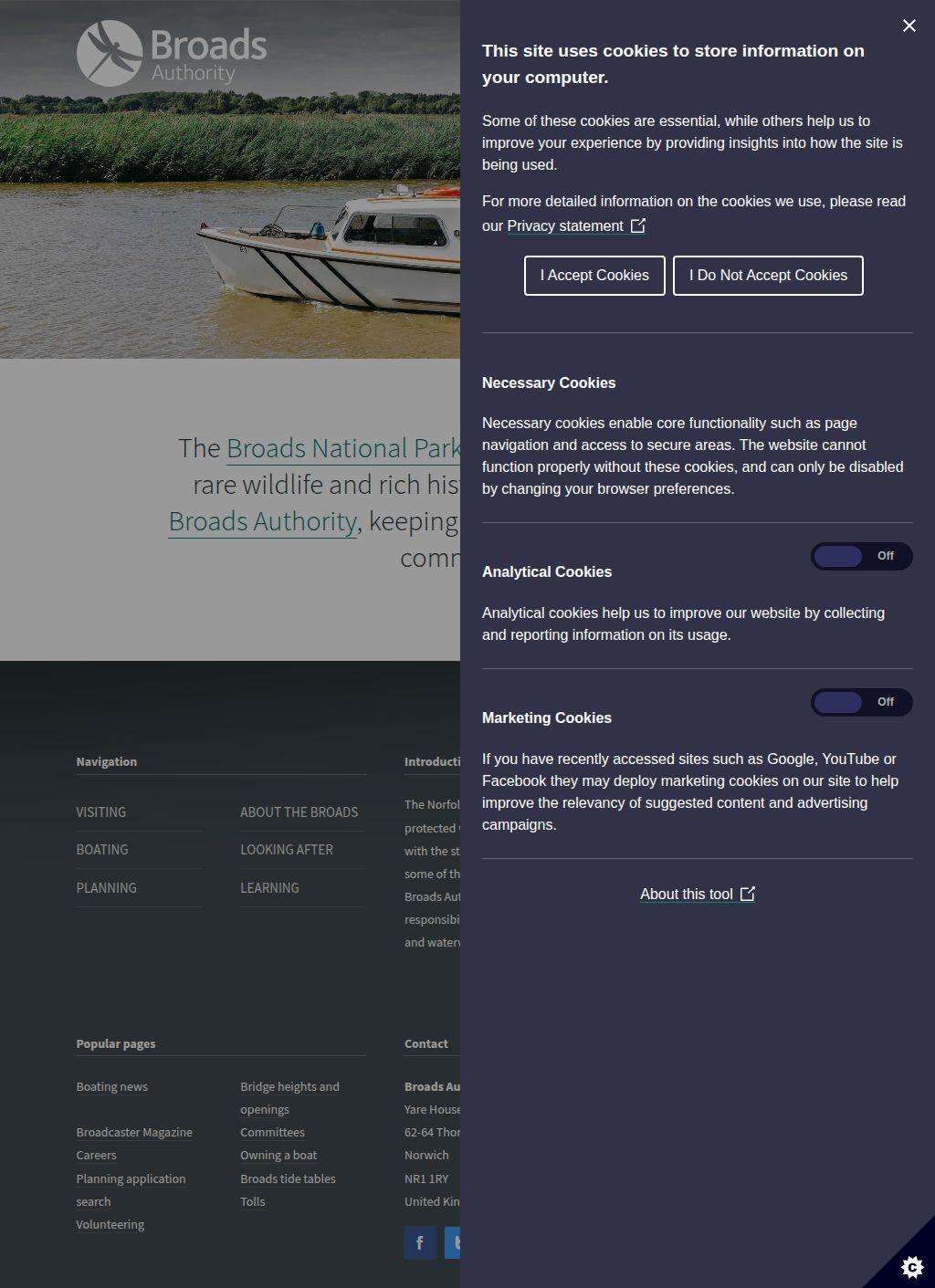
The Broads Authority is the special statutory body responsible for the Norfolk and Suffolk Broads, the network of lakes and rivers that forms Britain's largest protected wetland and a member of the national park family. It was set up under the Norfolk and Suffolk Broads Act 1988 and became operational in 1989, with its head office at Yare House on Thorpe Road in Norwich. The Authority has two jobs that most national park bodies do not combine: it manages the area for conservation, scenery and public enjoyment in the way a national park authority does, and it is also the navigation authority for around 125 miles of lock-free navigable water used by thousands of boats. That dual role makes it an unusual and important institution, and a clear candidate for a business directory of Norfolk's public bodies.
Planning and conservation duties
The conservation and planning side of the work is what gives the Broads its protected status. The Authority is the local planning authority for the executive area, which means it decides planning applications within the Broads and produces the local plan that guides development there, balancing the needs of residents and businesses against the protection of an internationally important wetland. Much of the area carries additional national and European nature designations, and the Authority works to maintain water quality, manage reedbeds and fen, control invasive species, and protect the habitats that support bitterns, marsh harriers, swallowtail butterflies and the other wildlife the Broads is known for. These responsibilities sit alongside its duty to promote understanding and enjoyment of the area by the public.
Maintaining navigation for boat users
The navigation role is the part that touches the largest number of visitors directly. The Broads carry a constant flow of hire boats, private motor cruisers, sailing craft and, increasingly, paddleboards and kayaks, and the Authority maintains the channels, moorings, signage and safety arrangements that make this possible. It collects tolls from boat owners, which fund a large part of the navigation work, and it employs rangers who patrol the water, assist users and enforce the byelaws. The toll system, the registration of boats and the rules for boating are all set out on the website, and they form some of the most heavily used pages on the site because every boat owner and hire operator needs them.
The dredging programme deserves a mention because it sits at the centre of the Authority's navigation duty and its funding debate. Decades of sediment build-up reduce the depth of the channels, and the Authority runs a rolling programme to dredge priority stretches and to reuse the spoil where it can, often to repair eroding banks. This work is expensive, slow and never quite finished, and it is the clearest example of the maintenance burden that the toll income has to cover. The Authority publishes its sediment management strategy and progress reports, which are worth reading for anyone who wants to understand why navigation charges are set where they are and why user groups follow the figures so closely.
Access for walkers and cyclists
Access for visitors who never set foot on a boat is something the Authority takes seriously, and the way the Broads are laid out makes that possible. A network of footpaths, boardwalks across the wetter ground, and waterside trails lets walkers and cyclists reach much of the area on foot, and several staffed information points and country parks act as gateways for people arriving by car.
The Authority also runs and supports short boat trips and electric-boat hire at some locations, which gives non-boaters a way onto the water for an hour or two without hiring a cruiser for a week. For wheelchair users and families with young children, the accessibility information on the website is reasonably detailed, though the practical reality of a wetland means that not every mooring or path is easy to use, and checking ahead is sensible.
Website sections for different audiences
The website reflects the breadth of the Authority's responsibilities and is organised around its main audiences. Boaters and other water users have detailed sections on tolls, navigation, safety, moorings and slipways. Visitors who are walking, cycling, birdwatching or simply planning a day out find information on trails, visitor centres, events and accessibility. A separate planning section serves applicants, agents and residents with the local plan, planning policies and the application process. There is also corporate content covering the Authority's committees, budgets, governance and consultations, which is the material a researcher, journalist or parish council is most likely to need. For a business directory entry the contact and how-to-find-us pages give the Yare House address and the main telephone number.
Visitor facilities across the Broads
The Authority runs or supports a number of visitor facilities that bring the work to life. These have included information centres at points around the Broads and the Whitlingham Country Park and broads on the edge of Norwich, where activities such as canoeing and sailing are available to the public. Events through the season range from guided walks and family activity days to talks on wildlife and history. For local schools, community groups and tourism businesses, the Authority is a useful partner, and its learning and engagement pages set out what is on offer. The combination of a working navigation, a protected wetland and a programme of public activity is part of why the body appears so often in regional tourism material and in any business directory covering the area.
Who uses the Authority and its website? Boat owners and hire-boat operators are a core constituency, because they pay tolls and depend on the navigation being maintained. Visitors planning a holiday or a day trip use the site for practical information and ideas. Residents and businesses within the Broads use the planning pages, sometimes in the course of disputes about development, since the Authority's planning decisions can be contentious in a place where conservation and economic activity pull in different directions. Conservation volunteers, wildlife groups and researchers form another audience, as do the parish councils and local authorities the Authority works alongside. That mix mirrors the body's combination of regulatory, environmental and public-service functions.
Funding tensions over tolls
A few honest caveats are worth stating. The Authority's funding model is unusual and has been the subject of public debate: it receives a national park grant for its conservation and countryside work but, unlike other major inland navigation authorities, it does not receive government funding specifically for navigation maintenance, relying instead on boat tolls. That has led to recurring tension over toll levels and to questions, raised by navigation user groups, about the long-term financial sustainability of maintaining the waterways. Separately, the Authority's planning decisions can be controversial with residents and developers who feel the balance between protection and growth is wrong, which is an inherent feature of being both a regulator and a custodian of a protected area.
There is also a point of clarification that the website itself addresses: the Broads are often described as having a status equivalent to a national park rather than being designated under exactly the same legislation as the older parks, because the 1988 Act gave the Authority its additional navigation functions. For most practical purposes the area is treated as, and promoted as, a national park, and visitors will see that branding. The distinction matters mainly to those interested in the legal and governance detail, which the corporate sections of the site set out accurately for anyone who needs it.
For a directory of Norfolk institutions, the Broads Authority is a strong and somewhat distinctive listing. It is the body that protects and runs the wetland and waterways that define a large part of the county's geography and tourism, combining conservation, planning and navigation in a way no other single organisation does. The official website is the authoritative source for tolls, navigation rules, planning policy and visitor information, and the head office at Yare House in Norwich handles correspondence and general enquiries. The contact details below point to that Norwich office, which is the right address for the Authority as a whole.
Business address
Broads Authority
Yare House, 62-64 Thorpe Road,
Norwich,
Norfolk
NR1 1RY
United Kingdom
Contact details
Phone: 01603 610734