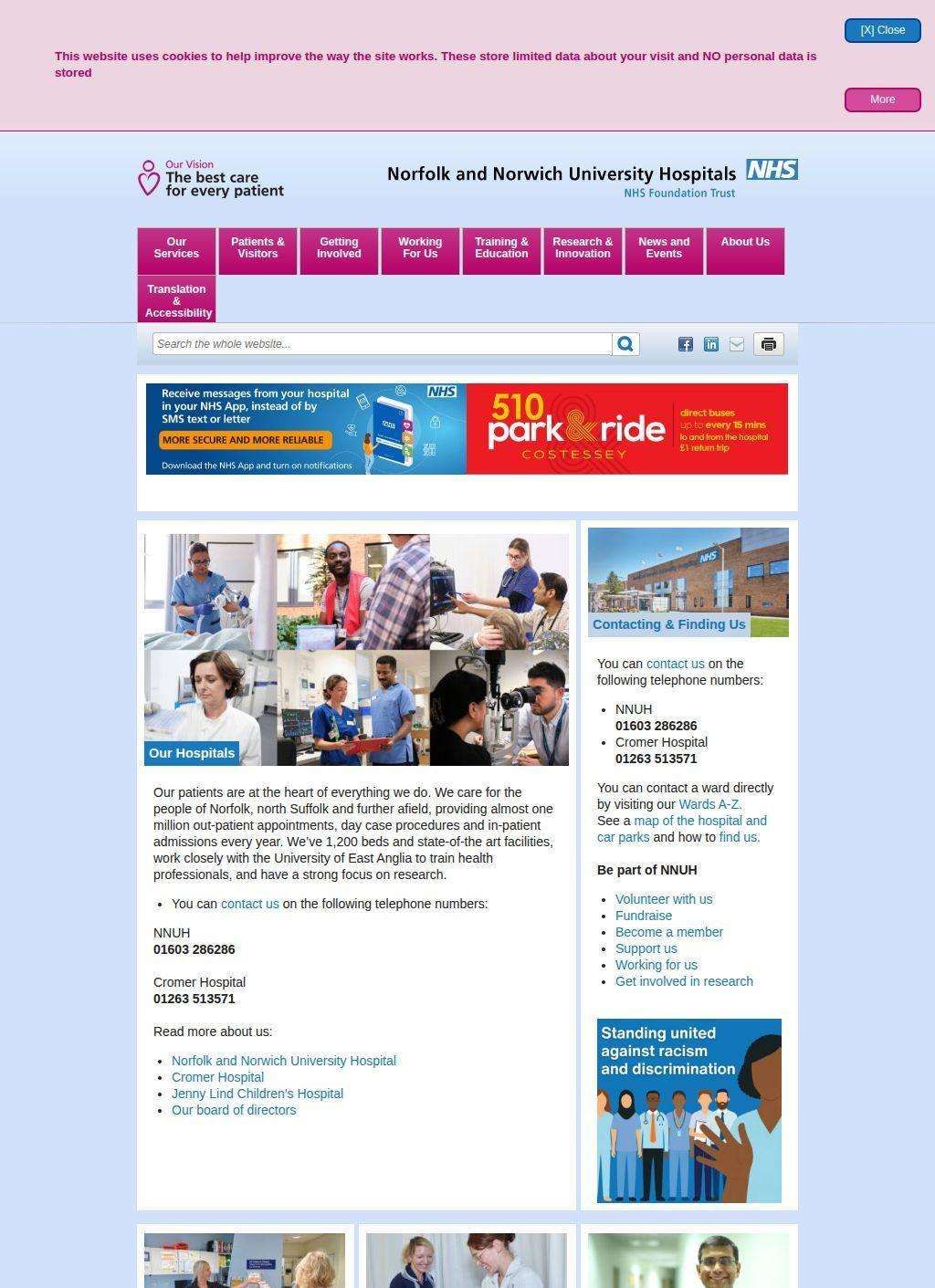
Close to a million outpatient appointments, day cases, and inpatient admissions move through this trust in a single year, which gives you the measure of what Norfolk and Norwich University Hospitals NHS Foundation Trust is dealing with before you read a word of the rest. That figure sits on top of roughly 1,200 beds split across the main hospital on Colney Lane in Norwich plus two other sites, and it is the kind of scale that defines what Norfolk and Norwich University Hospitals NHS Foundation Trust is built to handle. The website has to hold all of that together, and for the most part it does the job without trying to be clever about it.
Three hospital sites across Norfolk and Suffolk
The main hospital is the centre of gravity, but Norfolk and Norwich University Hospitals NHS Foundation Trust also runs Cromer Hospital and the Jenny Lind Children's Hospital, and the site keeps those distinct so you are not left guessing which building a clinic actually sits in. Coverage stretches across Norfolk, north Suffolk, and the surrounding areas, which is a wide patch of largely rural England where the nearest alternative acute hospital can be a long drive. That geography is the quiet justification for how broad the service list runs.
Emergency, cardiology, cancer, maternity services
The clinical breadth is the part worth slowing down on. Emergency care through A&E, cardiology, cancer services, and maternity all have their own footing on the site, and beyond those headline departments Norfolk and Norwich University Hospitals NHS Foundation Trust lists a long roster of specialist clinics. The A-Z directory is the practical way in: instead of forcing you to guess which department label your referral falls under, it lets you scan alphabetically and land on the right page. For a hospital this size that index is doing more work than it looks like it is, and I found it the single most useful part of the whole site for anyone trying to prepare for an appointment.
Patient pathways tailored to admission type
What helps is that the structure mirrors how patients are actually routed. Someone heading in for a day-case procedure is in a different position from someone facing a multi-week inpatient stay, and the departmental pages tend to acknowledge that difference instead of flattening everything into one generic patient-information template. Maternity sits apart from the children's services at Jenny Lind, cancer pathways have their own space, and the cardiology material reads as written for people who already have a reason to be looking it up.
None of this is flashy. The pages are functional and text-led, and that is the correct call for a hospital. A patient checking what to bring for an admission, or a relative working out where to go on the day, wants accuracy and findability over polish, and Norfolk and Norwich University Hospitals NHS Foundation Trust generally delivers it.
Academic partnership with University of East Anglia
The thing that lifts Norfolk and Norwich University Hospitals NHS Foundation Trust above an ordinary district hospital is the formal academic partnership with the University of East Anglia. That link covers training for health professionals, research, and clinical innovation, and it is the reason the "University Hospitals" part of the name is more than a label. A teaching trust tends to attract specialist staff and run trials that a non-teaching hospital would refer out, and while the website does not turn that into a sales pitch, the partnership is present enough that a prospective trainee or a researcher can see where they would fit.
Access to newer clinical approaches
For patients the practical upshot is subtler. Treatment at a trust tied to a medical school often means access to newer approaches and to clinicians who teach as well as practise, and Norfolk and Norwich University Hospitals NHS Foundation Trust frames itself around that combination of acute care and academic work without overstating it. The site gives the partnership real estate rather than burying it, which is the right instinct.
Volunteer programmes, facilities, membership options
Around the core clinical offering sit the things that make a hospital function as a place people spend time in: volunteer programmes, fundraising, a patient membership scheme, and on-site facilities such as shops and cafes. These are easy to dismiss as filler, but anyone who has waited a long afternoon at a relative's bedside knows the difference a cafe and a clear map make, and Norfolk and Norwich University Hospitals NHS Foundation Trust treats them as part of the offering, not an afterthought. The membership and volunteer routes also give local people a way to be involved beyond being a patient, which suits a trust embedded in its region.
If there is a limitation, it is the inherent one for any organisation of this scale: the sheer number of departments means the site is large, and a first-time visitor can feel the size of it before the A-Z directory rescues them. That is a navigation reality more than a flaw, and the index largely answers it. The information is there; you sometimes have to commit a minute to reaching the exact page you need.
Independent review platforms carry some NHS survey responses for Norfolk and Norwich University Hospitals NHS Foundation Trust but not in the volume typical of a GP surgery; for a hospital, the external accountability picture sits mainly in NHS England data and formal CQC inspection records rather than consumer-style ratings, and those are where the meaningful track record lives.
Taken together, this is a serious, well-organised presence for a major acute trust, and Norfolk and Norwich University Hospitals NHS Foundation Trust uses its site to do the unglamorous work patients actually need instead of straining to impress. The Colney Lane operation, the Cromer site, and the Jenny Lind children's services are all accounted for, the clinical range is genuinely deep, and the University of East Anglia tie gives the whole thing a research backbone.
The A-Z directory is where to start: it covers the full breadth of what Norfolk and Norwich University Hospitals NHS Foundation Trust offers faster than any other entry point on the site, and each department page tends to carry the practical detail you need on the day of an appointment. The website is built around utility, which is exactly the right priority for a hospital serving this large a patch of rural England.
Business address
Norfolk and Norwich University Hospitals NHS Foundation Trust
Colney Lane,
Norwich,
Norfolk
NR4 7UY
United Kingdom
Contact details
Phone: 01603 286286