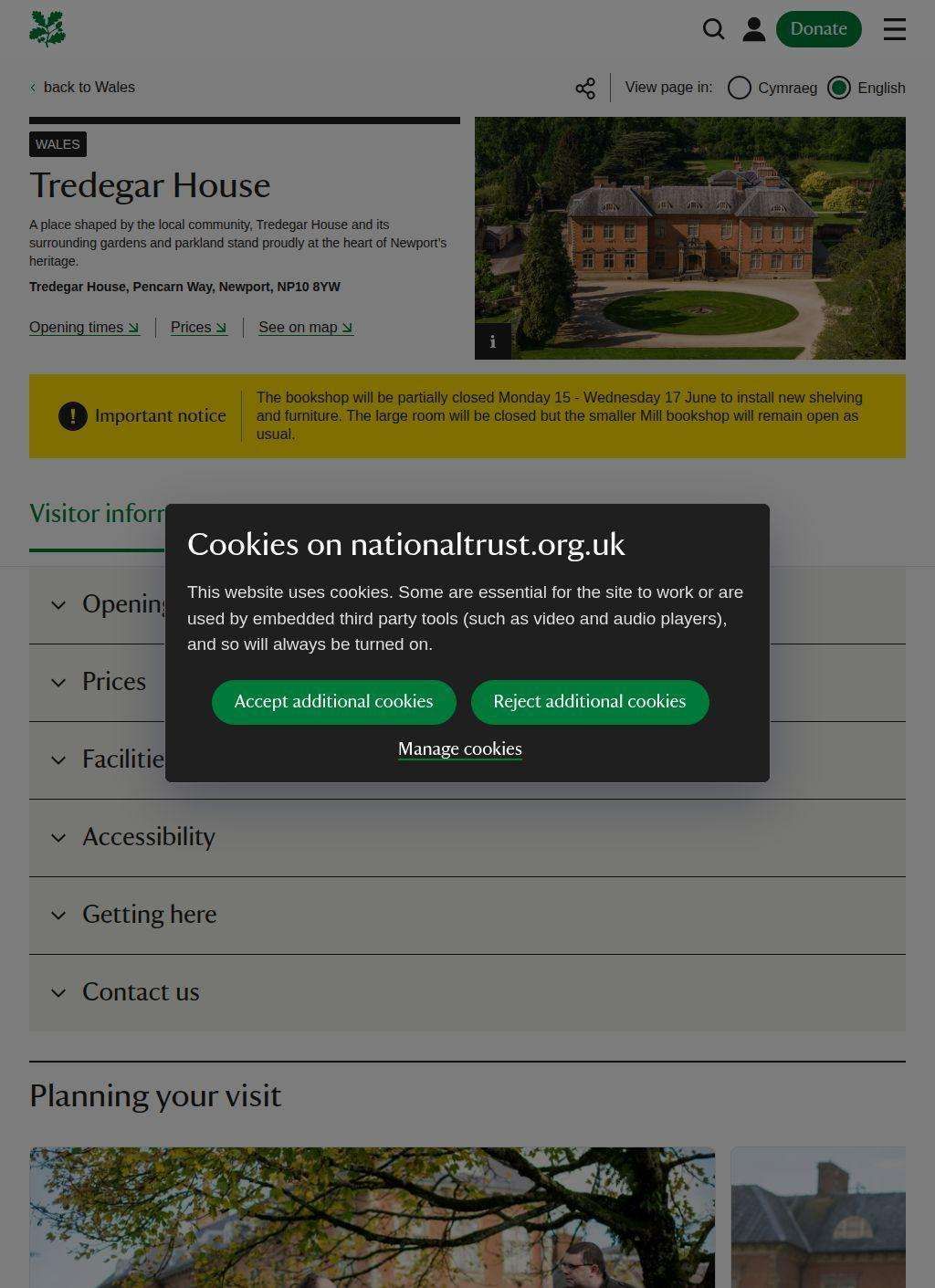
Managed by the National Trust, Tredegar House is a 17th-century red brick mansion at Pencarn Way in Newport, NP10 8YW, surrounded by 90 acres of gardens and parkland. The house is Grade I listed, and the property splits into two distinct experiences that shape a visit. There is the mansion, ticketed, and there is the wider parkland, free and open year-round with a 24-hour pedestrian exit. For anyone who only wants a walk by the ornamental lake or along the woodland trails, that second option means coming and going without paying anything or watching the clock.
Touring the mansion's historic rooms
Inside, the offering covers both guided and self-guided tours of the historic rooms. The guided tours run on specific dates rather than continuously, so anyone hoping for the fuller talk-through version needs to check the calendar before setting out. Self-guided access gives more flexibility for people who would rather move at their own pace and read the room cards. The Morgan family held the estate for centuries, and that long single ownership is part of why the interior still hangs together as a coherent home and not a patchwork of unrelated rooms. I appreciated that Tredegar House does not force one style of visit on everyone. Seasonal opening hours apply to the mansion and to the cafe, which is the standard arrangement for a building of this age that cannot stay fully staffed through every month.
The grounds carry a fair amount beyond the lawns. The formal gardens are level and laid out for walking, the lake gives the parkland a focal point, and the woodland trails extend the route for anyone who wants a longer loop. Across the year the Trust schedules seasonal family activities and theatrical performances, giving the place a reason to draw returning visitors who have already seen the interior and want something new pinned to the calendar.
Food, shops and local makers
Food and small independent retail round out the day. The Brewhouse Cafe serves seasonal food and drink with an emphasis on local sourcing, and the on-site retail is more varied than the single gift shop a visitor might expect. A volunteer-run second-hand bookshop sits alongside independent tenant shops covering crafts, music, and woodwork. That tenant mix is a genuine point of interest: Tredegar House supports working makers instead of only selling branded merchandise, and browsers have something to do that is not tied to the timed mansion entry. For a property of this size, that breadth of small shops keeps the visit from feeling like a single corridor of rooms followed by an exit.
Pricing is set out clearly. Mansion admission runs roughly 14 to 15.40 pounds for adults and 7 to 7.70 pounds for children aged 5 to 17, while National Trust members enter free. For a family weighing a single visit against the cost of joining the Trust, those figures make the comparison easy to run before anyone gets in the car. Households that visit several Trust sites a year will reach the break-even point on membership quickly, and Tredegar House alone may be enough to tip that decision.
Accessibility features across the site
Accessibility has clearly had real attention. Blue Badge parking is provided, wheelchairs and mobility vehicles can be borrowed, and there are accessible toilets and induction loops on site. The formal gardens are level, and a mobi-lift handles mansion entry up to a 250 kg limit. Listing the lift's weight capacity is precise enough that a wheelchair user or carer can judge in advance whether the building will work for them, and that saves a wasted trip.
Getting to Tredegar House is straightforward by several routes. Newport railway station sits about two miles away, bus routes 32 and 33 serve the area, and there is parking on site for drivers. National Cycle Network route 4 passes through, so cyclists can fold a visit into a longer ride. The combination means Tredegar House is not stranded behind a car-only approach, which broadens who can realistically reach it. Train, bus, bike, or car all land within easy distance of the gates, and that flexibility is rare for a country house set in this much ground.
Planning a full day visit
Put together, the property reads as a place that wants to hold a visitor for the better part of a day. A self-guided wander through the rooms of Tredegar House, lunch at the Brewhouse Cafe, a slow circuit of the lake and woods, and a browse through the bookshop and the makers' units add up to a full outing. Families have the seasonal events to anchor a return, and the free parkland gives locals a reason to treat the estate as a regular walking spot and not a one-time attraction. Two visitors with different interests, one drawn by the architecture and one by the grounds, can both leave satisfied.
There are a couple of practical points worth noting. Because guided tours run only on set dates and the mansion keeps seasonal hours, the worst version of a trip is arriving to find full house access unavailable. The free parkland softens that risk since the walk is always there, but anyone whose main goal is the interior should confirm the day before travelling. The ticketed mansion against the free grounds is a structure that rewards a little planning, and it is the one quirk of Tredegar House a first-time visitor should learn in advance.
Outside reviews on Google and TripAdvisor run to hundreds of entries and are consistently positive, with praise landing on the grounds, the cafe, and the variety of the estate rather than any single feature. No significant pattern of complaints emerges from recent entries. For a site operating at this scale, that kind of sustained public record is a reasonable indicator of consistent delivery. The membership maths often makes Tredegar House cheaper than it first looks, and cyclists on National Cycle Network route 4 can fold Tredegar House into a longer ride without any additional detour.
Business address
Tredegar House (National Trust)
Pencarn Way, Coedkernew,
Newport,
Gwent
NP10 8YW
United Kingdom
Contact details
Phone: 01633 811661