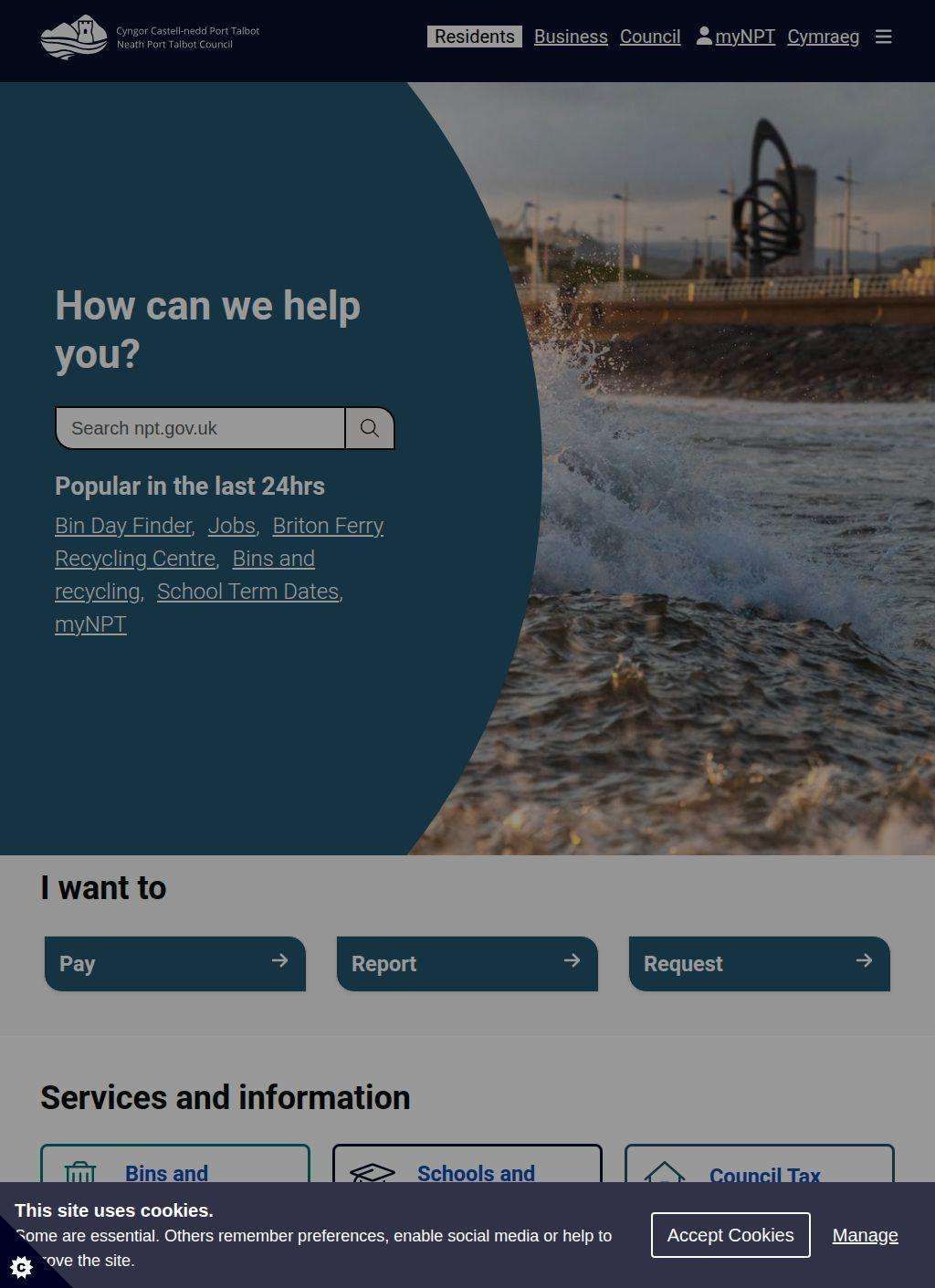
What does the website for a south Wales unitary authority actually need to do well? Mostly it needs to get a resident to the right service without a fight, and the site for Neath Port Talbot County Borough Council is built around that practical test. Bin collection schedules, a Bin Day Finder tool, bulky-item pickup, recycling-centre locations and email reminders are all grouped where someone hunting for "when do my bins go out" would look. That is the most-used corner of any council site, and it gets proper room here.
Waste collection and council tax
Council Tax sits close behind in everyday importance, and the coverage is the kind you would hope for: payments, queries about a bill, and the reductions or exemptions that people often do not realise they qualify for. Planning and building control go a step deeper than the basics. You can submit an application, search existing ones, and find information on inspections, which is useful for both homeowners doing an extension and businesses with a larger scheme. Parking, roads and travel pull together permits, car parks and roadworks updates in one place.
Services for families, students and businesses
The breadth past those headline services is where the site shows it is doing the full job of a unitary authority. Schools and learning cover admissions, term dates and school meals. There is adult social care, housing benefits, and registration of births, deaths and marriages. Environmental health, libraries, leisure facilities, and elections and voting each have a home. For families, students and job-seekers, the spread means the same domain answers a wide set of unrelated questions, which is the entire point of a single council web presence.
Managing council interactions with myNPT
Beyond the static service pages, Neath Port Talbot County Borough Council runs a personalised community platform called myNPT, which lets residents manage their council interactions online rather than treating every task as a fresh phone call or visit. An account-based hub like this is the difference between a site that simply publishes information and one that lets people transact, track and return to something they started. It is the feature most likely to reward a repeat visit.
An event calendar covers multiple venues across the borough, tying the cultural and tourism side of the area to the same place residents already use for admin. Business resources and support sit alongside that, so the audience extends beyond households to local enterprises looking for guidance. The council also publishes its own news, job vacancies, and committee and democratic governance material. That transparency layer tells you how decisions get made, who sits on what, and what posts are open.
Responding to local industrial change
One section stands out because it speaks directly to where this borough is right now. Neath Port Talbot County Borough Council hosts a dedicated Tata Steel Transition Information Hub, a set of economic support resources tied to the area's industrial restructuring. Port Talbot's steelmaking has been central to the local economy for generations, and a council that builds a focused hub for workers and businesses affected by that change is responding to a real situation, not a hypothetical one. That is the sort of content a generic template would never carry, and it tells you the site is maintained by people who know the ground.
The organisation of all this leans toward the task-based, which suits how people approach a council. Someone rarely lands wanting to admire the homepage. They arrive mid-problem: a missed collection, a tax question, a planning deadline, a benefit they are owed. Grouping the busy services up front and keeping the deeper governance and business material a click further in matches that behaviour without burying the common needs under institutional structure.
There are limits worth naming plainly. A site this wide will always have corners that update less often than the core services, and the sheer number of departments under one roof can make some routes longer than a single subject-specific site would be. That is the trade every unitary authority makes, and Neath Port Talbot County Borough Council is no exception. The Bin Day Finder and myNPT do a lot to shorten the most frequent journeys, which is the right priority. A listing in a business directory will only ever point you to the front door; the value is in how quickly the door leads to the specific thing you came for.
For residents of the borough, the case for using npt.gov.uk is straightforward. Neath Port Talbot County Borough Council is the only official route for most of these services. Council Tax, planning permission, social care assessments and voter registration are not things you sort through a third party, and Neath Port Talbot County Borough Council is the body that runs them. The question of whether the site is worth visiting almost answers itself in that sense: if you live, work, study or run a business in the area, you will need it sooner or later.
What makes this site worth returning to?
More useful to judge is whether the site rewards returning to, and the recurring-value features make a fair case. The bin reminders, the myNPT account, the roadworks updates and the event calendar all change week to week, so there is good reason to keep coming back. Neath Port Talbot County Borough Council has clearly aimed the design at frequent, practical use, and the Tata Steel hub shows it can also respond to a fast-moving local situation when one demands attention.
Taken as a whole, this is a capable and genuinely useful authority site covering the full range of what a south Wales county borough has to administer, from everyday bin and tax queries up to democratic governance and a targeted economic-support hub. Neath Port Talbot County Borough Council has built something residents will return to rather than visit once and forget, and the Tata Steel Transition hub in particular shows an administration paying attention to what is happening in its own backyard.
Business address
Neath Port Talbot County Borough Council
Civic Centre, Port Talbot,
Port Talbot,
Neath Port Talbot
SA13 1PJ
United Kingdom
Contact details
Phone: 01639 686868