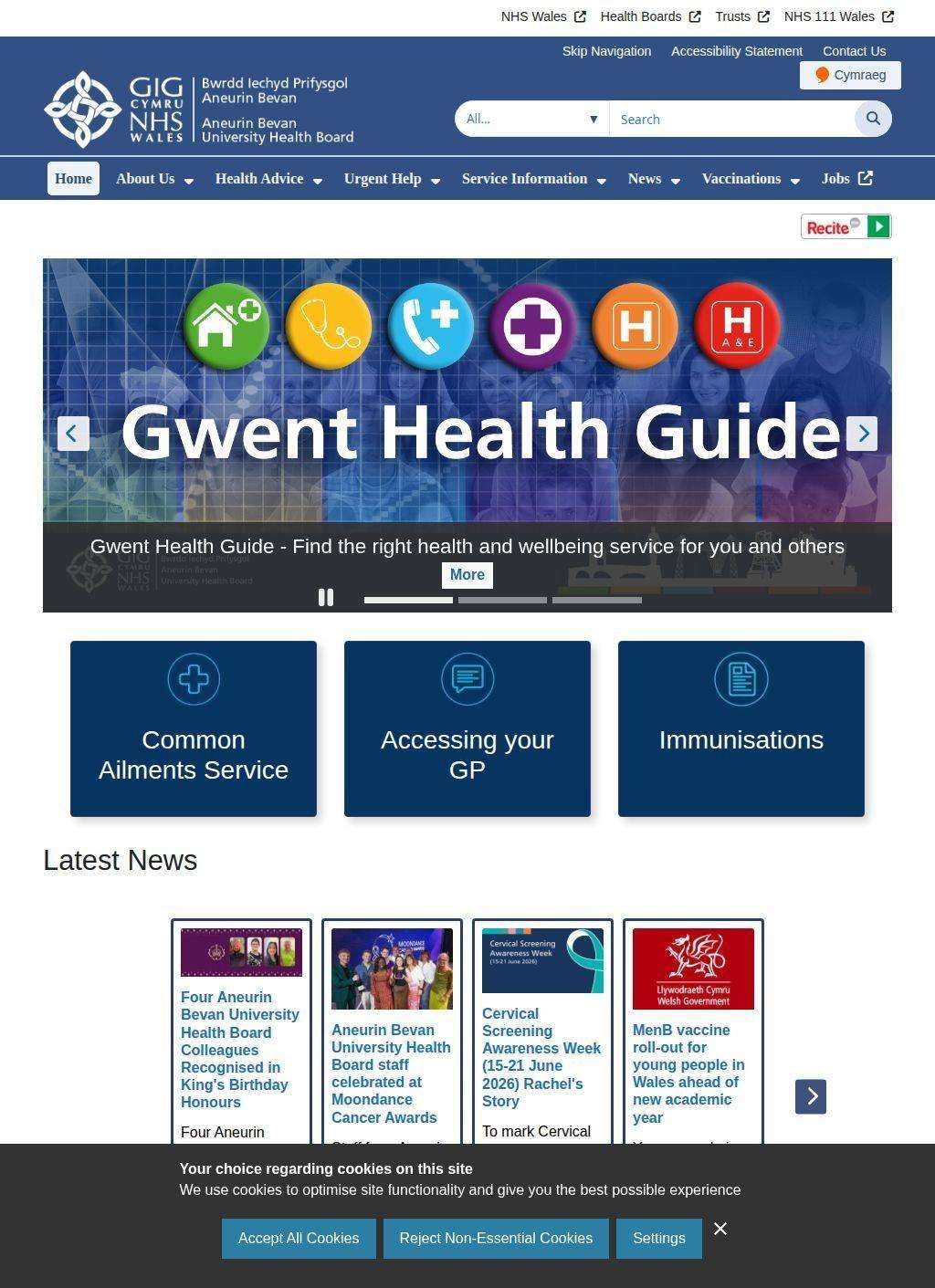
Who runs the hospitals and clinics across Gwent, and where do residents of Monmouthshire and its neighbouring counties turn when they need to understand the care available to them? The answer sits with Aneurin Bevan University Health Board, one of seven NHS Wales health boards, charged with planning and delivering healthcare for the whole southeast corner of the country. That remit covers Blaenau Gwent, Caerphilly, Monmouthshire, Newport and Torfaen, a large and varied population to serve, and the website tries to be the single front door to all of it.
The Aneurin Bevan University Health Board site is organised around what people tend to need from a health authority, and it splits roughly into two halves. One half is about hospitals and treatment: where to go, what each site does, and how urgent the situation is. The other half is about staying well before anything goes wrong, the public health and community side. Both are present in reasonable depth, and the structure mostly reflects how a worried person or a carer would think their way through a problem. That dual focus is a fair signal of what the organisation considers its job.
Hospital network and urgent care routes
On the hospital side, Aneurin Bevan University Health Board operates a network that centres on The Grange University Hospital, described as the region's major acute hospital, alongside several enhanced local general hospitals. The acute and local sites are presented together so a reader can work out which one fits their situation. Services listed run across emergency departments, minor injury units, and access to urgent care through NHS 111 Wales. There is also detail on inpatient stays, outpatient appointments, and surgical services. For anyone trying to decide whether a problem warrants an emergency department or a minor injury unit, having those routes laid out in one place is genuinely useful, because that decision is one people get wrong under stress.
Routing people to the right level of help
Aneurin Bevan University Health Board addresses both ends of that range, and the dividing line is handled with some care. The urgent material points people toward the right level of help, with NHS 111 Wales sitting as the contact point for cases that are pressing but not life-threatening. Mental health crisis services are flagged as available too, a detail that counts because crisis information needs to be findable fast and is often buried elsewhere. Aneurin Bevan University Health Board keeps that route visible instead of leaving it to chance.
Community services beyond hospital walls
The everyday side is broader than I expected. The community offering from Aneurin Bevan University Health Board ties together primary care coordination with GPs, dentists and opticians, so the site makes plain that not all care happens inside a hospital. Community nursing and therapy teams are part of the picture, which reflects how much treatment now happens at home or close to it. Then there is the preventive layer: immunisation schedules, seasonal flu and COVID-19 vaccination campaigns, smoking cessation, weight management, and mental wellbeing support. These are the programmes that quietly do the heavy lifting in public health, and the site treats them as core business rather than an afterthought.
From vaccination schedules to smoking cessation
What gives that everyday material some force is that it connects to action. Vaccination campaigns are seasonal and time-sensitive, and a health board that publishes the schedules and access points is doing the practical job it exists to do. Smoking cessation and weight management are framed as services a person can enrol in, not slogans. The breadth here is more convincing than any single headline service, because it shows the organisation thinking about a population's health over years, well beyond isolated episodes of illness.
Practical information for patients and visitors
Patient-facing practicalities are covered as well. There is guidance on hospital visiting, which sounds minor until you are the relative standing outside a ward unsure of the rules. Discharge planning gets attention, showing Aneurin Bevan University Health Board thinks about what happens after a stay as much as during it. Interpreting and translation services for people who do not speak English are listed too, a detail that reflects the range of communities the board covers across Newport and the surrounding areas.
Governance and public accountability
Beyond care itself, the Aneurin Bevan University Health Board site carries the material you would expect from a statutory public body that has to answer for how it works. Board meeting publications and governance documents are published openly. A patient browsing for an appointment will probably skip past them, but a journalist or a resident wanting to know how a decision was made will value having them accessible.
Connecting to the wider local health ecosystem
One link worth singling out is the connection to the Gwent Health Guide, presented as a local health resource directory. That is sensible signposting. Aneurin Bevan University Health Board cannot run every local service itself, and pointing residents toward a wider local guide acknowledges that the surrounding health ecosystem matters. It also keeps the main site from trying to be everything at once, which would only make navigation harder.
No independent review platforms turned up a meaningful public profile for Aneurin Bevan University Health Board, which is common for NHS bodies: patients tend to use NHS feedback channels rather than consumer review sites, and the absence of a TrustPilot listing tells you nothing about the care Aneurin Bevan University Health Board delivers.
If I were weighing the site as a whole, the strongest impression is coherence. The services described map onto the real responsibilities of a regional NHS body, and they are arranged so that the urgent, the routine and the preventive each have a clear place. Aneurin Bevan University Health Board is explaining a system that people are entitled to use, and the explanation is mostly clear about where to go for what. The hospital network is named and differentiated, the community services are spelled out, and the public health programmes are tied to specific campaigns a person can join.
There are limits to what a site like this can do. A directory of services is only as good as the person's ability to find the exact thing they need at the moment they need it, and any organisation covering five counties and a major acute hospital is managing enormous complexity. The breadth that makes Aneurin Bevan University Health Board comprehensive is also the thing that can make any single page feel like one room in a very large building. That is the nature of a regional health authority more than a flaw in the website, but a first visit rewards patience.
Residents of Monmouthshire, Newport, Torfaen, Caerphilly and Blaenau Gwent will find concrete value in what Aneurin Bevan University Health Board publishes. Someone planning a hospital visit can check the visiting guidance before they travel. A parent can look up the immunisation schedule. Someone trying to quit smoking or manage their weight can find the relevant service and how to reach it. Anyone unsure whether to head to an emergency department can read the urgent care guidance and use NHS 111 Wales for the in-between cases. Aneurin Bevan University Health Board does the unglamorous work of telling people what exists and how to access it, and that is exactly what a regional health body should be publishing.
Business address
Aneurin Bevan University Health Board
Headquarters, St Cadoc's Hospital, Lodge Road, Caerleon,
Newport,
Monmouthshire
NP18 3XQ
United Kingdom
Contact details
Phone: 01633 436700