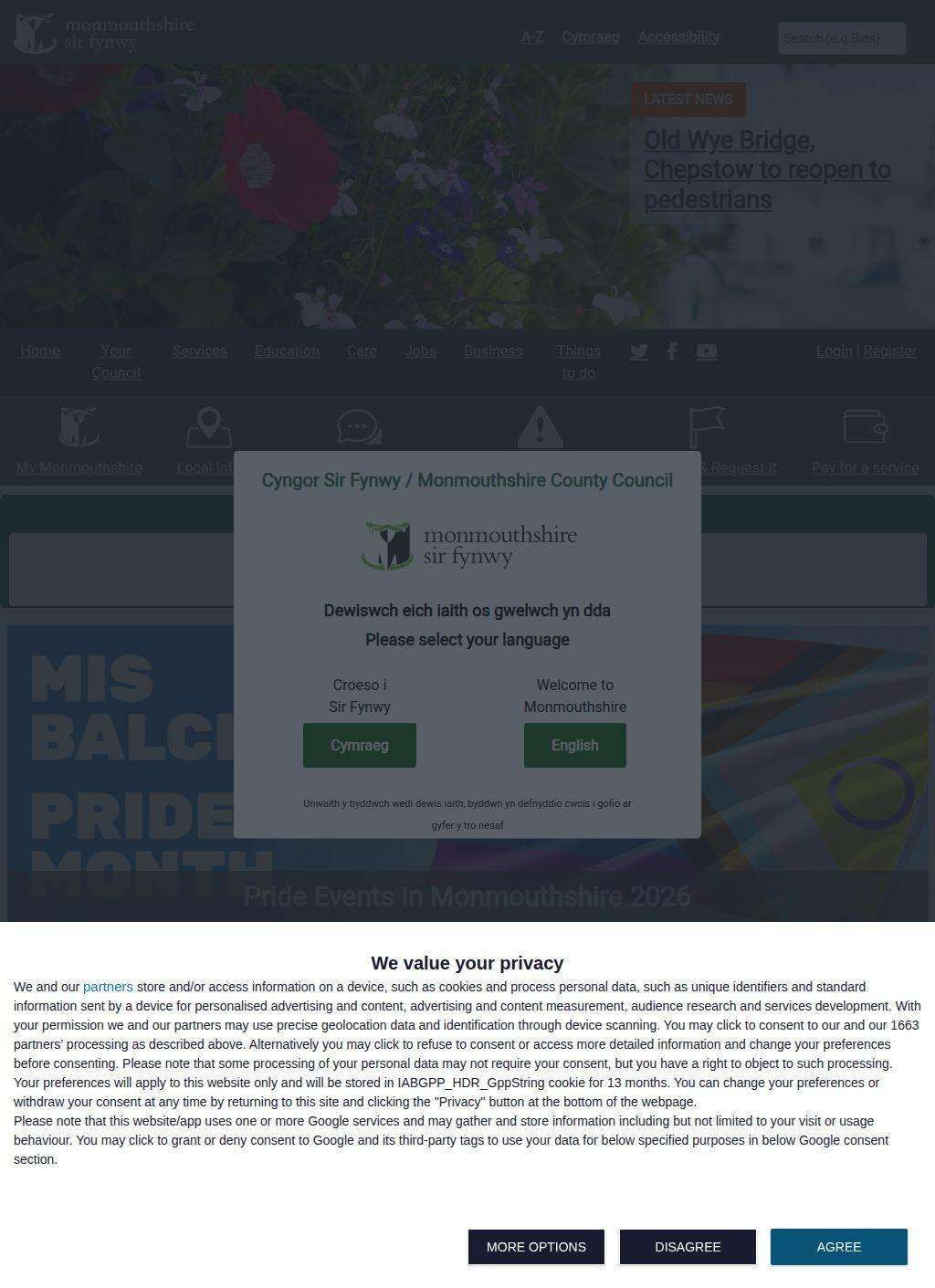
Every page of this site exists twice, once in English and once in Welsh, because Monmouthshire County Council is bound by Welsh language obligations and treats them as a baseline. That bilingual mirroring sets the tone for what the rest of the site tries to be: a single place where a resident can sort out the small administrative chores of living in the county. The breadth is the first thing you notice. It is the working machinery of a local authority, exposed online, and the range of services on offer is wide enough that a newcomer to the area could spend an hour here and still not see everything.
Handling council tax and waste collection
Start with the things people use most. Council tax and business rates billing sit near the front, with options to set up direct debit, claim benefits, and apply for cost-of-living help. Waste and recycling gets equal weight: bin collection schedules, the Red and Purple Bag schemes, garden waste collection, and the locations of recycling centres. These are the dull, recurring questions that drive most council web traffic, and Monmouthshire County Council puts them where they can be found quickly. The site clearly knows that a resident usually arrives mid-task, needing one specific answer, not a tour of everything available.
Planning applications and school admissions
Planning is handled with more depth than you might expect from a county of this size. You can submit and track planning applications, read guidance on permitted development, and check weekly application lists, which is useful to neighbours who want to know what is going up next door as much as it is to the person doing the building. Education runs along similar lines. School admissions applications, school transport arrangements, term dates, and childcare programme information all live here, with consultation material attached to some of it. A parent juggling a September start and a transport claim can do both in roughly the same corner of the site.
Streets, transport, mobile coverage
Transport and streets form another cluster. Parking facilities and payment, street maintenance reporting, bus and rail information, and highway project updates are grouped so that someone reporting a pothole and someone planning a commute are not sent to opposite ends of the navigation. Then there is the community layer: library and community hub locations, employment support resources, and a mobile coverage checker, which is an unusually practical touch for a rural county where dropped signals are a real daily problem. Monmouthshire County Council has clearly thought about who actually lives here, as opposed to designing for a generic British local authority catchment.
My Monmouthshire self-service portal
The centrepiece of the modern offering is "My Monmouthshire", a self-service portal for reporting issues, requesting services, and making payments online. On paper this is exactly what a council site should be building toward: a single account that ties a resident to the requests they have made and lets them check back without picking up a phone. Monmouthshire County Council leans on it heavily, and the logic is sound. Fold the scattered reporting forms into one consistent flow and people will use it more.
Testing the portal's reliability
What the listing cannot tell you, and what would decide whether the portal is genuinely good or merely present, is how it behaves once you are inside. Self-service systems at this level tend to live or die on small frictions. Does a reported issue generate a reference you can actually track to resolution, or does it vanish into a queue with no visible status? Does the payment flow remember you, or make you re-enter the same details for council tax that you entered last month for parking? The description covers the doors. It says nothing about what is behind them, and that gap is where a lot of council portals quietly disappoint.
Engaging residents in decision-making
Alongside the transactional tools, the consultation and engagement features point at something beyond pure administration. Residents can take part in local decision-making through these tools, which is the part of local government that is easiest to neglect and hardest to do well. Whether the consultations are open and substantive or closed and ceremonial is not something a feature list reveals, but the presence of the channel at least keeps the door open. Monmouthshire County Council also publishes annual financial statements and council meeting records, which separates an authority doing the minimum from one that expects to be read. Anyone curious about where the money goes, or what was decided in which meeting, has somewhere to look, and for a public body funded by the people using the site, that level of disclosure is the sort of thing that rewards attention.
One site for many audiences
The audience here is genuinely mixed, and the site is aware of it. Residents are the obvious core, but businesses get their own paths through rates and planning, and visitors are folded in through practical county information. Monmouthshire County Council has to serve a pensioner checking a bin day and a developer filing a major application from the same homepage, and it mostly manages to keep both in view without burying one to serve the other. That is a harder editorial problem than it looks, and plenty of authority sites get it wrong by mirroring their own internal org chart instead, forcing a resident to know which directorate owns their question before they can find the answer.
If there is a structural strength worth naming, it is coherence. The services on Monmouthshire County Council are not bolted on as a pile of unrelated forms; they are grouped by the way people think about their dealings with a council, which is to say by problem rather than by department. That sounds obvious and is surprisingly rare. The site tends to start from the question a resident is already asking, rather than from the administrative category that happens to own the answer. Over a site this size, sustaining that discipline across dozens of service areas is real work.
Set against the obvious effort, the unanswered question keeps nagging. A council site can list every service imaginable and still frustrate the person who arrives needing one of them to work right now. The waste schedules, the planning tracker, the school applications, the payment portal: each is only as good as the moment a real resident hits submit and waits to see whether anything happens on the other side. Monmouthshire County Council has clearly built the inventory.
Whether the inventory delivers, on a wet Tuesday when the form throws an error and the reference number never arrives, is the thing this overview cannot confirm. The doubt is fair enough to leave standing, and the weight of the site's public financial disclosures and its bilingual commitment do more to establish Monmouthshire County Council as a serious institution than any feature count alone could.
Business address
Monmouthshire County Council
County Hall, The Rhadyr,
Usk,
Monmouthshire
NP15 1GA
United Kingdom
Contact details
Phone: 01633 644644