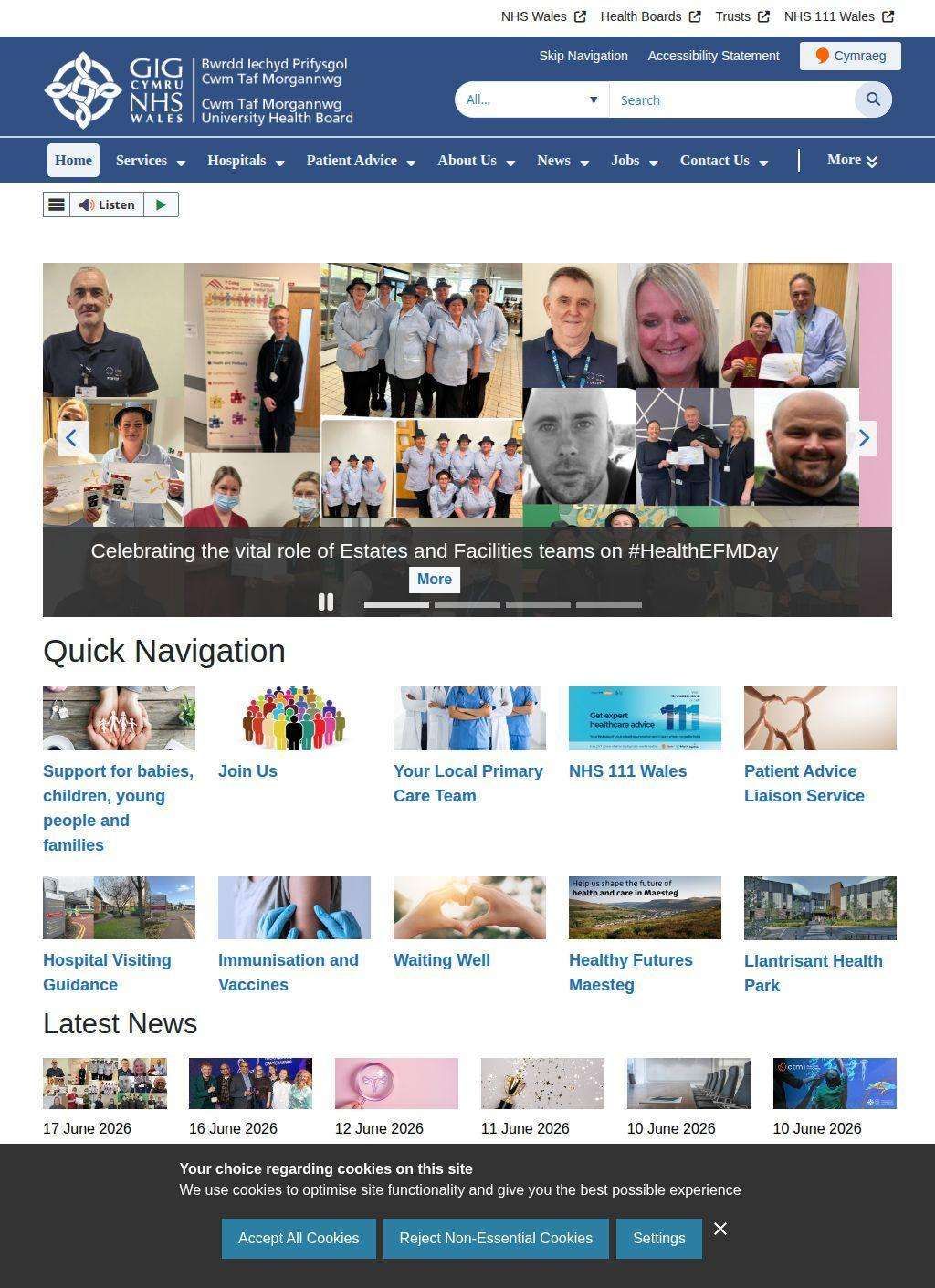
Cwm Taf Morgannwg University Health Board is the NHS organisation responsible for planning and delivering health and care services across Merthyr Tydfil, Rhondda Cynon Taf, and Bridgend in South Wales. The website listed here is its public face, built to do several jobs at once: explain where services are, point patients toward the right pathway, and carry the governance and employment information an organisation of this scale has to publish.
Hospital sites and service locations
The reach is worth pinning down early. Cwm Taf Morgannwg University Health Board operates more than fifteen hospitals and community facilities. Three of those sites carry most of the recognition. Prince Charles Hospital sits in Merthyr Tydfil itself, which makes it the local anchor for anyone reading this under the Merthyr heading. Princess of Wales Hospital covers Bridgend, and Royal Glamorgan Hospital serves the Llantrisant area. Between them they hold the acute and inpatient capacity for the region, while the smaller community sites fill in the outpatient and day-to-day gaps closer to where people live.
Clinical services offered
The clinical span goes well past buildings on a map. It covers secondary and community healthcare across most of the categories a household would ever need: maternity and obstetrics, mental health and crisis support, physiotherapy and rehabilitation, pathology and radiology, dental services, diabetes clinics, women's health, and paediatric specialist clinics. Cwm Taf Morgannwg University Health Board also runs immunisation programmes and cancer support pathways, which are the kinds of services where clear online information genuinely changes whether someone shows up at the right place at the right time.
This is an orientation tool more than a transactional one. A health board website in NHS Wales is rarely where a patient books their own scan or specialist appointment; those routes still run through referrals and clinic systems. What the site does well is tell people which hospital handles what, where to go, and what to expect.
Patient signposting across the region
For a region as spread out as the one Cwm Taf Morgannwg University Health Board covers, that signposting saves a patient a wasted journey. Someone in Merthyr Tydfil needs to know quickly whether a service is at Prince Charles Hospital or whether they will be sent across to Royal Glamorgan or Princess of Wales. The site keeps those distinctions reasonably clear, which is the most useful function it could perform for a patient juggling a new diagnosis and an unfamiliar set of place names.
Employment, charitable giving, patient resources
Beyond the clinical signposting, the board publishes patient advice resources, which turns a list of departments into something a worried family can use. There is also a staff and jobs portal. Cwm Taf Morgannwg University Health Board is one of the larger employers in the area and recruits across an enormous range of roles, so that portal stays busy. Charitable fund information is hosted here as well, for people who want to give back to the local hospitals or track where donations go. None of these are flashy features, but together they cover the practical reasons a person lands on a health board site.
Welsh language provision
One detail worth a plain mention: all correspondence and telephone services are available in Welsh or English. In this part of Wales that is not a token gesture; it is a working requirement, and Cwm Taf Morgannwg University Health Board treats it as standard. For Welsh-speaking patients and families, being able to deal with their own health authority in their first language is a real practical matter, easy to overlook from the outside.
The governance side is where the scale becomes clearest. Cwm Taf Morgannwg University Health Board holds responsibility for all NHS-funded care across its catchment, which means it runs its own hospitals and is also accountable for care commissioned under the wider NHS Wales framework. It answers to Welsh Government and operates inside that national structure. The takeaway for a visitor is that this is the planning authority for the region's health, not a single clinic or a marketing front for one hospital.
Social media channels
Social presence is maintained across Facebook, Twitter/X, LinkedIn, and Instagram. For a public health body those channels do real work during pressure points: pushing immunisation reminders, flagging service changes, recruiting staff, and getting urgent messages out when an emergency department is under strain. It is a sensible spread of platforms for an organisation that has to reach both patients and prospective employees, and it fits the public role Cwm Taf Morgannwg University Health Board is expected to play in keeping its region informed.
A search for third-party ratings turns up nothing aggregated on the usual consumer platforms for Cwm Taf Morgannwg University Health Board as a whole, which is typical for NHS health boards. The organisation is covered regularly in Welsh media and in NHS Wales accountability reports, but there is no single star-rating count to cite here. That absence reflects how Cwm Taf Morgannwg University Health Board operates as a statutory body; the NHS accountability framework, not Google or Trustpilot, is where its performance gets scrutinised.
It is worth being realistic about what a site like this is for. A health board web presence carries a heavy load of statutory publishing alongside its patient-facing content, and that mix makes any such site feel dense in places. The structure serves several audiences at once: patients, job seekers, donors, and the public record. That is the nature of the organisation rather than a flaw in how Cwm Taf Morgannwg University Health Board presents itself, though a first-time visitor looking for one specific clinic may need a moment to find the right thread.
The depth of the clinical offering is the strongest reason to take this listing seriously. Cwm Taf Morgannwg University Health Board covers maternity units, mental health and crisis teams, rehabilitation services, diagnostic departments, dental provision, diabetes and women's health clinics, and dedicated paediatric care, all under one accountable structure. The scale here is genuine: Cwm Taf Morgannwg University Health Board is not a specialist unit but a full regional health authority. For anyone in Merthyr Tydfil and the surrounding valleys, that breadth is the practical point: the same organisation that staffs Prince Charles Hospital also coordinates the specialist care a patient may be referred onward to receive.
The verdict is measured rather than glowing, and that suits the subject. This is a serious public institution doing a wide job across three local authority areas, and the website reflects that scope honestly. Cwm Taf Morgannwg University Health Board is worth knowing about because it is the body responsible for a region's health, and the resources gathered here, from hospital locations to patient advice to the jobs and charity sections, give a clear enough map of what it does. The breadth of what it is accountable for is what gives Cwm Taf Morgannwg University Health Board its standing, not any polish in how it is dressed up.
Business address
Cwm Taf Morgannwg University Health Board
Ynysmeurig House, Navigation Park,
Abercynon,
Rhondda Cynon Taf
CF45 4SN
United Kingdom
Contact details
Phone: 01443 744800