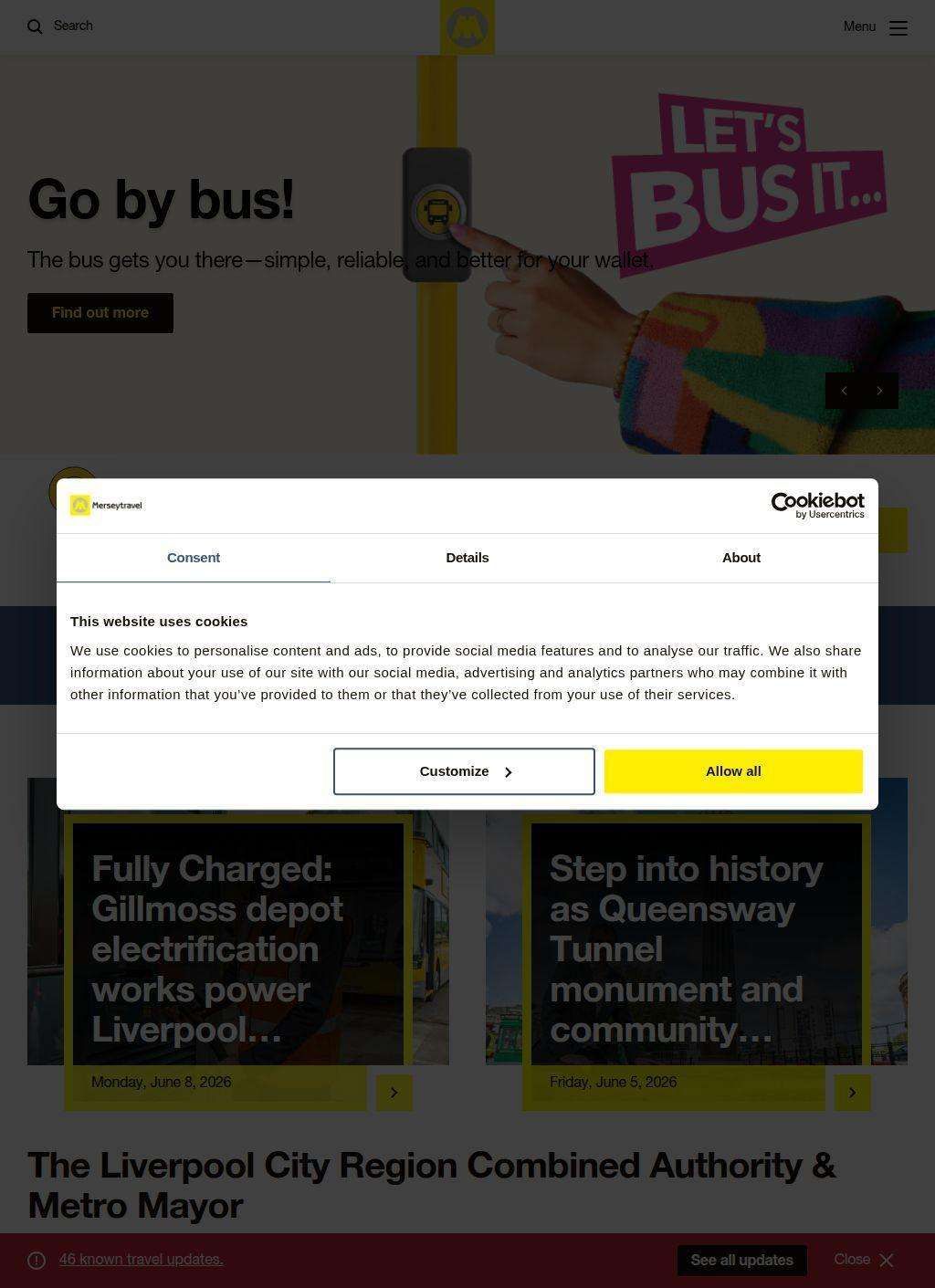
Walrus cards and tunnel tolls do not usually belong to the same organisation, but Merseytravel manages both. It is the statutory Passenger Transport Executive for the Liverpool City Region, covering Liverpool, Knowsley, Sefton, St Helens and Wirral, and its remit is wider than the typical transport authority: coordinating buses, rail and ferries under a shared ticket structure while also operating the Queensway and Kingsway road tunnels under the Mersey. The site reflects that breadth without trying to dress it up. It reads like a working tool, organised around what a passenger or a policy reader needs to find.
The Walrus smartcard for integrated travel
The Walrus smartcard is what most passengers encounter first. An ITSO-compatible card that consolidates bus, train and ferry travel onto one piece of plastic, it has replaced the old paper Solo, Railpass and Trio passes across the region. The site carries timetables, a journey planner, and full details of the integrated ticket types from day passes through to annual options that the card handles.
Rail coordination across three Merseyrail lines
The rail side ties into the Merseyrail City, Wirral and Northern lines, though Merseytravel does not run those trains directly; its role is the coordination behind the scenes, keeping operators aligned so a passenger experiences one network and not a tangle of separate, competing ones. The site is honest about this distinction, which is more than some transport bodies manage. It states plainly that the Merseyrail services it ties together are run by operators, while Merseytravel sets the ticketing and integration that make them feel like a single system.
Ferries for commuters and River Explorer visitors
Mersey Ferries is one thing that changes the character of the offering. Beyond the regular cross-river crossings, the service runs River Explorer cruises aimed at visitors, which means the same body that sells a commuter a weekly pass also runs a tourist attraction on the water. The ferry pages handle both purposes at once, part timetable, part day-out.
Tunnel operations and road infrastructure
The tunnel operation is the other. Merseytravel runs the T-FLOW payment system and a Concessionary Travel Scheme allowing eligible residents to use the tunnels free of charge. Running two major pieces of road infrastructure alongside a public-transport network is unusual, and it explains why the customer-services side of the site stretches from lost property to tunnel-payment support to press queries without any obvious seam. There is a lot bundled here, and the site mostly keeps it navigable.
Free travel passes for older adults and disabled passengers
Where the public-facing value is clearest is the concessions. The Over 60s Travel Pass covers free bus and train travel within Merseyside and out to Chester, Ellesmere Port and Ormskirk, plus single ferry crossings, and separate disability passes extend free travel across bus, train and ferry. The eligibility detail is laid out precisely, which is what people come to a site like this to confirm. That material is the most worthwhile part, because it answers a specific question with a specific answer instead of routing visitors toward a general enquiry form. Someone checking whether a parent qualifies for the Over 60s pass, or whether a disability pass extends to the ferry, can read the conditions and reach a conclusion in one sitting, which is exactly the test a public-transport site of this size should pass.
Merseylink dial-a-ride service for mobility needs
Merseylink deserves mention because it fills a gap the fixed network cannot. A dial-a-ride, on-demand accessible bus service for people with mobility challenges, it provides door-to-door provision between scheduled routes. Listing it openly shows Merseytravel is thinking about passengers who fall outside the standard timetable, and a fixed route map cannot reach everyone; an on-demand service quietly acknowledges as much.
Policy advice to the combined authority
Merseytravel also advises the Liverpool City Region Combined Authority on transport investment and policy, which means a portion of its work never touches the average passenger. That dual audience is visible in places: the commuter checking a Wirral line departure and the policy reader following an investment decision are sometimes sharing the same page, and the two do not always sit comfortably together. It is a structural tension rather than a design failure, and the site handles it better than expected.
Maintenance of currency across multiple systems
My one genuine reservation is depth. Merseytravel is asked to be a ticket vendor, a ferry operator, a tunnel authority, a concessions administrator, an on-demand bus provider and a strategic advisor, and one website carrying all of that risks stretching its attention across too many fronts. The smartcard rollout, the tunnel payment system and the concessionary schemes each have eligibility rules, pricing and update cycles, and whether every corner of the site stays current is something a single read-through cannot settle. That is the uncertainty I would want resolved before relying on it as the definitive source on any one of those products.
Business address
Merseytravel
PO Box 1976, 1 Mann Island,
Liverpool,
Merseyside
L3 1BP
United Kingdom
Contact details
Phone: 0151 330 1000