Seven separate buildings sit behind one umbrella, and the spread is wider than many people expect when they first look up National Museums Liverpool. Four cluster in the city centre: the Museum of Liverpool, World Museum, International Slavery Museum, and the Maritime Museum. The art side adds the Walker Art Gallery in town, Sudley House in the suburbs, and the Lady Lever Art Gallery in Port Sunlight. One website run by National Museums Liverpool pulls all of them together, which is genuinely useful when you are trying to plan a day and do not yet know whether you want fossils, slave-trade history, or oil paintings.
Collections across seven venues
What the collections cover is the part worth slowing down on. National Museums Liverpool holds material across natural history, ancient Egypt, and world cultures, and that sits inside the World Museum end of things. The International Slavery Museum carries the history of transatlantic slavery, heavy subject matter handled as a standing commitment and not a temporary feature. The Maritime Museum takes on the port's seafaring past, fitting for a city that built so much of its identity on the docks. On the art side, the Walker covers fine and decorative arts, while the two house-galleries, Sudley and Lady Lever, give a different texture to the visit. Social history runs through several of the sites, so National Museums Liverpool reads less like a single-theme organisation and more like a layered account of a region.
Checking current versus permanent exhibitions
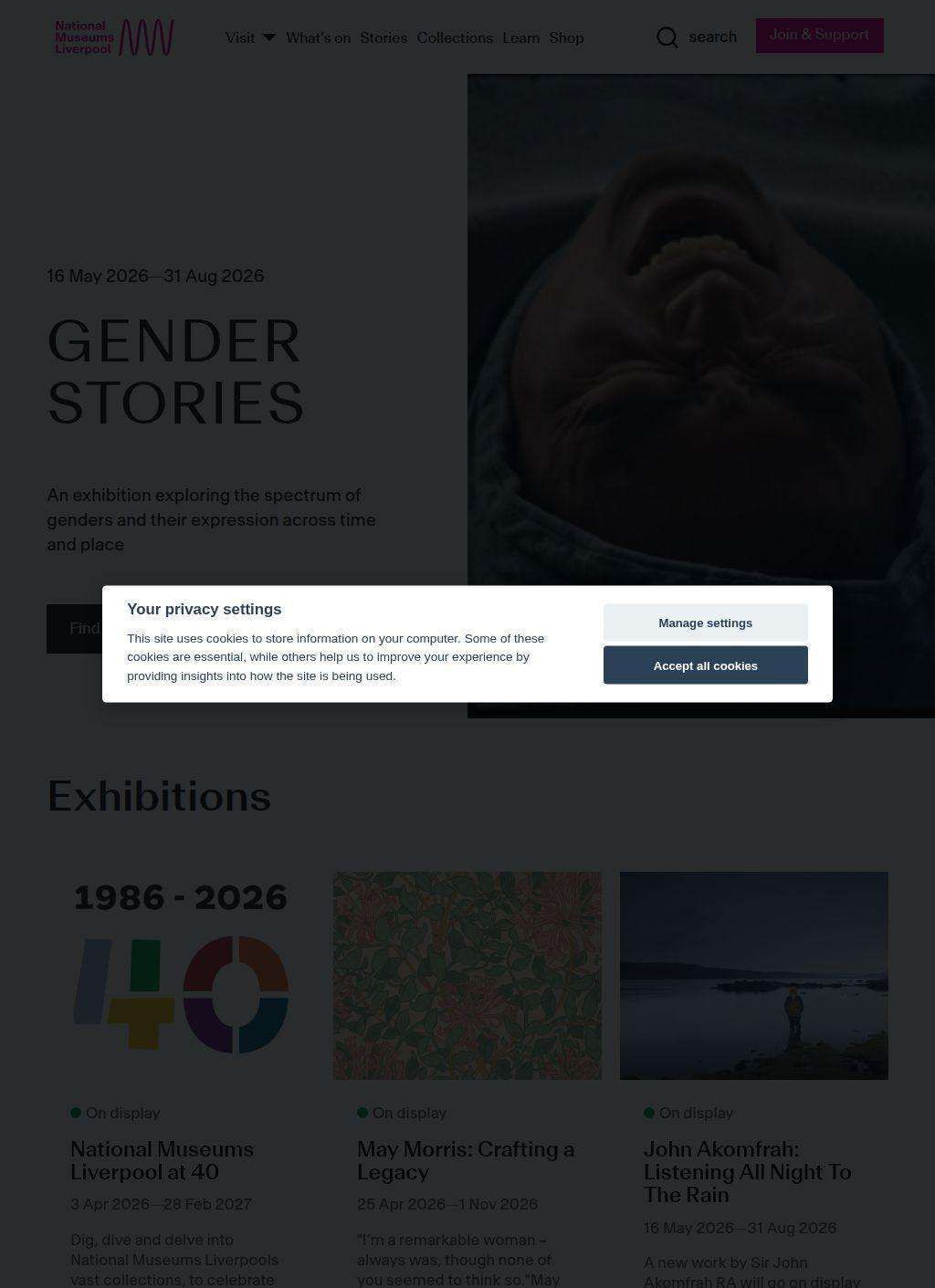
The web presence is built to answer practical questions, and that is where it does well. You can see which galleries are permanent and which are rotating, so a trip can be timed around something specific. A current example is "Gender Stories" at the Walker Art Gallery, running May to August 2026, the kind of temporary show that gives a repeat visitor a fresh reason to come back. The structure makes it easy to tell a fixed collection from a limited run, so you can decide whether to wait or to go now.
Learning programmes for schools
There is also a "Learn" section aimed at schools, with educational programmes and resources for teachers. A public body with collections of this scale is expected to feed classrooms, and National Museums Liverpool puts that work in plain reach instead of burying it. For a teacher planning a visit or a remote lesson, having the programmes on the same site as the exhibition listings saves cross-referencing. A newsletter rounds out the practical side and is the simplest way to keep track of what is opening next.
Venue hire across the sites is another line worth noting, though it serves a narrower audience. If you want to hold an event inside a gallery or a museum hall, the option exists across the group. Most casual visitors will skip past it, but for an event planner it is a real and specific offering. It tells you the organisation treats these buildings as living, used spaces.
Public funding and free admission
The funding model shapes how all of this is presented. National Museums Liverpool is a non-departmental public body sponsored by the UK Department for Culture, Media and Sport, which places it in the same bracket as the country's other national collections. The practical upshot for a visitor is free admission running through the sites, and the website does not bury that fact behind a wall of pricing pages. Public funding also explains the breadth: a privately run group would struggle to keep seven distinct venues, several of them free, operating under one banner.
Searching for independent ratings turns up very little in the way of aggregated scores. There are no prominent review totals on the main third-party platforms for National Museums Liverpool as a group entity, though individual venues such as the Museum of Liverpool and the Walker Art Gallery carry visitor comments on travel sites. For a publicly funded institution that is not unusual: foot-traffic is high, but visitors tend not to cluster on rating platforms the way they would for a restaurant or hotel.
Comparing venue popularity and navigation
Browsing the seven venues together does expose the trade-off of any large group site. The Museum of Liverpool and the World Museum draw most of the foot traffic, and the smaller house-galleries can feel like an afterthought in the navigation even though Sudley House and the Lady Lever Art Gallery reward the people who make the trip. National Museums Liverpool keeps them on equal footing in the listings, which is fair, but a first-time user might need a moment to register that Port Sunlight is a separate journey from the city centre cluster. That is a planning quirk rather than a flaw, and the site gives you enough information to sort it out.
The temporary-exhibition handling deserves a second mention because it is what keeps the offer current. A standing collection, however good, becomes familiar after a couple of visits. By rotating shows across the Walker and the other sites, National Museums Liverpool gives a local audience an ongoing reason to return, and the calendar of what is coming is the part of the site a regular will check most often. The newsletter ties into the same need, pushing the next opening to people who have already decided they care.
One thing the site does not do is flatten the differences between its venues. The International Slavery Museum and the World Museum ask very different things of a visitor, emotionally and intellectually, and presenting them under a single organisation could have produced a generic house style. It does not. Each museum keeps its own identity within the group, and the website respects that by letting each one explain its own collections. National Museums Liverpool manages that balance about as well as a seven-venue organisation can.
For depth of collection, the natural-history and ancient-Egypt holdings at the World Museum give National Museums Liverpool a genuine claim to national standing, the same level the organisation sits at by virtue of its funding and its designation. The art side, anchored by the Walker, is strong enough that a visitor interested only in paintings could spend a full day without setting foot in the science galleries. That range, covering science alongside slavery history, maritime heritage, and fine art, is the real argument for treating National Museums Liverpool as a single destination across several stops.
How does it compare to Tate Liverpool?
Against a single-focus alternative the comparison gets interesting. Someone whose only interest is contemporary art might be better served by Tate Liverpool, which concentrates everything in one waterfront building and keeps a tighter modern-art remit. National Museums Liverpool answers a broader question. It suits the visitor who wants Egyptology in the morning and a Pre-Raphaelite collection in the afternoon, or a family that needs the day to bend around several ages and attention spans. The seven-venue spread is the whole point, and for a few days in Merseyside, National Museums Liverpool gives more ground to cover, at no admission cost, than any single specialist museum could match. The gaps in outside review data are a product of the institution's public character; the published evidence on what National Museums Liverpool actually offers is substantial enough to plan around.
Business address
National Museums Liverpool
127 Dale Street,
Liverpool,
Merseyside
L2 2JH
United Kingdom
Contact details
Phone: 0151 478 4982