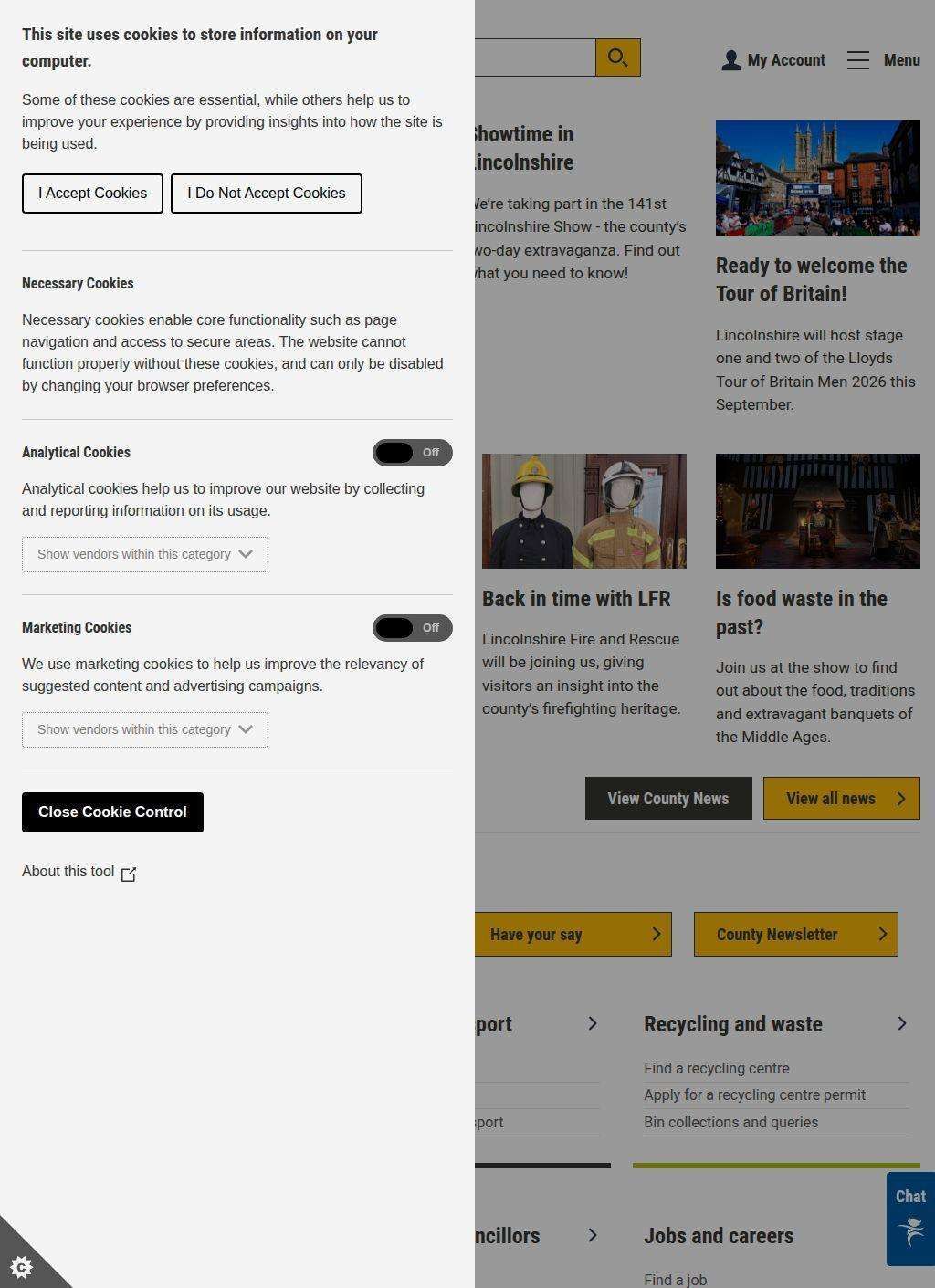
One organisation handles your child's school place, your bin collection, your parking permit, your marriage certificate and the state of the road outside your house. That breadth is the first thing worth understanding about Lincolnshire County Council, the upper-tier authority covering roughly 770,000 people across a county that stretches from Lincoln out through Boston, the Kestevens and the Lindseys. The website is the front door to nearly all of it, and the range on offer is wide enough that most residents will land here for several unrelated reasons over the course of a year.
Education, children's services, adult social care
Education is one of the heavier sections. Parents can apply for school admissions, sort out school transport enrolment, and check term-time calendars without hunting through a phone tree. Children's services sit nearby and cover adoption, foster care, and help with childcare costs, which are the sorts of decisions where having the official process written down plainly has real value. Adult social care runs in parallel: care assessments, guidance on carer benefits, and a route to report safeguarding concerns. These are not glamorous pages, but they are the ones people genuinely need at difficult moments, and they are present.
School admissions, transport, term calendars
Highways and transport get real attention too. There is a roadworks finder, a tool to report a fault in the road, and rights of way information for anyone walking the county's footpaths. Environment and waste pulls together a recycling centre locator with the permit system attached, bin collection queries, flood risk management, and planning application searches. For a county with as much low-lying ground and coastline as this one, Lincolnshire County Council has placed flood material alongside the recycling and planning tools, which is a sensible piece of organisation rather than an afterthought.
Adoption, foster care, childcare support
A lot of what brings people to a council site is administrative, and Lincolnshire County Council covers the predictable list. Registration services handle births, deaths, marriages and civil ceremonies, with coroner services and certificate ordering folded in. The Blue Badge scheme for disabled parking has its own application path. Libraries and leisure are served by a facility locator that maps out what exists across the county, which is more useful than a static list when the sites are spread over such a large area.
Roads, waste, environment
Business and consumer needs are handled through Trading Standards, which supports both shoppers and traders, plus information on business grants and funding. The employment section lists council vacancies and early careers programmes, so the site doubles as the recruitment shopfront. Safety guidance covers fire safety and emergency planning, the kind of reference material you hope never to use but want to find quickly when you do.
Report faults, find recycling centres
What ties these together is a set of digital tools that try to cut down on guesswork. A postcode-based service locator points you to what applies to your specific address, a councillor finder tells you who represents you, and there is a Freedom of Information request route for anyone who wants documents Lincolnshire County Council holds. A virtual chat assistant called Impy sits on top of all this as a first line of help. Whether a chatbot genuinely shortens the path to the right page depends heavily on how it is tuned, and that is the sort of thing only repeated use reveals.
Flood risk alongside planning tools
The scale of the operation is worth keeping in mind when judging the site. Seven districts, three-quarters of a million people, and a statutory duty to deliver every one of these services whether or not the web journey is smooth. A council site is measured less by polish than by whether a worried parent or carer can find the correct form on the first try. On the evidence of the structure here, the major service areas are all accounted for and grouped in ways that follow how people think about their problems, by life event or by location, instead of by internal department. Lincolnshire County Council does not pretend otherwise: the navigation categories map to real life circumstances rather than organisational charts.
Registration, business, safety
There are limits to what a directory entry can tell you. The presence of a recycling permit system or a fostering page says the function exists; it says less about response times, waiting lists, or how often the forms break. Those are the realities residents discover in practice, and they vary by service. What the site does well is make the full span of county responsibilities visible in one place, so that someone who only ever associated Lincolnshire County Council with bins discovers it also handles their parking badge, their planning query and their elderly relative's care assessment.
Births, deaths, marriages, blue badges
Residents, businesses and visitors in the county all share the same starting point: the statutory processes begin here. The website is the most direct route into most of them, and the structure is organised well enough that locating the right department is rarely the hard part. Whether the service itself delivers is a separate matter, decided case by case, but Lincolnshire County Council has at least made sure the entry point is clear.
Business address
Lincolnshire County Council
County Offices, Newland,
Lincoln,
Lincolnshire
LN1 1YL
United Kingdom
Contact details
Phone: 01522 552222