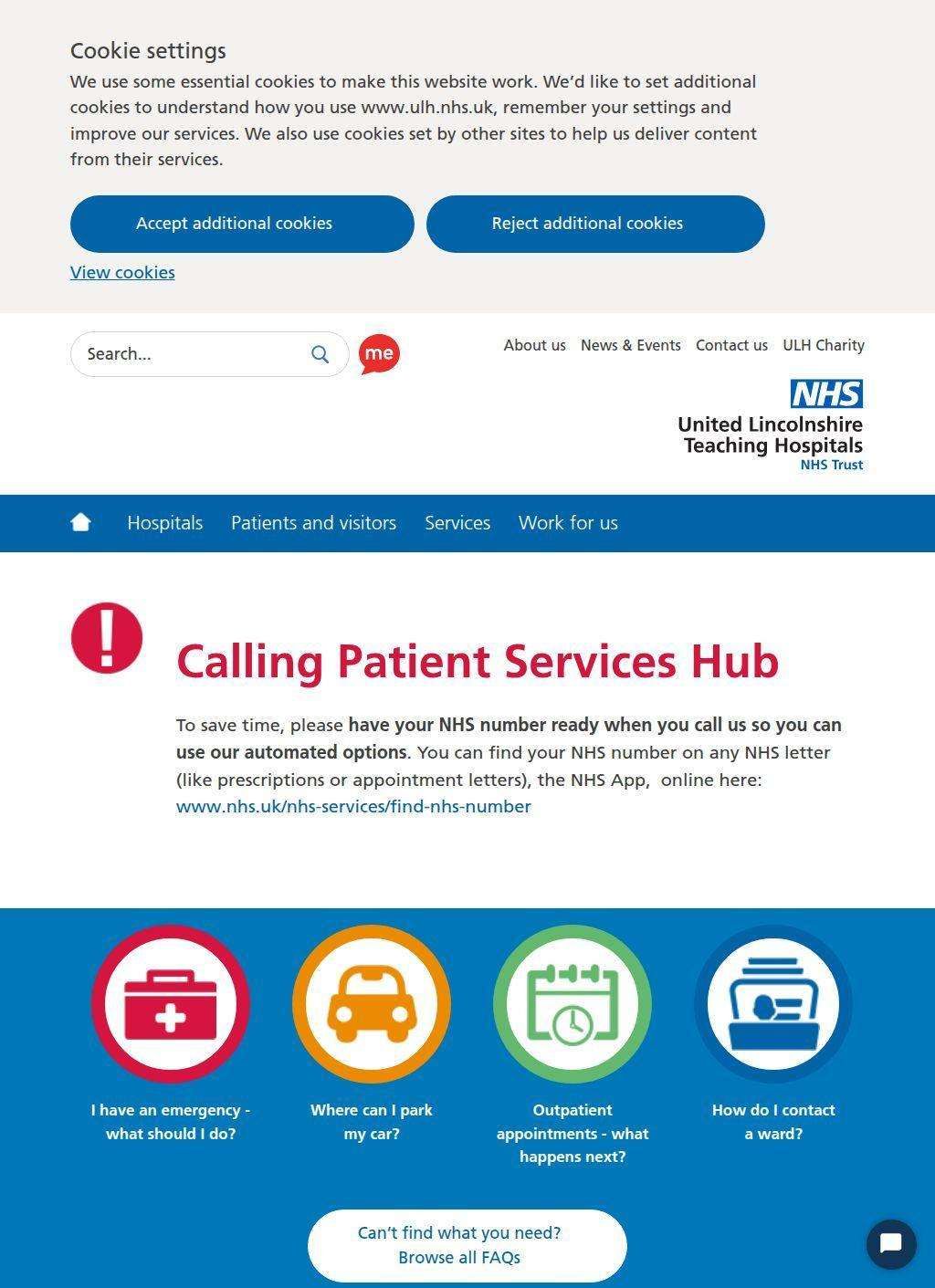
If you live anywhere across Lincolnshire and need acute hospital treatment, the answer for most people is United Lincolnshire Teaching Hospitals NHS Trust. The trust runs four main hospitals: Lincoln County Hospital, Pilgrim Hospital in Boston, and two sites in Grantham, namely Grantham and District Hospital and County Hospital Grantham. Between them they cover a county of roughly 700,000 to 750,000 residents, which is a lot of ground and a lot of patients for one organisation to carry.
Hospital sites and specialties
The site reflects that scale without trying to dress it up. United Lincolnshire Teaching Hospitals NHS Trust uses its web presence the way a large acute provider should: as a practical front door to its services. You can read about emergency and urgent care through the A&E departments, surgery, maternity and obstetrics, paediatrics, oncology, cardiology, orthopaedics, and stroke services, alongside a long list of outpatient specialties. That breadth is the point. A county this size needs a single organisation able to handle a heart attack, a broken hip, a cancer pathway, and a routine clinic appointment, and United Lincolnshire Teaching Hospitals NHS Trust is built to do all of it. Few organisations have to span the urgent and the routine quite so widely.
Diagnostic services made clear
Diagnostics get proper coverage too. The pages describe imaging, pathology, and endoscopy, the unglamorous machinery that sits behind nearly every diagnosis and treatment plan. I find it genuinely useful when a hospital site lays these out plainly, because patients are often referred for a scan or a test without much idea of where it happens or what to expect, and seeing it named on the official site removes some of that uncertainty. United Lincolnshire Teaching Hospitals NHS Trust does not bury this behind clinical jargon, which counts for something when the reader is anxious and short on time.
Practical patient tools
Beyond the clinical departments, United Lincolnshire Teaching Hospitals NHS Trust gives over a good portion of the site to the things patients have to deal with day to day. There is a patient portal, information on waiting times, guidance on referral pathways, and tools for managing appointments. None of that is exciting, and that is exactly why it matters. A waiting-times page that is kept current, or a portal that lets someone check an upcoming appointment, saves a phone call and a fair amount of worry. For anyone navigating a long referral or trying to keep track of where they are in a queue, those sections do real work.
Teaching hospital status
The teaching hospital designation is more than a label sitting in the trust's name. Research and education functions are present on the site, which fits an organisation that trains clinicians and contributes to studies. That status tends to matter to patients in a quiet way: a teaching trust is usually closer to current practice and more likely to be running trials or adopting newer techniques. United Lincolnshire Teaching Hospitals NHS Trust folds this into its public pages alongside everything else, so a curious patient or a prospective student can find it without digging. The teaching role also explains why the clinical content runs deeper than a smaller community hospital would bother with, and why United Lincolnshire Teaching Hospitals NHS Trust treats education and care as part of the same job.
Careers and volunteering opportunities
There is also a layer aimed at people who are not patients at all. United Lincolnshire Teaching Hospitals NHS Trust carries a careers section and a volunteering section, both of which are substantial parts of how a trust this size keeps running. A hospital group serving three-quarters of a million people employs and depends on a great many staff and volunteers, and putting recruitment and volunteer information on the same site as clinical content is a sensible bit of housekeeping. Someone in Lincoln or Boston thinking about working for the NHS, or wanting to give time on a ward, lands in the right place without chasing details across several pages.
Openness about performance data
Where the site earns particular credit is its commitment to openness about how the trust performs. United Lincolnshire Teaching Hospitals NHS Trust publishes CQC inspection reports, board meeting papers, annual reports, and its trust strategies. For a public body funded by taxpayers, this is the right instinct, and it is more thorough than many organisations of comparable size manage. A resident who wants to understand how their local hospitals are governed, or what the regulator has said about quality and safety, can read the source documents rather than relying on summaries.
Patient experience survey results
That kind of transparency does more to build trust than any amount of reassuring copy, and the CQC reports are the first place a sceptical reader should look. The NHS also publishes NHS Friends and Family Test results for the trust's sites; no third-party consumer review platform aggregates ratings for United Lincolnshire Teaching Hospitals NHS Trust in the way they do for retail or hospitality, but the regulator's inspection history is publicly searchable and gives a clearer picture than star ratings would.
Healthcare professionals are served as well. The site hosts clinical guidelines and staff resources, which means it works on two levels at once: a public-facing information hub and a working reference for the people delivering care. That dual role is common among large NHS trusts, and United Lincolnshire Teaching Hospitals NHS Trust handles it without the two audiences tripping over each other. A GP looking for a referral pathway and a patient checking a clinic time are both accommodated.
It is worth being clear-eyed about what a site like this is and is not. The organisation behind it is an NHS foundation trust under real pressure, the same pressure facing acute providers across England, and a website cannot fix waiting lists or staffing gaps. What the web presence can do is make the system legible, and on that count United Lincolnshire Teaching Hospitals NHS Trust does a solid job. The information is organised around how people actually arrive: in an emergency, through a referral, for a planned procedure, or simply trying to find out what is going on with their care.
For a Lincolnshire resident who has just been referred to one of the four hospitals, or who needs to check a waiting time or manage an appointment, the trust's site is the place to start rather than a third-party page or a phone tree. Go to the patient portal first, find the department named in your referral letter, and if you are weighing how the trust is doing, open the most recent CQC report before anything else. Prospective staff and volunteers should head straight for the careers and volunteering sections. The reach of United Lincolnshire Teaching Hospitals NHS Trust across the county means that for most people here, this is not one option among several. It is the option, and the site treats that responsibility seriously.
Business address
United Lincolnshire Teaching Hospitals NHS Trust
Greetwell Road,
Lincoln,
Lincolnshire
LN2 5QY
United Kingdom
Contact details
Phone: 01522 512512