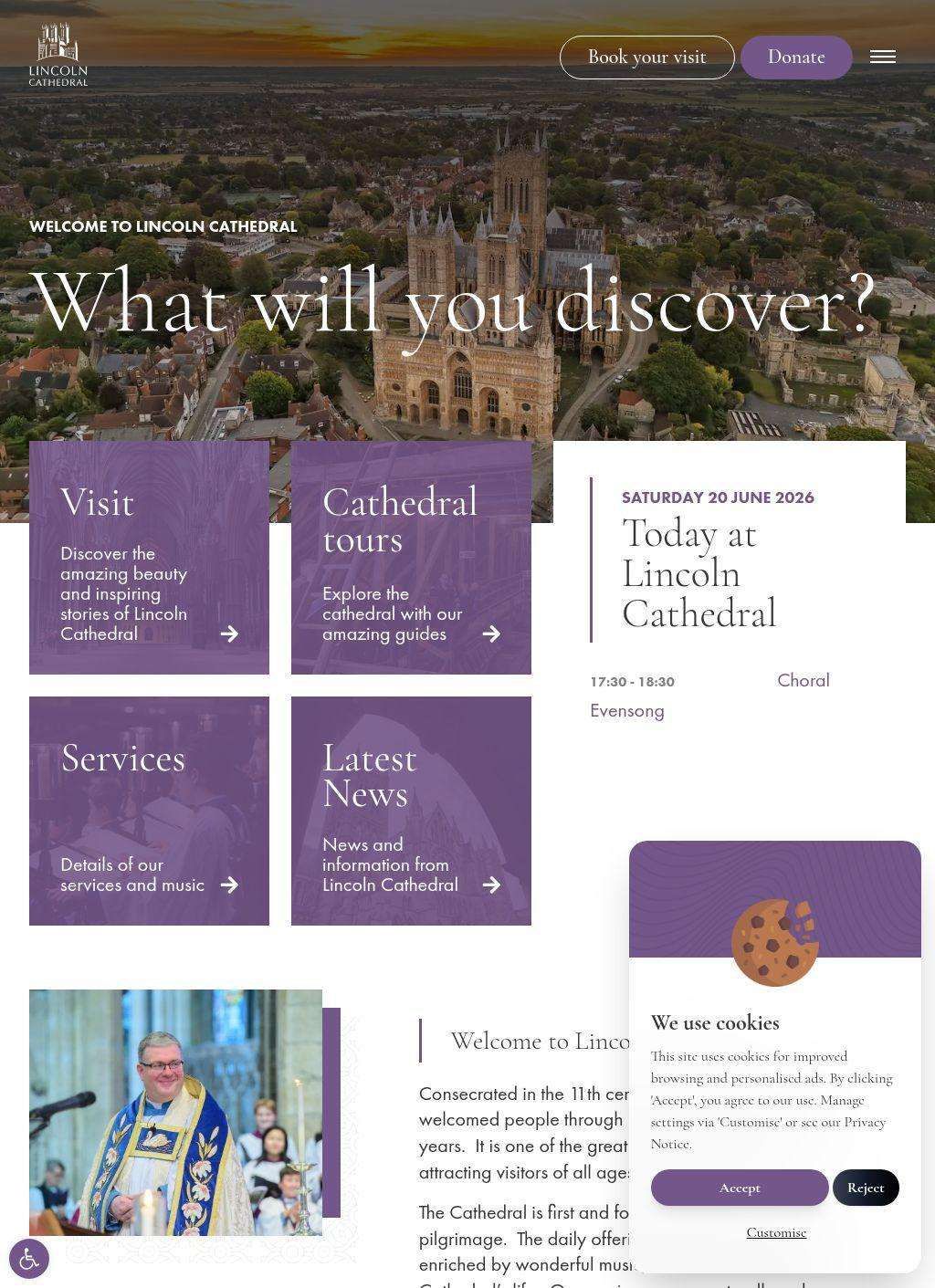
Perched on the hilltop above Lincoln, Lincoln Cathedral is the working Anglican cathedral formally known as the Cathedral Church of the Blessed Virgin Mary, consecrated in the 11th century and still holding daily services. Its website does the practical job of explaining how a building of that scale operates as both a place of worship and a destination people travel to see. The Gothic architecture is the headline draw, but the site treats Lincoln Cathedral as a living institution with a cafe, a shop, a learning centre and a music programme, not a frozen monument. That balance comes through quickly once you read past the front page.
Admission and opening hours
Admission is handled openly. Lincoln Cathedral charges for visitors during the main daytime window, Monday to Saturday from 10am to 4pm and Sunday from 11:30am to 2:30pm, and the ticket includes a complimentary floor tour along with access to the Exhibition Gallery and Discovery Centre on weekdays. Knowing that before you arrive tells you the paid entry is buying guided context and curated spaces, not simply the right to walk through the door. Guided tours sit alongside the self-led option, so a first-time visitor and a returning one can each find a way in that suits them.
Visitor centre facilities
The Visitor Centre is where the day-to-day experience clusters. Lincoln Cathedral runs a cathedral cafe open from 9am daily, which means you can get a coffee before the building itself opens to paying visitors. The cathedral shop keeps its own hours, 9:30am to 5pm on weekdays and shorter on Sunday. Around those two are community meeting rooms, the Exhibition Gallery, the Discovery Centre and the Ross Learning Centre. The grouping makes sense: a single block of the site holds everything a casual visitor, a school group and a local community user might each need, and the opening times are spelled out for each part with no ambiguity.
Worship, music and education
For someone coming to pray, the regular Anglican services run daily, and the choral tradition is given real weight. The chorister programme is described as a serious musical education for the young singers who carry that tradition, and the Lincoln Cathedral Music Fund exists as a dedicated vehicle to support it. That is more than a line about a choir. It shows an ongoing commitment with its own funding structure, which a parent considering the programme would want to see laid out plainly. For the visitor chasing the history and the stonework, the Magna Carta association and the medieval fabric of the place are the obvious draws, and the floor tour included in admission is the route the site steers you toward.
School visit programmes
For schools, Lincoln Cathedral offers dedicated education programmes with structured visit materials. Teachers are not expected to invent their own lesson around a trip, which is the right call: a school group needs to know what a visit will contain before booking a coach, and the presence of prepared materials answers that question directly. It is worth noting that anyone searching a business directory for heritage education venues in the East Midlands would find Lincoln Cathedral repeatedly recommended in that context, and the site backs that reputation up with substance.
Concerts and seasonal events
Events round out the picture and show Lincoln Cathedral is used for far more than the obvious. The listings run across concerts, special services, sewing clubs, drama, family activities and seasonal light shows. The light shows in particular are the kind of programming that brings people in who might never come for a service, and putting them on the same calendar as the choral evensong tells you the institution is comfortable wearing several hats at once. It reads as a place that wants the building full, by whatever reason gets someone through the door.
Venue hire for private events
Venue hire is offered too, covering both corporate and private events, with in-house catering available. For a setting of this kind that is a sensible use of the space and a revenue stream that helps keep the lights on, and Lincoln Cathedral does not bury it. A couple planning a reception or a company looking for an unusual conference backdrop can find the relevant information without hunting, which is the right call given how specific those enquiries tend to be.
Accessibility provisions for visitors
Accessibility is where Lincoln Cathedral's site does noticeably better than many heritage attractions, which often treat a medieval building's limitations as an excuse. Here the detail is concrete. There is level access, a hearing loop in the nave, a touch model of the cathedral for visitors who cannot take in the scale by sight, and a platform lift in the visitor centre. Specifying the touch model shows someone thought about how a blind or partially sighted visitor experiences a vast interior, rather than stopping at getting a wheelchair through the entrance. Mobility, hearing and sight are all addressed, so a wider range of people can plan a visit with some confidence about what they will and will not be able to do.
For a building first raised in the 11th century, retrofitting a platform lift and level access is real work, and Lincoln Cathedral treating it as standard information rather than a grudging footnote reflects well on how the place is run. A visitor with a specific need can read the relevant lines and make a decision without phoning ahead and hoping for the best.
One more piece of context worth knowing is the legal footing. Lincoln Cathedral is registered as a charity, Charity Number 1207411, with the Music Fund running alongside it. That status is the quiet backdrop to almost everything described above: the admission charges, the venue hire, the shop and cafe all feed the upkeep of a structure that costs a fortune to maintain. Seeing the charity registration stated outright gives the commercial elements of the site an honest frame. The money is not the point, the building is, and the trading exists to keep the building standing.
A search for reviews on platforms like Tripadvisor or Google Maps turns up no substantial presence under the Lincoln Cathedral listing, though the cathedral draws significant visitor numbers annually. The absence of a consolidated rating profile is common for registered charities of this type; the Lincoln Cathedral website's own depth of detail does more to convey trustworthiness than a star count would.
What the site does best is refuse to flatten a complicated institution into a single brochure pitch. Lincoln Cathedral is at once a tourist attraction with timed admission, a parish at prayer every day, a music school, a charity, a community venue and an events space, and the website lets each of those exist on its own terms. The information is specific where it counts, on hours, on what admission includes, on access provision. If you are weighing a trip to the Lincolnshire heritage city, the practical questions are answered before you arrive, and that is more than most heritage sites manage.
Business address
Lincoln Cathedral
Minster Yard,
Lincoln,
Lincolnshire
LN2 1PX
United Kingdom
Contact details
Phone: 01522 561 600