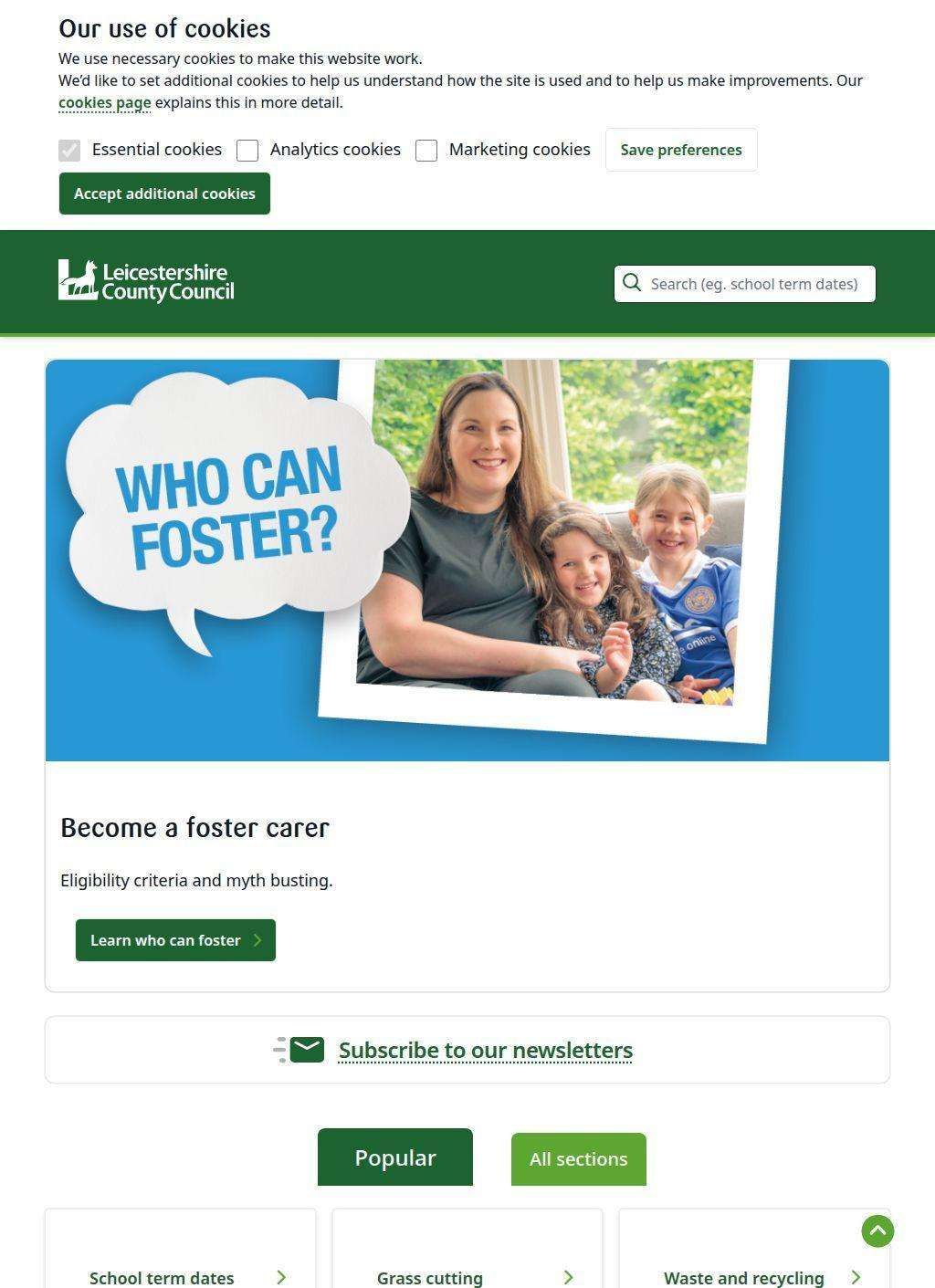
Report a pothole from your phone, and within a few clicks the same portal lets you check when your bin is due, find your nearest household waste recycling centre, and apply for a school place. That practical spread is the clearest way to describe what Leicestershire County Council puts online: a working front door to the services that run a county of roughly a million people across everything from Melton to Hinckley, minus the city of Leicester itself, which is governed by its own separate unitary authority and its own website.
Services for residents and families
Leicestershire County Council organises the site around the things residents actually come looking for. Adult social care and health sit alongside children and family services, and the latter covers the heavier end of local government work: safeguarding, foster care, adoption. Education gets real room here too, with school admissions, a school finder, and support for children with special educational needs and disabilities. None of it is dressed up. The pages read like tasks to complete, which is the right instinct for a site people mostly visit because something needs doing.
Roads, transport, libraries, waste
Highways and transport is one of the busier corners. Road maintenance schedules, live road works, traffic updates, public transport information, and bus pass applications all live under that banner, and the pothole and fly-tipping reporting forms are woven through it. The libraries section carries a branch locator, the full catalogue, and e-book borrowing, so a card holder in Loughborough can reserve a title without leaving the house. That is a minor feature on its own, but conveniences like it are the practical reason a council puts services online in the first place. Waste and recycling handles the two questions that generate the most repeat traffic anywhere in local government: when is my bin collected, and where do I take the stuff that does not fit in it.
Planning, registration, council tax
For most of what Leicestershire County Council covers, yes, and the reason is that a lot of these functions exist nowhere else. Planning applications and environmental health, council tax and benefits information, trading standards, emergency planning, community safety: these are not services a private site can replicate, because the council is the body that delivers them. Registration of births, deaths and marriages runs through here as well, which means anyone in the county needing a certificate or booking a ceremony starts on these pages whether they arrive by search or by typing the address.
Democratic access and consultations
There is a civic layer that rewards a closer look, and this is where Leicestershire County Council goes beyond the transactional. Council meetings, committee papers, councillor details, and democratic services are published openly, and the elections information sits with them. Consultations and the have-your-say pages let residents weigh in on policy before decisions are set, which is the sort of function that tends to get buried and here at least has a home. The news and press releases section keeps a running record of what the authority is doing, useful if you want to follow a decision as it forms instead of reacting once it lands.
Business support and community grants
Business gets its own track, too. Support for local firms and economic development sits next to jobs and careers with the council, and community services and grants round out the offering for local groups looking for funding, advice, or a route into partnership with the authority. The breadth is genuinely wide, and Leicestershire County Council does a reasonable job of keeping the transactional stuff (applying, paying, reporting) separate from the informational stuff, so someone who just wants to settle a bill is not wading through policy documents to get there.
Forms, portals, navigation challenges
The online forms and portals are the backbone of what Leicestershire County Council offers day to day. Reporting issues, applying for services, and paying for them are all handled digitally, which spares residents a phone call for the routine cases and frees the phones for the ones that genuinely need a human. That said, the sheer number of distinct services means the navigation can feel like a lot at first glance. A first-time visitor hunting for one specific form may click around a fair bit before landing on it, and the search box does more heavy lifting than the menus in places. It is the honest cost of a site that has to be everything to everyone in the county, and it is a cost worth naming rather than glossing over.
Local authority scope versus national portals
Where Leicestershire County Council stands out against the obvious comparison, GOV.UK, is scope. The national portal handles passports, tax, and driving licences, but it will always redirect you to your local authority for bins, potholes, school places, and social care. Those are precisely the tasks that fill most people's actual dealings with government, and this is where they get resolved. GOV.UK tells you which council to contact; Leicestershire County Council is the council you land on when you follow that instruction, and for a resident of the shire that distinction is the whole point. Anyone living, working, or running a business in the county will end up here sooner or later, and the site is built to make that visit end in a completed task more often than not.
Business address
Leicestershire County Council
County Hall, Glenfield,
Leicester,
Leicestershire
LE3 8RA
United Kingdom
Contact details
Phone: 0116 232 3232