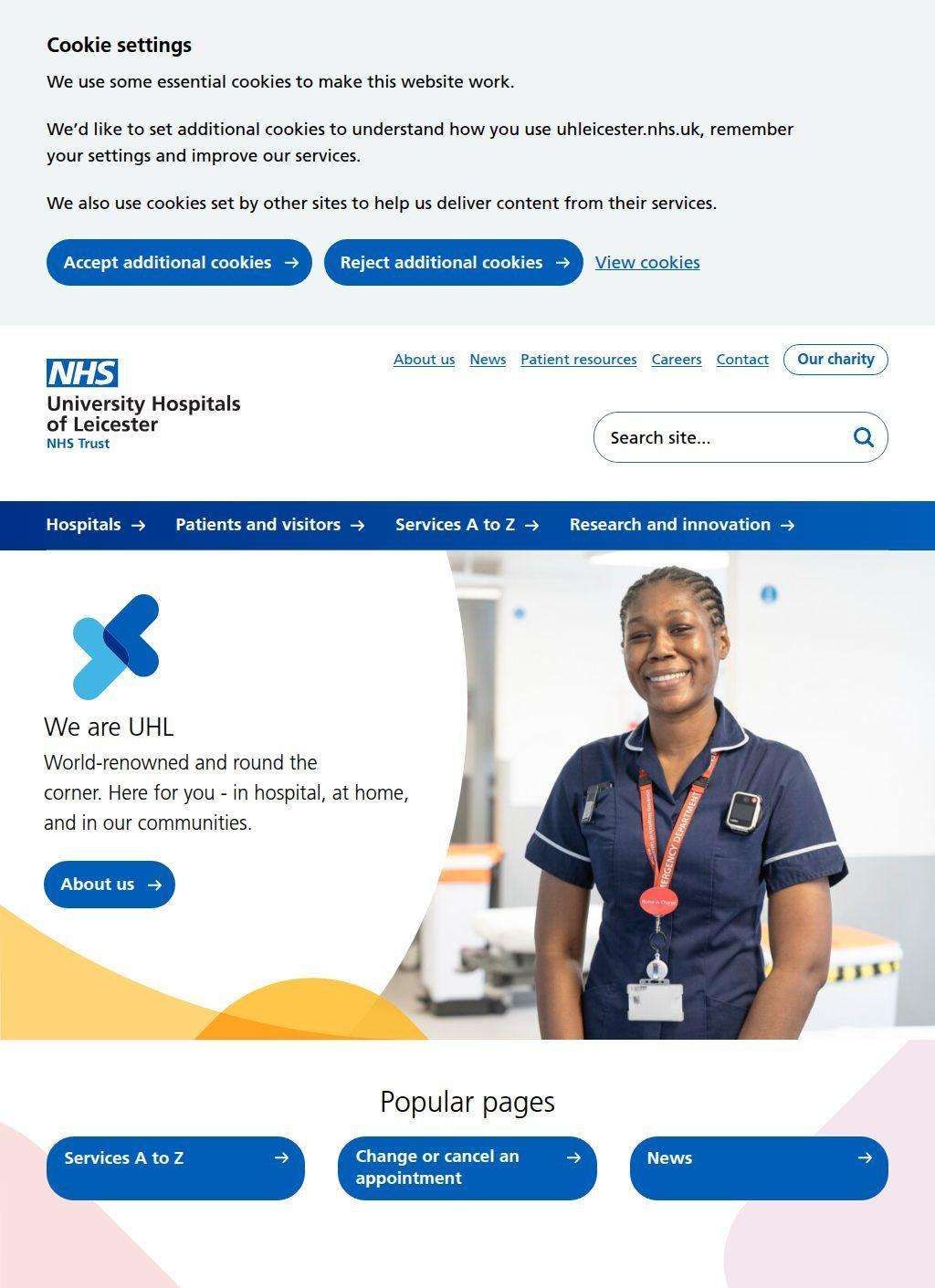
Running acute hospital care across Leicester, Leicestershire and Rutland, University Hospitals of Leicester NHS Trust operates three large sites: Leicester Royal Infirmary, Glenfield Hospital and Leicester General Hospital, with seven community hospitals extending care through the surrounding county. That footprint answers to a catchment of roughly a million people and takes regional and national specialist referrals on top of the local load. Getting the scale of the organisation clear from the start is the only way to judge a website against what it is genuinely trying to do, which is a great deal.
Services directory across clinical specialties
What the site does well is treat itself as a working tool. The Services A to Z is the centre of gravity, and it is long because the clinical range is wide. University Hospitals of Leicester NHS Trust lists emergency and trauma care alongside cardiology and cardiac surgery, respiratory medicine, oncology, renal services and neurosciences. Maternity and midwifery sit next to neonatal care and paediatrics. Ophthalmology, including ophthalmic genetics, orthopaedics, vascular surgery, gastroenterology, diabetes and endocrinology, and a mental health liaison service all get their own entries. A directory that granular is genuinely useful to a patient who has been handed a referral letter and wants to read about the department before the appointment.
Appointment management and visitor information
Around that clinical core, the practical sections are where a returning visitor will spend most time. Appointment management, patient information resources and visitor guidance form the unglamorous trio that a hospital website lives or dies by. Someone visiting a relative needs ward and parking information at speed; someone with a letter needs to know what to bring and how to change a date. University Hospitals of Leicester NHS Trust puts those things where they can be found, which is more than can be said for a fair number of public-sector sites that bury the basics under news carousels.
Keeping hundreds of entries current
This is the doubt worth sitting with. An organisation this large is in constant flux: departments move buildings, services consolidate, waiting times shift, and a single page that has gone stale can send a worried patient to the wrong entrance on the wrong day. A Services A to Z is only as good as its last update, and from outside you cannot see how tightly each of those hundreds of entries is maintained. The breadth described above is a strength on the day it is right and a liability on the day it is not. University Hospitals of Leicester NHS Trust carries that tension openly by publishing the A to Z at all; the alternative would be a sparse site that conceals nothing because it promises nothing.
Teaching partnerships and research updates
There is also the teaching and research dimension, which the site carries through its news and research updates and its staff and careers sections. University Hospitals of Leicester NHS Trust is a major teaching partner with the University of Leicester, supporting medical education and clinical research, and that academic link is a real part of what the organisation is. The careers material reads as it should for a large employer, and the research notes give the site a pulse that a purely transactional NHS portal would lack. Whether a casual visitor needs any of that is another matter; for a prospective trainee or a clinician weighing a move, it justifies its place on the page.
Serving patients, staff and referrers together
The information architecture is broad rather than deep in places. Covering emergency care, specialist surgery, maternity, oncology and community services under one roof means the homepage has to serve patients, visitors, staff and referrers at once, and no single layout pleases all four cleanly. The trade is unavoidable for an organisation of this size, and University Hospitals of Leicester NHS Trust handles it by leaning on its A to Z and its search, not by flattening everything into a tidy top-level menu. That is the right call. It does mean a first-time visitor sometimes has to know roughly what they are looking for before the site can help them narrow down.
Plain language in patient information
On clarity, University Hospitals of Leicester NHS Trust does its job. The language across the patient information pages is plain, the visitor guidance is concrete, and the service descriptions stay short of jargon while still telling you which conditions a department treats. For an audience that is often reading under stress, that restraint is worth more than it might look from the outside. A site that reaches for clinical precision and loses plain English has failed its audience entirely; University Hospitals of Leicester NHS Trust mostly avoids that failure.
Focus on local hospital navigation
It is also worth saying that the site does not overreach. It is not trying to be a health encyclopaedia or a symptom checker, and it sensibly leaves general medical advice to national NHS resources while keeping its own pages focused on what happens at these specific hospitals. That focus keeps University Hospitals of Leicester NHS Trust useful for its actual job, which is helping the people of Leicester and the wider county navigate the three acute sites and the community hospitals attached to them. A listing in a business directory of Leicestershire institutions points here to a real and substantial public body, and this is one of the more consequential entries under the Leics heading.
Specialist services drawing national referrals
For research-minded readers, the combination of clinical breadth and the University of Leicester partnership is the part of University Hospitals of Leicester NHS Trust that rewards a deeper look. The specialist services, ophthalmic genetics being one of the more unusual, draw national referrals, and the site covers them as fully as the everyday departments. That even-handedness across common and rare services points to content written by people who know the place rather than assembled from a generic template.
University Hospitals of Leicester NHS Trust gives you a clear, comprehensive and well-organised picture of one of England's busiest acute trusts, and the tools a patient or visitor needs are present and findable. The one reservation that cannot be resolved from outside is maintenance: across a directory this size, serving services that move and change, the currency of any given page is an open variable. On the published evidence, University Hospitals of Leicester NHS Trust is a clear and substantial presence, and the site does its job more reliably than the majority of NHS portals at comparable scale.
Business address
University Hospitals of Leicester NHS Trust
Leicester Royal Infirmary, Infirmary Square,
Leicester,
Leicestershire
LE1 5WW
United Kingdom
Contact details
Phone: 0300 303 1573