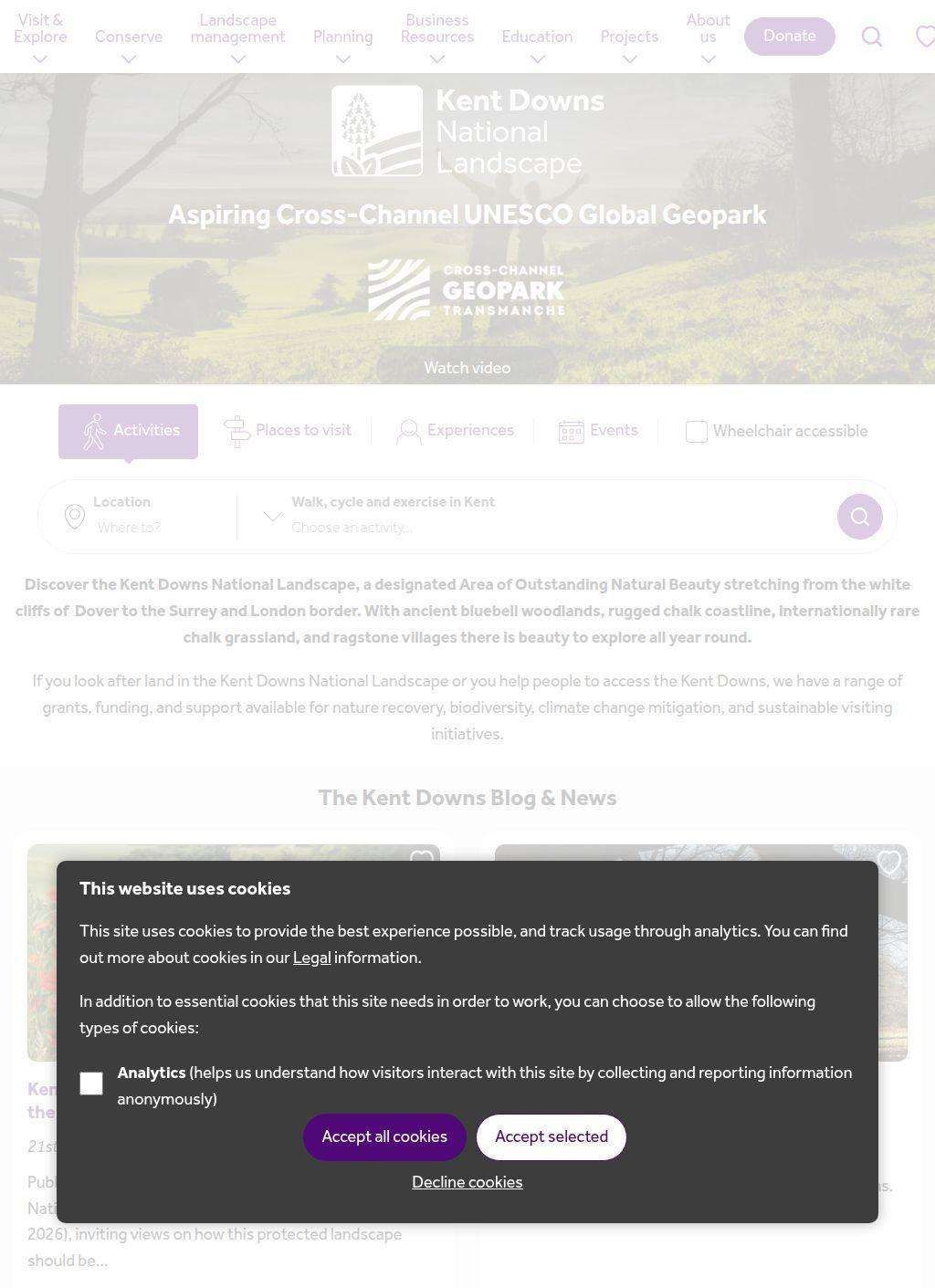
Someone planning a weekend walk between Dover and the Surrey border usually starts with a vague idea and a lot of unanswered questions: which paths are open, how long they run, whether a particular stretch suits children or needs proper boots. The site run by Kent Downs National Landscape answers that kind of question directly. It maps out walking routes and cycling paths across the protected area, and it gives the North Downs Way National Trail its own treatment, all 153 miles of it, so a person can decide whether they want a short loop or a multi-day march along the ridge.
Walking routes and trail planning
That trail is the spine of the place, and the way the area is described makes its scale clear. This runs from the white cliffs at Dover up toward London and Surrey, a designated protected area that until recently carried the older label of Area of Outstanding Natural Beauty. The rename to a National Landscape sits behind the whole site, and Kent Downs National Landscape is the body charged with looking after it. Beaches and woodland get their own visitor pages too, so the coverage extends past long-distance hiking into the smaller decisions: where to take a family for an afternoon among trees, which bit of shoreline is worth the drive.
Protected landscape designation
How many different readers the site tries to serve without losing the thread is one of its more useful qualities. A parent and a rural landowner are not looking for the same thing, and the structure of Kent Downs National Landscape reflects that split. The pages do not assume everyone arriving is a hiker, which is a trap a lot of regional sites fall into.
Resources for schools and educators
Visitors are the obvious audience, and they get the routes, the trail detail, the beach and woodland guides. But the educational side is more substantial than a tacked-on schools page. There are teaching materials, activity sheets, and guided walks aimed at schools and children, which means a teacher can pull resources for a classroom session and also book something out in the field. That combination, downloadable material plus real guided walks, is the sort of thing that takes ongoing effort to keep current.
Grant funding for landowners
Then there is a whole strand pointed at people who own or work the land. Kent Downs National Landscape runs grant funding programmes for landowners and rural businesses, with the money tied to nature recovery and sustainable tourism. A farmer weighing up a habitat project, or a small rural enterprise wondering whether there is support for greener operations, has a concrete starting point here. This is where the protected-area body acts less like a tourist board and more like a public agency, channelling funding toward outcomes that match its conservation purpose. The shift in tone between the visitor pages and the grant pages is noticeable, and it should be, because the two readers want completely different things.
Governance and partnership structure
The governance is stated plainly. The area is managed under a Joint Advisory Committee, with a wider National Landscape Partnership pulling in multiple stakeholder bodies. That structure explains the breadth: a single private operator would rarely cover trails, schools, grants, and cross-border heritage all at once, but a partnership built around a designated landscape has reason to. Kent Downs National Landscape is the public face of that arrangement, and the site reads as the work of an organisation answerable to several partners rather than to a marketing brief. Kent Downs National Landscape differs from a commercial tourism outfit in this accountability to public and environmental goals over audience metrics.
Events across heritage, wellness, food
The events and experiences section pulls the public-facing side together. It covers arts and heritage, wellness, food, and outdoor activities, which is a fairly wide spread for one calendar. A person could use it to find a guided heritage walk one month and a food-themed outdoor event the next. That breadth keeps Kent Downs National Landscape useful as a listing well beyond a single walking season, and it explains why a business directory search for activities in this part of Kent is likely to surface this site near the top.
Cross-Channel UNESCO Global Geopark
One of the more unexpected parts of the Kent Downs National Landscape site is the Cross-Channel UNESCO Global Geopark initiative, a project shared with France. It sits a little apart from the day-to-day walking and grant content, and it points to an ambition that reaches past the county line. Kent Downs National Landscape is positioning the geology and heritage of this stretch of England alongside its French counterpart. For a curious visitor it adds a layer of context to the cliffs and chalk that the rest of the site treats mainly as scenery. The chalk under your boots, it turns out, has a story that crosses the water.
Reading across all of it, the consistency of purpose is what stands out. The walking content, the school resources, the landowner grants, and the geopark work all trace back to the same job: caring for a designated landscape and helping the public, educators, and the rural economy engage with it sensibly. The Kent Downs National Landscape pages do not wander into unrelated territory or pad themselves with material that has nothing to do with that core. Everything connects back to the land itself, and the Kent Downs National Landscape remit stays clear enough that a reader always knows which part they are in.
There is a practical honesty to how the offering is laid out. A walker gets distances and a named trail to plan around. A teacher gets sheets and the option of a led walk. A landowner gets a route to funding aimed at nature recovery. The site does not promise the same experience to all of them; it gives each group its own door. That kind of segmentation, where Kent Downs National Landscape sorts its audiences instead of flattening them into one generic visitor, reflects an organisation that understands the real range of people who hold a stake in this corner of the country.
The split between visitor information and the more administrative grant and partnership content is handled without friction. A casual user looking for a Sunday walk does not have to wade through funding criteria to reach the routes, and a landowner researching a scheme can move straight to funding criteria without wading through family-day suggestions. Each kind of reader finds material pitched at their level, which is harder to pull off than it sounds when one body is responsible for tourism, education, conservation funding, and international heritage projects at the same time. Kent Downs National Landscape carries all of those duties on one site and still keeps the navigation legible.
The geopark partnership remains the detail worth dwelling on, because it reaches outside the obvious brief of a landscape body and puts this stretch of Kent into a shared frame with France. Kent Downs National Landscape treats the chalk on both coasts as one connected geology, and the page on the initiative is where that idea lands. The educational strand rewards a closer look too, since the guided walks for schools bridge the gap between a downloaded worksheet and a day spent outdoors, and that is a harder thing for any organisation to sustain than a static resource page.
Business address
Kent Downs National Landscape
The Granary, Penstock Hall Farm, Canterbury Road, East Brabourne,
Ashford,
Kent
TN25 5LL
United Kingdom
Contact details
Phone: 01303 815170