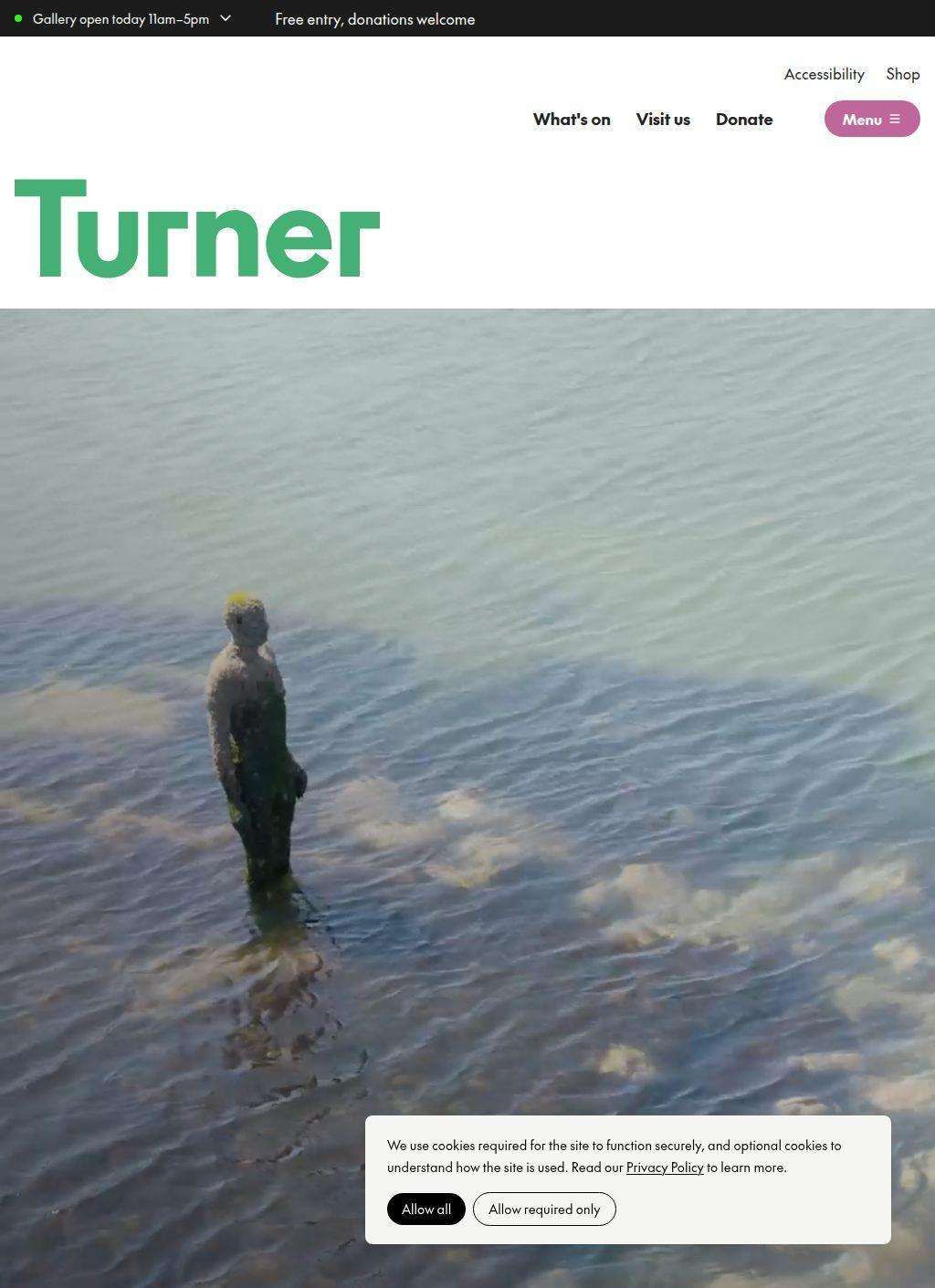
The entry is free, and that single fact reorders how you approach everything else about Turner Contemporary. Turner Contemporary sits on the Margate seafront showing international contemporary art, housed in a building by Sir David Chipperfield, and it could easily have priced itself as a destination. Instead the exhibitions rotate and cost nothing to walk into, which changes the calculation from "is this worth the ticket" to "why not drop in." That framing runs through the whole site.
What the site does well is treat Turner Contemporary as more than a set of walls with paintings on them. The exhibition and events pages carry the main billing, and they are refreshed as shows change, so the programme reads as the living centre of the place. Turner himself gives the gallery its name and a thread of history, but the emphasis on the page is squarely on current and international work, with the eighteenth-century painter kept in the background. That is a sensible editorial choice, and it keeps the focus where a working gallery wants it.
Learning programmes for families and schools
A large part of what Turner Contemporary offers sits under learning, and it is broader than the token education tab many arts venues put up. There are family activities aimed at drop-in visitors, structured workshops split between young people and adults, and a route for educational group visits that schools or other organised parties can book. The separation matters: a workshop pitched at a teenager is a different thing from one pitched at an adult hobbyist, and the site does not blur the two into a single vague "events" bucket.
Planning visits with complete information
The group-visit provision is the most telling detail, because it signals a gallery that expects to host coaches of schoolchildren and has thought about how to handle them, not one that merely tolerates the idea. Combined with the accessibility information and the getting-there guidance, the practical scaffolding around a visit is unusually complete. Someone planning a family trip or a class outing can answer most of their questions before leaving home.
Opening hours and practical details
The visitor basics at Turner Contemporary are handled plainly. Opening hours run 11am to 5pm from Tuesday to Sunday and on bank holidays, the accessibility notes are given their own space, and there is a mailing list for anyone who wants to know when a new exhibition opens. None of this is glamorous, and that is the point. It is the connective tissue that turns a good exhibition into an easy afternoon.
Revenue streams beyond exhibitions
Two strands push the site beyond the usual gallery remit, and they are worth weighing carefully because they change what Turner Contemporary is for. The first is venue hire. The building is offered for weddings, private events, corporate experiences, and brand activations, which is a frank acknowledgement that a Chipperfield structure on the coast is a commercial asset as much as a cultural one. Some visitors will find that mixing of purposes slightly jarring; others will see it as the pragmatic way a free-entry gallery keeps the lights on. Both readings are fair, and the site does not hide the commercial side.
Evening dining and music at Louie On Sea
The second strand is Louie On Sea, the on-site cafe, and it is more ambitious than a counter selling flat whites. It runs daytime dining, then shifts in the evening to chef residencies, aperitivo, and music events. That evening programme effectively gives Turner Contemporary a second life after the art has closed for the day, and it is the kind of thing that could pull in people who would not otherwise think of a gallery as a night out. Whether the residencies live up to the billing is not something the page can prove, but the intent is clearly to make the building work past 5pm.
Then there is the Turner Contemporary shop, which operates both on site and online. Alongside the expected merchandise it sells "Turner Editions" art prints, which is a neater proposition than fridge magnets and tote bags: a way to take a piece of the gallery's sensibility home without the price of an original. For a free venue, the shop and the cafe are the obvious ways revenue flows back in, and the site is upfront about all of it. The prints in particular are a smart move, because they carry the gallery's taste into a buyer's home at a price an ordinary visitor might reach, and they keep a thread running between what hangs on the wall and what leaves in a bag.
The one genuine tension in the whole proposition is that spread. A gallery that also hires itself out for brand activations, runs a chef-residency supper club, and pushes a print shop is doing a lot at once, and there is a version of that where the core mission of Turner Contemporary gets crowded out. There is nothing on the site to indicate that has happened, and the exhibition programme still holds the top of the hierarchy, but it is the thing worth keeping an eye on across a few visits. Breadth can be a strength or a dilution depending on how the balance holds.
The site itself carries no visitor reviews, and there is no rating widget anywhere on it. A general search turns up plenty of independent commentary on Google and TripAdvisor, the kind of volume you would expect for a coastal gallery with a Chipperfield building behind it, though none of that sits on the official pages themselves and none of it is quoted back at visitors.
For anyone weighing a trip, the verdict lands on the warm side of measured. Turner Contemporary offers real substance: rotating international shows at no cost, a learning programme with actual structure, complete visitor logistics, and enough food-and-retail around the edges to fill a whole day rather than an hour. The commercial layers are visible and, to some tastes, a little busy, and the gallery is clearly betting that a mix of art, dining, and hire keeps a free institution solvent. If that bet pays off in the quality of the exhibitions, and the site gives every reason to think the shows remain the priority, then this is one of the more considered art destinations on the Kent coast, and the fact that Turner Contemporary asks nothing at the door only sharpens the case for going.
Business address
Turner Contemporary
Rendezvous,
Margate,
Kent
CT9 1HG
United Kingdom
Contact details
Phone: 01843 233000