Kent County Council is the upper-tier local authority for most of the county, and its work touches almost everyone who lives in or passes through Kent. From its base at County Hall in Maidstone, the council is responsible for the services that a county of well over a million and a half residents depends on every day: schools and education, adult and children's social care, the highways network, libraries, waste disposal, public health, trading standards and a long list of other statutory functions. It is one of the largest local authorities in England by population, and the scale of what it does is matched by the size of its budget and workforce.
District and borough councils
The relationship between the county council and the district and borough councils underneath it is worth understanding before anyone contacts the wrong office. Kent operates a two-tier system across most of its area. The twelve district and borough councils, such as Canterbury, Maidstone, Ashford and Thanet, handle things like bin collections, planning applications, council tax billing and local housing.
Kent County Council sits above them and looks after the bigger, county-wide functions. Medway, by contrast, is a unitary authority and is not part of Kent County Council at all, which trips up a fair number of people who assume the county boundary and the council boundary are the same thing. Anyone using this business directory to find the right point of contact should keep that split in mind, because the council's switchboard cannot resolve a missed refuse collection that belongs to a district authority.
Education services
Education is one of the council's most visible responsibilities. It coordinates admissions for state schools across the county, manages the school transport network, and oversees support for children with special educational needs and disabilities through its SEND service. Kent retains a selective grammar school system, which makes the eleven-plus testing arrangements a significant part of the council's annual calendar and a topic that generates a steady stream of enquiries from parents. The council also runs adult education and a range of early-years and family support programmes. For families moving into the area, the education pages on kent.gov.uk are usually the first port of call, and the site carries the published admissions criteria, term dates and appeals guidance.
Social care and children's services
Adult social care and children's services together account for a very large share of the council's spending. The authority commissions and, in some cases, directly provides care for older people, people with disabilities and adults with mental health needs, alongside safeguarding work for vulnerable children. These are demand-led services, and like most county councils in England, Kent has spent recent years managing rising costs against tight settlements from central government. That financial pressure is no secret; the council's own budget consultations and cabinet papers set out the choices it has had to make, and residents who follow local affairs will be familiar with the recurring debate about how to fund care without cutting other services.
Highways and transport
The highways function is another area where the council's work is felt directly. Kent County Council maintains thousands of miles of road, from rural lanes to the busy corridors that feed the Channel ports at Dover and the Eurotunnel terminal at Folkestone. It is responsible for street lighting, gritting in winter, pothole repairs and the coordination of roadworks. Kent's position as the gateway between Britain and the continent gives this work an unusual edge. When cross-Channel traffic backs up, the county becomes the holding area for lorries, and schemes such as Operation Brock, the contraflow system on the M20, involve the council alongside National Highways, Kent Police and the Port of Dover. Residents can report road faults online, and the site offers a map-based reporting tool that has become the standard way of logging a problem.
How do I find information on the website?
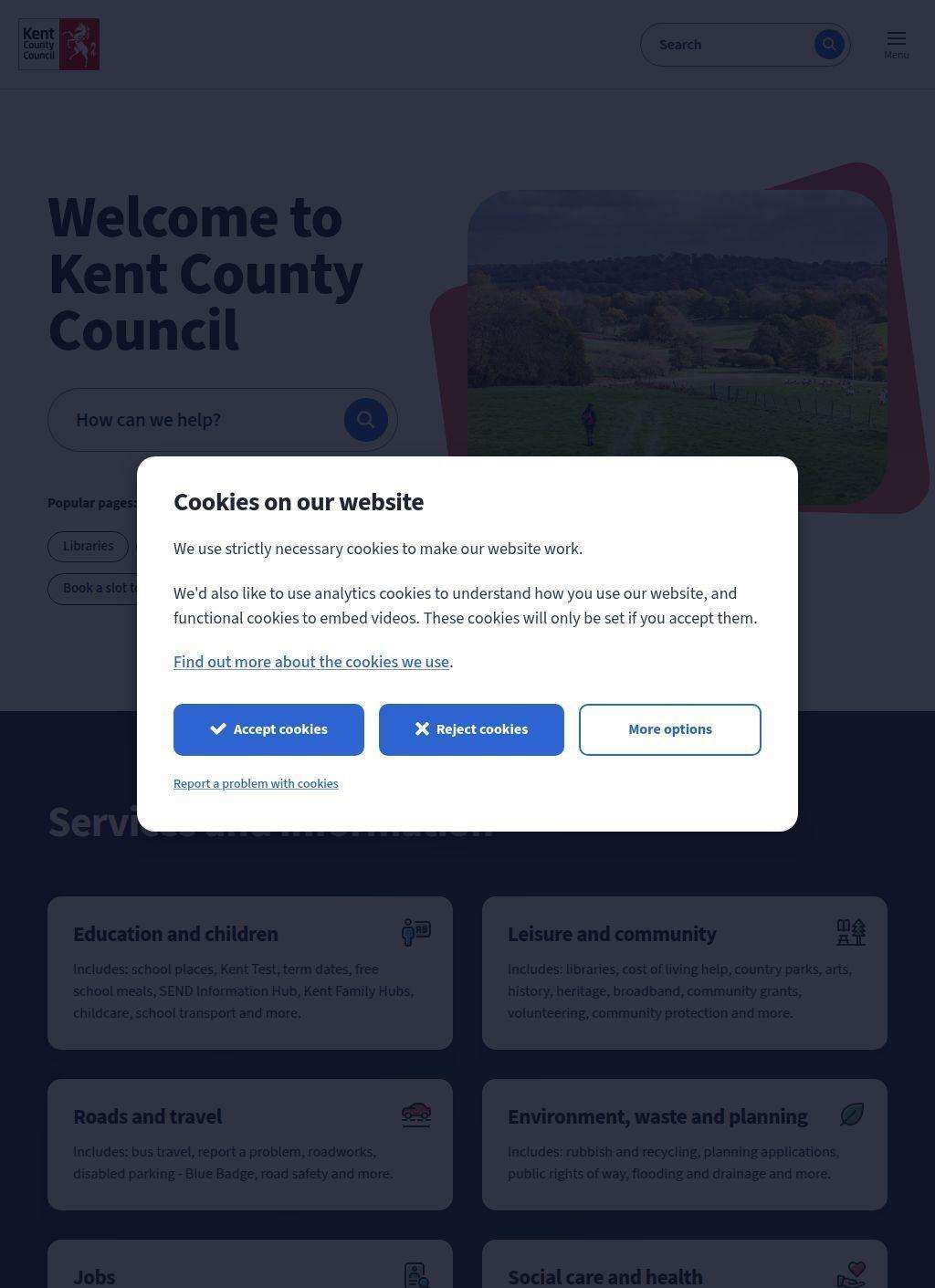
The council's website is genuinely large, and that is both a strength and a mild frustration. It holds an enormous amount of information, from the register of public rights of way to school performance data, library catalogues, planning policy for minerals and waste, and the full record of council and committee meetings. The democracy section publishes agendas, minutes and webcasts, which makes the authority's decision-making reasonably easy to follow for anyone who wants to. The flip side is that finding a specific form or service can take a few clicks more than expected, and the search function does not always surface the most relevant page first. Most people find that going through the main service categories on the homepage is more reliable than searching by keyword.
Libraries, registration services and archives sit within the council's remit too. Kent runs a network of public libraries along with the Kent History and Library Centre in Maidstone, which holds the county's archives and is a serious resource for local historians and genealogists. The registration service handles births, deaths, marriages and civil partnerships, and ceremonies can be booked at register offices and approved venues across the county. These are the kinds of everyday transactions that bring ordinary residents into contact with the council, and they are mostly bookable online now, though phone support remains available for those who prefer it.
Public health became a county council responsibility some years ago, and Kent's team works on areas such as smoking cessation, sexual health services, drug and alcohol support, and health visiting for young children. The council also has a role in emergency planning and resilience, coordinating the local response to flooding, severe weather and other incidents through the Kent Resilience Forum. Given the county's long coastline and its exposure to cross-Channel disruption, this is not a token function.
The council is run by elected county councillors, with elections held every four years across electoral divisions covering the whole county. Day-to-day decisions rest with a cabinet drawn from the majority group, while scrutiny committees, a planning applications committee and other bodies provide checks and handle specific functions. The political control of Kent has shifted at the ballot box like any other authority, and the balance of the chamber affects the council's priorities and spending choices.
For residents who want to raise an issue, the starting point is usually their local county councillor, whose details and surgery arrangements are published on the democracy pages of the website alongside the record of how each member has voted and which committees they sit on. This level of openness is a requirement of local government, but the way each council presents it varies, and Kent's webcasting and published papers make its proceedings reasonably accessible.
For businesses, the council offers procurement opportunities, trading standards advice and economic development support, and several of these strands are relevant to anyone listing themselves in a business directory aimed at the county. Suppliers can register to bid for council contracts, and the trading standards service handles consumer protection, weights and measures, and action against rogue traders. The council has also been involved in major infrastructure and regeneration programmes, working with partners on housing growth, transport schemes and the economic implications of the county's port and freight role. Its economic development arm has supported skills initiatives and inward investment, recognising that the county's proximity to London and the continent gives it a particular position in the wider regional economy.
Contacting the council is straightforward in principle. The main customer service line is 03000 41 41 41, and County Hall sits on the Sessions House site in Maidstone at ME14 1XQ, a short distance from Maidstone East railway station. Many services now push residents towards online forms and self-service accounts first, which is efficient for routine matters but can feel impersonal for anything complicated. The honest assessment is that Kent County Council does what a large county authority is meant to do, across a county with unusual geography and real financial constraints, and its website is the practical entry point for almost all of it.
Business address
Kent County Council
County Hall, Sessions House,
Maidstone,
Kent
ME14 1XQ
United Kingdom
Contact details
Phone: 03000 41 41 41