East Kent Hospitals University NHS Foundation Trust is the acute hospital provider for the eastern half of the county, serving a population of around seven hundred thousand people across an area that runs from Ashford out to the coast at Thanet, Dover and Folkestone. It is one of the larger acute trusts in England and runs services from several hospital sites, the principal ones being the William Harvey Hospital in Ashford, the Queen Elizabeth The Queen Mother Hospital, usually shortened to the QEQM, in Margate, and the Kent and Canterbury Hospital in Canterbury, which is also the location of the trust's headquarters.
Hospital sites across east Kent
The split of services across these sites reflects a model that the trust has developed over years, where some specialties are concentrated at one hospital rather than duplicated everywhere. The William Harvey in Ashford has the major emergency department and is the centre for several specialist services, including a hyper-acute stroke unit and the trust's main maternity and neonatal provision. The QEQM in Margate also has an emergency department and serves the densely populated and relatively deprived communities of Thanet. The Kent and Canterbury Hospital, despite no longer having a full accident and emergency department in the way it once did, remains an important site for planned care, day surgery, renal services and outpatient work, and it houses the trust's administrative base on Ethelbert Road.
Education, training and research
The "University" in the trust's name signals its role in education and training. It is a teaching trust, working with the universities in the region to train doctors, nurses and other health professionals, and it has links to the Kent and Medway Medical School. Clinical research is part of its activity too, with patients in east Kent able to take part in trials and studies. For a trust covering a large rural and coastal area, the ability to attract and retain clinical staff is a constant theme, and recruitment is a recurring item in its board papers.
Maternity services investigation
It would not be honest to describe this trust without acknowledging the serious problems it has faced, particularly in maternity care. An independent investigation led by Dr Bill Kirkup, published in 2022, examined maternity and neonatal services at the trust and found a pattern of failures over a period of years, concluding that a number of baby deaths might have been avoided with better care.
The report was a landmark in NHS patient safety and led to a national response as well as a programme of change within the trust. East Kent Hospitals has since been working to rebuild its maternity services and its wider safety culture, and its progress has been monitored closely by regulators including the Care Quality Commission. Anyone forming a view of the trust should read that history alongside its current improvement work; it is a significant part of the picture and the trust itself does not hide from it.
Accessing information online
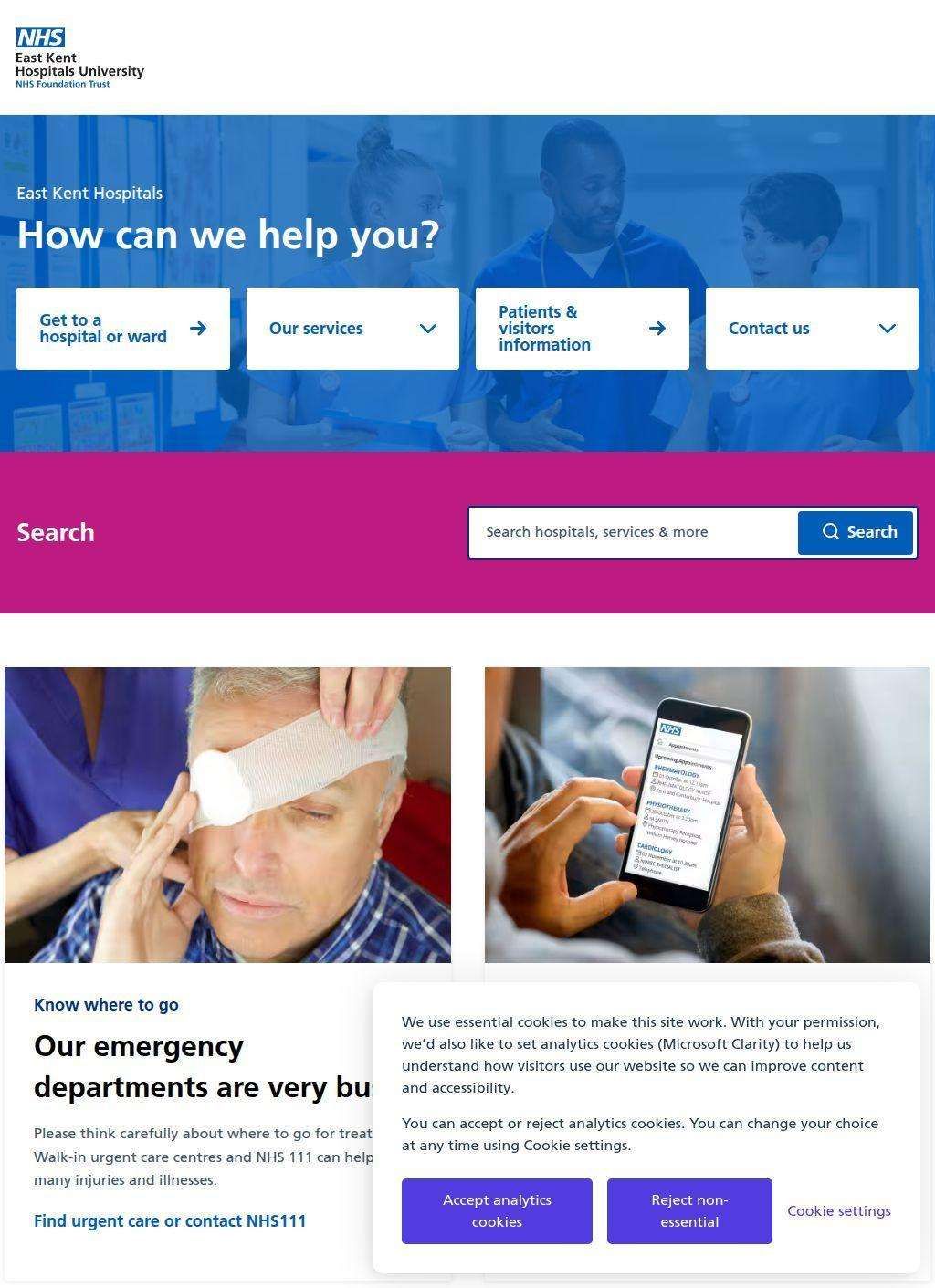
For patients and the public, the trust's website is the practical front door to a large organisation. It carries information on each hospital, departmental pages, visiting arrangements, guidance on outpatient appointments, and details of how to access services. There are pages explaining how to give feedback or make a complaint through the Patient Advice and Liaison Service, how to request medical records, and how to find a ward. The site also publishes the trust's board papers, annual reports and quality accounts, which is where the detail of its performance, finances and improvement plans can be found by anyone who wants to look. As is common with large NHS sites, the volume of information is high, and finding a specific phone number for a particular clinic sometimes takes a little patience.
Emergency and specialist services
The trust operates the usual range of acute services: emergency and urgent care, general and specialist surgery, medicine, cancer services, diagnostics, maternity and children's services, and a large outpatient operation. Like every acute provider in England, it works against national targets for emergency department waiting times, planned treatment waits and cancer pathways, and like most trusts it has struggled at times to meet them in the face of high demand and the pressures that built up across the health service in recent years. Its published performance data is the fairest source for how it is doing on any given measure at any given time.
Geography and service configuration
Geography shapes a lot of what this trust does. East Kent is a mix of market towns, coastal communities and rural villages, and parts of it, especially Thanet, have significant levels of deprivation and associated health needs. The distances involved mean that ambulance journeys and patient transport are real considerations, and the configuration of emergency services across the William Harvey and the QEQM has been the subject of long-running public debate, with proposals to reorganise acute services attracting strong local feeling. The trust does not make these decisions in isolation; they sit within wider NHS planning for Kent and Medway, but they affect its sites directly.
The trust does not sit alone in the local health system. It works within the Kent and Medway Integrated Care System, the partnership of NHS organisations, councils and other bodies that plans and joins up health and care across the wider area. Patients move between the acute hospitals, GP practices, community health services and mental health provision, and increasingly the emphasis across the NHS has been on keeping people well at home and out of hospital where that is the right thing.
For an acute trust covering a large area with an older-than-average population in parts, the pressure on beds and on the emergency front door is a constant, and the way the trust works with social care and community services to discharge patients safely is a recurring theme in its planning. The Kent and Canterbury Hospital's role has been reshaped over the years as part of this wider thinking about where different kinds of care are best delivered.
On the patient-facing side, the trust offers a range of ways to engage beyond turning up for an appointment. Outpatient bookings, test results and some correspondence are increasingly handled digitally, and the trust has been adopting electronic systems for records and appointments in line with the rest of the NHS. There is a chaplaincy and bereavement service, support for carers, and volunteer programmes that put people on wards and in public areas to help patients and visitors find their way around large, sometimes confusing hospital sites. The website explains how to access interpreting services, how to give consent and how to raise a concern, and it carries patient information leaflets for many common procedures and conditions.
For families travelling some distance, practical details such as parking, public transport and ward visiting times are set out for each hospital, which matters in a rural county where a hospital visit can mean a long journey. People who reach the trust through a business directory rather than a search engine at least arrive at the verified official site, which reduces the risk of being misdirected by outdated third-party listings.
For staff and prospective staff, the trust is one of the largest employers in east Kent, with many thousands of people on its payroll across clinical and non-clinical roles. Its website carries a careers section, and it runs apprenticeships and training routes alongside professional recruitment. For local businesses and suppliers, the trust is also a substantial purchaser of goods and services, and procurement information is available through NHS channels. Listing the trust in a business directory helps patients, carers and partner organisations find the official source of information rather than relying on third-party pages that may be out of date.
The headquarters and switchboard sit at the Kent and Canterbury Hospital, Ethelbert Road, Canterbury, CT1 3NG, and the main switchboard number is 01227 766877, with each of the other hospitals also having its own direct switchboard. The trust is a large, complex organisation that has been through a genuinely difficult period and is working publicly to put things right, while continuing to deliver the day-to-day acute care that a large slice of the Kent population relies on. Its website is the authoritative starting point for patients, families and anyone needing to make contact, and it is kept reasonably current.
Business address
East Kent Hospitals University NHS Foundation Trust
Kent and Canterbury Hospital, Ethelbert Road,
Canterbury,
Kent
CT1 3NG
United Kingdom
Contact details
Phone: 01227 766877