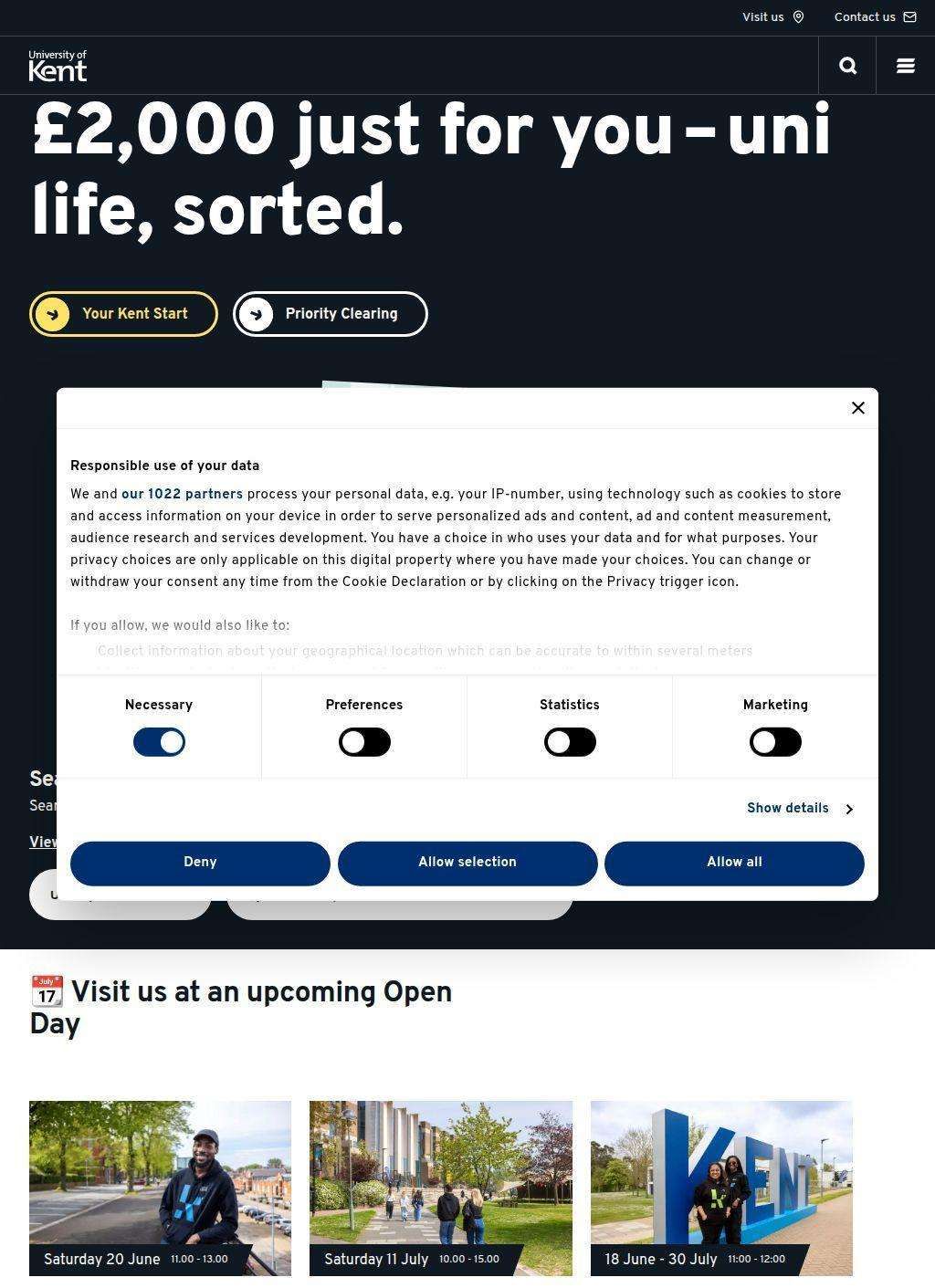
Founded in 1965, the University of Kent sits in Canterbury, in south-east England, with a second campus at Medway. It belongs to the generation of British universities built that decade, and its scale is what you would expect from that origin: ten academic schools, degrees from first-year undergraduate through to doctoral research, and a website designed to move a prospective student from a vague interest to a specific course page without too many dead ends.
Ten academic schools spanning sciences and humanities
Those ten schools span a genuine breadth. Computing; Engineering, Mathematics and Physics; Arts and Architecture; Psychology; Economics, Politics and International Relations; Social Sciences; Law; Humanities; Business; and Natural Sciences. Reading that list tells you something the University of Kent does not need to spell out: the place is built to hold both the sciences and the humanities at the same time, with professional disciplines like law and business alongside the more theoretical ends. A physics student and an architecture student both have a home here, and neither faculty looks like an afterthought.
Searching the course catalogue by UCAS code
The course catalogue can be searched three ways: by name, by subject, or by UCAS code. That third option is the clearest sign that University of Kent built this for people already inside the British admissions process. UCAS codes are the short identifiers applicants carry once they are deep into applications, and typing one in to land on the right page cuts out a real amount of digging. The catalogue covers taught undergraduate and postgraduate degrees, research degrees including the MRes and PhD, and professional programmes, so a school-leaver and a mid-career researcher use the same search box.
Funding and admissions routes for new students
Money gets addressed early, which makes sense given how much it shapes the decision. New students are offered a welcome grant called "Your Kent Start", worth 2,000 pounds, stated plainly enough that an applicant can factor it in without hunting through small print. Admissions splits into two routes: the standard UCAS application most people will use, and Priority Clearing for those applying late or scrambling after results day. Naming Clearing as a deliberate pathway rather than hiding it is a small honesty that students under time pressure will notice.
Reshaping teaching through the Kent 2030 programme
Reading the site, it is apparent that the University of Kent is in the middle of reshaping how it operates. A programme called "Kent 2030", described as Education Modernisation, is updating module structures and term dates. Module structure and term length shape daily life during a degree as much as the subject does, so putting that reform on the public site instead of treating it as internal administration lets an applicant ask better questions about what three or four years will look like in practice.
Research at the University of Kent is organised around specialist institutes pointed at regional, national, and international problems. For a prospective PhD student or a researcher choosing where to land, that institute structure is the more telling thing than any general claim about excellence, because it shows how work is grouped and what it is aimed at. The University of Kent uses this structure as the spine of its research identity, and it comes across as more purposeful than a generic "world-class research" line would.
Regional partnerships across industry sectors
The partnerships give the University of Kent a recognisable position in its corner of the country. Growing Kent and Medway, Creative Estuary, the Kent and Medway School, Eastern Arc, and the Universities of Medway consortium all appear on the site, and together they describe a university tied into its region across agriculture, the creative economy, and a shared higher-education footprint with neighbouring institutions. Eastern Arc is a research collaboration among several universities, and its presence indicates that the University of Kent does not see itself as working in isolation from its peers. These connections matter in practical terms: placements, joint projects, and a route into local industry that a more inward-looking campus cannot offer as easily.
Comparing Canterbury with Medway
Canterbury is the main site, larger and the one most people picture when they think of the University of Kent. Medway is smaller and described as close-knit, which is a fair shorthand for the trade-off any applicant should weigh. A bigger campus has more on it; a tighter community means the same faces recur. University of Kent presents neither as the obviously better choice, and that even-handedness is sensible because the answer depends entirely on the student.
The institution describes itself as "the university of ambition" and puts an explicit focus on community diversity. Slogans like that are easy to dismiss, and on their own they do not mean much. What gives it some footing here is that the rest of the site backs it with specifics: the breadth of the schools, the financial grant for new students, the Clearing route for those who need it, the regional partnerships that widen what a degree can lead to. The diversity focus reads as a stated intention more than a measured outcome, and a prospective student would be right to look past the wording to the lived experience on each campus.
Taken together, the University of Kent presents itself as a full-service research university with a clear regional identity and a site organised around the questions applicants ask most: what to study, how to get in, what it will cost, and where the work might lead. The Kent 2030 reforms add a note of motion, because the University of Kent is openly reshaping its teaching structure and not simply administering the status quo. For someone choosing between mid-sized British universities, the campuses are likely the deciding factor, and the University of Kent makes the contrast between Canterbury and Medway clear enough that the shape of the choice begins to form well before any campus visit.
Business address
University of Kent
The Registry, Canterbury campus,
Canterbury,
Kent
CT2 7NZ
United Kingdom
Contact details
Phone: 01227 764000