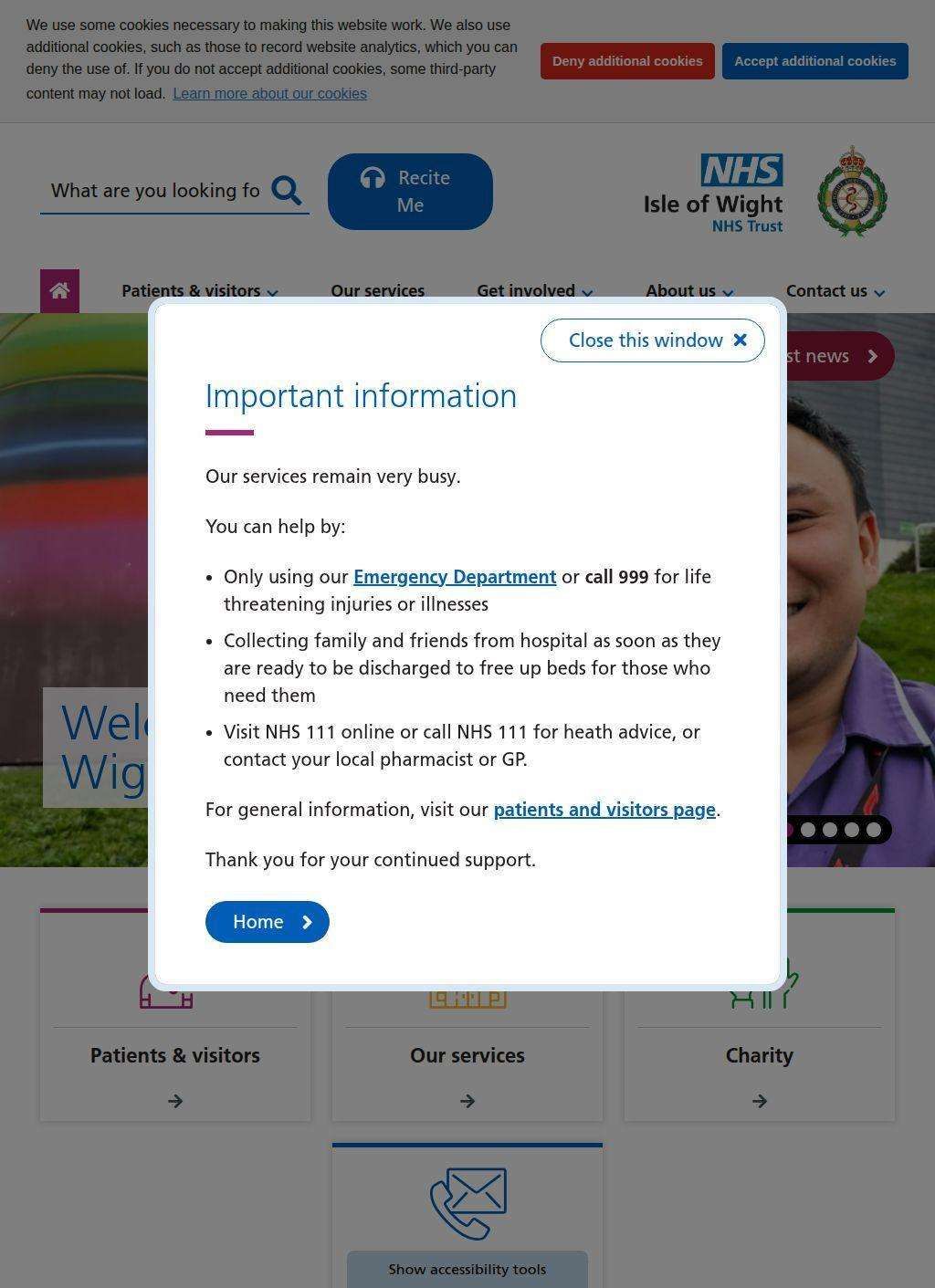
Isle of Wight NHS Trust is the NHS body responsible for acute hospital and ambulance services for the roughly 140,000 people who live on the Isle of Wight. Because the island sits off the mainland, with the practical barrier of a ferry crossing between residents and the teaching hospitals around Portsmouth and Southampton, that geography shapes what the trust has to cover and how its website is built. The site is patient-facing first and administrative second, and the structure makes that clear within a few clicks.
Core services at St Mary's Hospital
The clinical centre of gravity is St Mary's Hospital in Newport, which is where most of the activity described on the site lands. There is an Emergency Department, a range of outpatient clinics, and routine diagnostics including blood tests and a Community Diagnostic Centre. Isle of Wight NHS Trust does not bury any of this. It walks through how to access each service: what an appointment letter means, where to go for a blood test, what the diagnostic centre is for. For an organisation whose users are often anxious, unwell, or arranging care for a relative, that plainness is worth more than a slicker design would be.
Choosing between 999 and NHS 111
A useful thread running through the site is the split between urgent and non-urgent care, and the pages handle it without making the reader guess. Life-threatening emergencies point to 999, and the ambulance service is part of what Isle of Wight NHS Trust itself operates, which is unusual. It means the same organisation that answers the emergency call also runs the hospital it brings you to. For everything below that threshold, the site routes people to NHS 111 and to appointment guidance. I found the 999-versus-111 framing genuinely clear, the sort of distinction that other health sites tend to muddle. On an island where the nearest alternative hospital is a boat ride away, knowing which number to call has real consequences in a way it simply does not in a city with three A and E departments within driving distance.
From full remit to acute focus
One thing the site is honest about, and a reader needs to understand before relying on it, is that the trust's scope has narrowed. Community services, mental health, and learning disabilities services have moved to the Hampshire and Isle of Wight Healthcare NHS Foundation Trust. So Isle of Wight NHS Trust today is focused on acute hospital functions and the ambulance service, not the full spread of island healthcare its name might once have implied. The site reflects that reorganisation rather than pretending nothing changed, which matters when someone is trying to work out who is now responsible for a particular service.
That transfer is the kind of structural detail people miss and then waste time on. A resident searching for community nursing or a mental health referral will not find their answer at Isle of Wight NHS Trust anymore, and the site is reasonably upfront about pointing that work elsewhere. It would be easy for a public body to leave stale pages up after a handover. The clearer signposting here saves a caller from being bounced between switchboards.
Alongside the service narrowing, Isle of Wight NHS Trust shares an executive leadership structure with Portsmouth Hospitals University NHS Trust. The two run a joined-up senior team. For a patient this is mostly background, but it does explain how a relatively small island trust keeps access to the clinical and managerial depth of a much larger mainland teaching hospital. Pathways that need specialist mainland care become easier to understand once you know the two organisations are administratively close.
Reaching the Patient Advice and Liaison Service
The Patient Advice and Liaison Service, PALS, gets its own presence on the site, and that is a meaningful inclusion. PALS is where someone goes when they have a concern, a question that the clinical team has not answered, or a complaint they are not sure how to raise. Putting it within easy reach shows that Isle of Wight NHS Trust expects to field those queries and has a route ready for them. Plenty of organisations treat feedback as something buried three menus deep, so a visible PALS section reflects a genuine commitment.
The appointment guidance is the workhorse content. It explains what to do when a letter arrives, how to prepare, and what the various clinics involve. None of it is glamorous, and that is the point. A health site proves its usefulness by answering the dull, specific question a worried person has at ten at night, and the pages here lean toward that kind of literal instruction over reassurance for its own sake. The diagnostic content sits in the same register: here is what a Community Diagnostic Centre does, here is how a blood test works, here is where to turn up.
Gaps in clinical depth beyond access
Where the site is less expansive is in clinical depth beyond the access pathways. Isle of Wight NHS Trust tells you how to reach a service and what number to call, and it does that competently, but it is not as detailed on the specifics of individual specialties or what to expect once you are inside a clinic. For an island population that depends on this one acute trust, more granular condition-by-condition information would strengthen the resource. That is an expansion the trust could make, not a flaw in what is already there.
Public accountability through CQC records
In terms of public accountability, Isle of Wight NHS Trust has a CQC profile and appears in NHS England reporting. The NHS Friends and Family data is the main source of patient sentiment at scale; independent review platforms do not aggregate NHS trust feedback the way they do for private providers, so the absence of a Google review count is not itself informative. What the CQC inspection record shows is worth checking directly if you want a formal quality snapshot.
Set against all of that, the picture Isle of Wight NHS Trust presents is consistent. Isle of Wight NHS Trust presents itself as an acute and ambulance provider, scoped to St Mary's and emergency response, with the community and mental health work handed on and clearly marked as such. There is no overreach in how the site describes itself, no claiming of services that have moved away, and the information is organised around what a patient needs to do next. The ambulance service sitting inside the same trust as the hospital is the detail a mainland reader is most likely to overlook, and it is genuinely the thing that makes Isle of Wight NHS Trust structurally unlike most English NHS trusts.
Business address
Isle of Wight NHS Trust
St Mary's Hospital, Parkhurst Road,
Newport,
Isle of Wight
PO30 5TG
United Kingdom
Contact details
Phone: 01983 822099