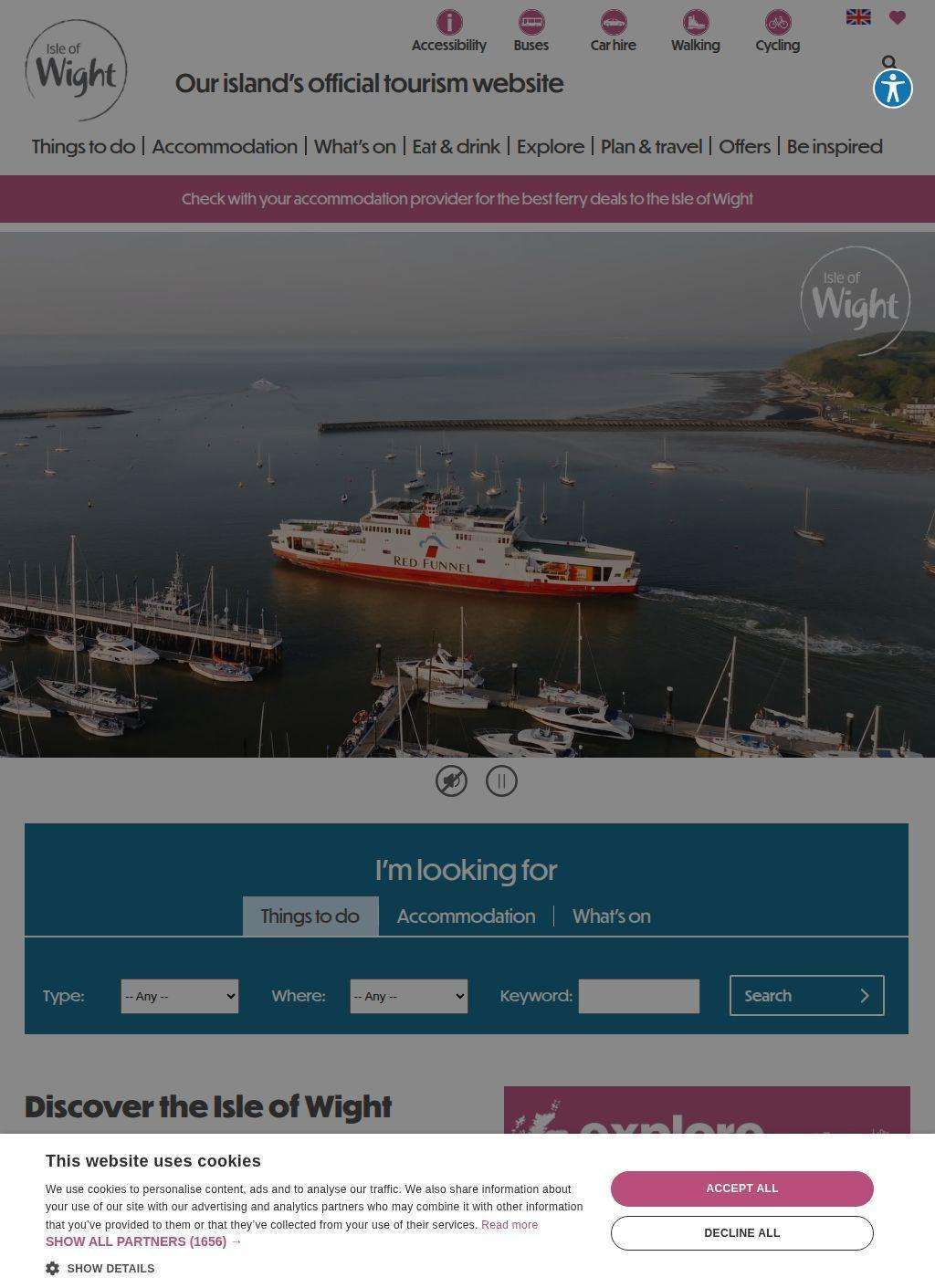
You can plan an entire Isle of Wight holiday from one place without opening a separate booking site for the crossing, because Visit Isle of Wight puts the ferry and hovercraft logistics right alongside everything you would do once you arrive. That ordering tells you who built it and for whom. The island sits off the south coast of England, reachable only by water, so the practical question for most visitors is not what to see but how to get there and back without fuss. Visit Isle of Wight answers that early, then moves on to the holiday itself.
Getting to the island by ferry or hovercraft
The travel section is more thorough than a typical destination guide bothers to be. Ferry and hovercraft booking information is there, as you would expect, but so are car hire details, a guide to EV charging points across the island, and route information for buses, walking, and cycling. That last grouping is useful for anyone weighing whether to bring a car at all. An island this size rewards people who want to leave the vehicle behind, and the cycling and walking route coverage shows that Visit Isle of Wight understands its own geography. The EV charging guide is a small touch that dates the site as something actively maintained, not left to gather dust.
Where to stay across multiple accommodation types
Accommodation is where the breadth shows. Listings cover hotels, bed and breakfasts, self-catering cottages, holiday parks, glamping, and stays Visit Isle of Wight files under unique, which usually means a lighthouse keeper's cottage or a converted something or other. Ferry discount partnerships are noted against some of these, which is a genuinely useful piece of information to surface at the point of choosing where to sleep, since the crossing cost is a real line item for a family. A traveller comparing a self-catering cottage against a holiday park can see the lodging and the travel saving in roughly the same view, and that integration is the sort of thing destination management organisations are supposed to do and often fail at.
What there is to do gets proportional treatment. Beaches, walking trails, and cycling routes anchor the outdoors side, which suits an island that draws people for its coastline and countryside. Theme parks and wildlife sanctuaries cover families with younger children. Heritage and cultural sites round it out for visitors who want more than a beach day. The categories map to how people actually decide a trip: some want to be on the sand, some want a day out the kids will remember, some want an old house or a museum. Visit Isle of Wight does not pretend the island is all one thing.
Planning activities and events throughout the year
The events calendar is a real asset, and it draws people to the island on purpose, not by accident. The Isle of Wight Festival is the obvious headliner, a music event with national pull, and the Garlic Festival sits at the other end of the scale as a quirky, distinctly local draw. Between those two poles the calendar fills out with the annual fixtures that give a return visitor a reason to time a trip. A festival calendar is only as good as its currency, and an organisation with a tourism mandate has every incentive to keep this one accurate, which is more than you can say for the scattered events pages a casual traveller might otherwise stumble across.
Eating gets its own listings, split across restaurants, pubs, and cafes, which is the right level of granularity. Nobody plans a holiday around a single dinner, but knowing the pub scene exists and can be filtered helps fill the gaps between the headline activities. The dining section reads as a directory of genuine options rather than a token gesture, and it sits naturally next to the accommodation and attractions so a day can be assembled in one sitting. Visit Isle of Wight keeps these categories adjacent in a way that a general travel aggregator would not bother to do.
From itinerary tools to multi-criteria search filters
The tools are where Visit Isle of Wight works hardest as a planning resource. An itinerary planner lets a visitor assemble the trip piece by piece, which is the natural way to use everything else on the site. The multi-criteria search, filtering by location, type, and date, is the unglamorous engine that makes a large catalogue usable; without it, breadth becomes a liability. A newsletter signup gives returning visitors a thread back to the calendar. None of this is novel, but it is competently assembled and it points in one direction: getting a person from idle curiosity to a booked, mapped-out short break.
One detail worth flagging is the dedicated section for tourism industry professionals and businesses. Visit Isle of Wight is a destination management resource serving two audiences at once: the visitor planning a holiday and the operator who wants to be found by that visitor. The dual remit explains the comprehensiveness. An organisation accountable to the island's tourism trade has reasons to keep listings complete and current that a casual blog does not share, and the visitor benefits from that accountability even without noticing it.
A search for Visit Isle of Wight turns up consistent positive coverage in travel media but no large pool of third-party user reviews for the site itself. That is typical of destination management organisations; people review the island and its attractions, not the planning resource. Nothing found was negative, and the site's association with VisitEngland backing gives it a degree of institutional credibility that a handful of five-star ratings cannot replicate.
If there is a fair criticism, it is that the sheer scope can feel like a lot to take in for someone who just wants a long weekend and a beach. The breadth that serves a two-week family holiday is more than a couple looking for an overnight needs to wade through. The search and the itinerary planner exist to cut that down, so the answer is built in, but a first-time visitor should expect to spend a little time letting the filters do the work rather than scrolling the full catalogue.
Visit Isle of Wight backs its pitch with the connective detail that makes a trip actually happen: how to cross, where to stay, what to do once there, and when the events worth catching take place. The integration of travel savings into accommodation choices is the sort of practical thinking that separates a working planning tool from a glossy front page, and it is the most distinctive thing Visit Isle of Wight does. For an island whose visitor economy depends on people deciding the crossing is worth it, having a single resource that makes that calculation straightforward is a genuine contribution to how the island gets visited.
Business address
Visit Isle of Wight Ltd
Suite 4, Mill Court Business Centre, Furrlongs,
Newport,
Isle of Wight
PO30 2AA
United Kingdom
Contact details
Phone: 01983 521555