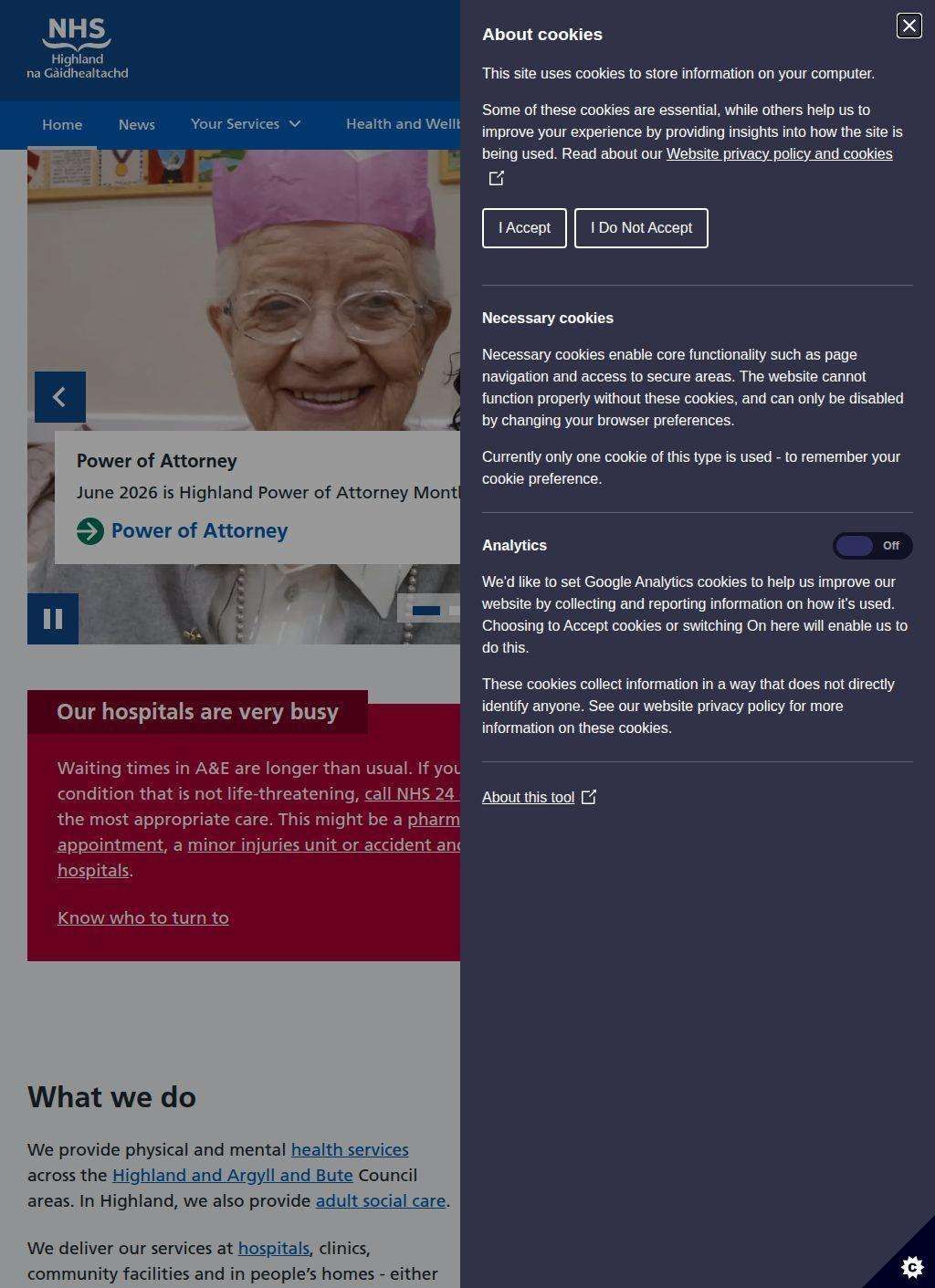
You wake up unwell in a glen two hours from the nearest town, or you need a consultant your local GP cannot provide, and the question becomes how a public health system stretched across some of the emptiest country in Britain actually reaches you. That geography is the whole story with NHS Highland. The patch NHS Highland covers runs from the suburbs of Inverness out to remote Argyll coastline and scattered island communities, and the way care is organised has to answer for those distances before anything else.
Hospital network across the region
The backbone is hospital provision, spread deliberately so that no single site carries the entire region. Raigmore Hospital in Inverness is the largest and the obvious reference point for acute and specialist work, but the network NHS Highland runs also takes in Lorn and Islands Hospital, Belford Hospital, Caithness General Hospital, and the more recent National Treatment Centre Highland. Listing them together makes the design clear: a person in Fort William or Wick is not expected to travel to the city for every need, because there is a closer hospital meant to handle a good share of it. For anyone trying to work out where a relative would be treated, or which site holds a particular service, the spread of these names matters in a practical way.
Primary care and social integration
Underneath the hospitals sits the primary care layer that most people touch far more often. GP practices, community pharmacy, dental, and optometry are all part of what NHS Highland oversees, which is the everyday machinery of getting a prescription, a check-up, or a referral started. NHS Highland also carries adult social care responsibility in the Highland Council area, an integration that links the medical side with the support someone needs at home. That join between health and social care is no small administrative footnote; it shapes how an older patient leaving Raigmore is looked after once they are back in their own house.
Specialist programmes for rural populations
The specialist list reads like a fair map of what a regional population needs over a lifetime. Mental health services, community maternity, orthopaedics, immunisation and vaccines, diabetes management, healthy weight programmes, and falls prevention all sit within NHS Highland's remit. Falls prevention in particular tells you something about who is being planned for: an ageing rural population where a single bad fall can mean a long, complicated recovery far from a major hospital. These are not glamorous headline services, and that is rather the point. They are the steady, unshowy programmes that keep a dispersed population functioning.
Digital access tools
Distance is where the digital tools start to earn their keep, and this is the part of the offering worth pointing a first-time visitor toward. Near Me handles video consultations, which for someone on a single-track road an hour from the nearest practice can replace a half-day round trip with a short call. Patient Hub gives a secure online portal for managing the patient side of things, and NHS 111 online offers non-emergency guidance when someone is unsure whether a problem warrants a trip at all. In a compact city these would be conveniences. Spread over the Highlands and the islands, they change what access actually means, because the alternative is often a long, costly, weather-dependent journey.
It is worth being honest that a website like this can only carry you so far. It is the front door to a vast operation, and the experience of care itself happens in clinics and wards the page cannot show you. What NHS Highland's site does well is make the structure legible: where the hospitals are, what primary and community services exist, which specialist programmes run, and how to reach help without leaving home. For a first-time user trying to navigate the system, that legibility is the most useful thing it could offer.
Governance and public accountability
There is also the governance side, which NHS Highland publishes openly: board information, recruitment, and public engagement material. Most patients will never read any of it, and that is fine. Its value is in being there for the people who do need it, whether that is a prospective employee weighing a move north, a resident who wants to follow how decisions get made, or a journalist checking accountability. A public body that keeps this material visible is doing something quietly important, even if the average visitor arrives looking for a clinic phone number and leaves none the wiser about board minutes.
System design for remote geography
Taken as a whole, what NHS Highland has put together is coherent in a way that suits its setting. A tiered hospital network so that acute care does not concentrate in one place, a full primary care and community layer, social care folded in where it counts, a sensible spread of specialist programmes, and digital channels built around the reality that some patients live a long way from everything. None of it is flashy. All of it answers a genuine logistical problem that less remote regions never have to think about as hard. The published evidence is enough to say that NHS Highland has structured the system thoughtfully for the geography it faces; whether that structure translates into timely care on the ground is the judgment only experience inside it can settle.
Business address
NHS Highland
Assynt House, Beechwood Park,
Inverness,
Highland
IV2 3BW
United Kingdom
Contact details
Phone: 01463 717123