Sabhal Mor Ostaig, the Gaelic-medium college on Skye, sits inside the same academic structure as a marine science station at Oban and a theological college in the Highlands. That mix tells you most of what you need to know about how the University of the Highlands and Islands is built. It is not one campus with a clock tower but a federation of partner institutions spread across 48 locations, from Shetland and Orkney in the north down through Moray, Perthshire and Argyll, stitched into a single degree-awarding body covering a region larger than several small countries. The University of the Highlands and Islands name covers all of it.
Course catalogue and study levels
The course catalogue is the first thing worth pulling apart, because the range is genuinely wide. The site lists more than 350 courses, and they do not cluster at one academic level: Higher National Certificates and diplomas sit alongside full undergraduate degrees, postgraduate taught masters, and research degrees running all the way to doctoral study. Layered on top are vocational short courses and CPD, plus a flexible online-learning strand for people who cannot or do not want to relocate to a campus. For a rural region where the nearest lecture hall might be a ferry ride away, that spread of levels and delivery modes is the point, not a footnote.
Partner colleges across the region
The partner network is the defining feature, worth understanding before deciding whether the University of the Highlands and Islands suits a given student. Study happens through named colleges: UHI Argyll, UHI Inverness, UHI Moray, UHI North West and Hebrides, UHI Orkney, UHI Perth and UHI Shetland, among others. Each has its own character, but a student enrols into a University of the Highlands and Islands programme rather than an isolated college with no wider pathway. That structure lets someone start with a further-education qualification at a small local centre and continue into higher education without changing institutions, harder to manage almost anywhere else in Scotland.
Specialist institutions within the network
Two of the partners stand out for what they show about the whole. Sabhal Mor Ostaig anchors Gaelic-language and culture teaching, which is not a token gesture in a region where the language still lives. The Scottish Association for Marine Science at Oban brings serious marine and environmental research into the fold, and Highland Theological College adds a specialist humanities strand. What strikes me as the most convincing part of the setup is that the breadth is baked into which institutions make up the university.
Research strengths
Research is grouped into a handful of clear strengths that map onto the geography: society, identity, landscape and knowledge, scholarship rooted in the specific history of the region; health research and innovation, relevant to a region with real questions about rural healthcare delivery; marine and environmental science and engineering, tied to SAMS and the coastline; and humanities and art. This isn't a university trying to compete head-on with Edinburgh across every field. It has picked areas where its location gives it something to say, and the groupings reflect that focus honestly.
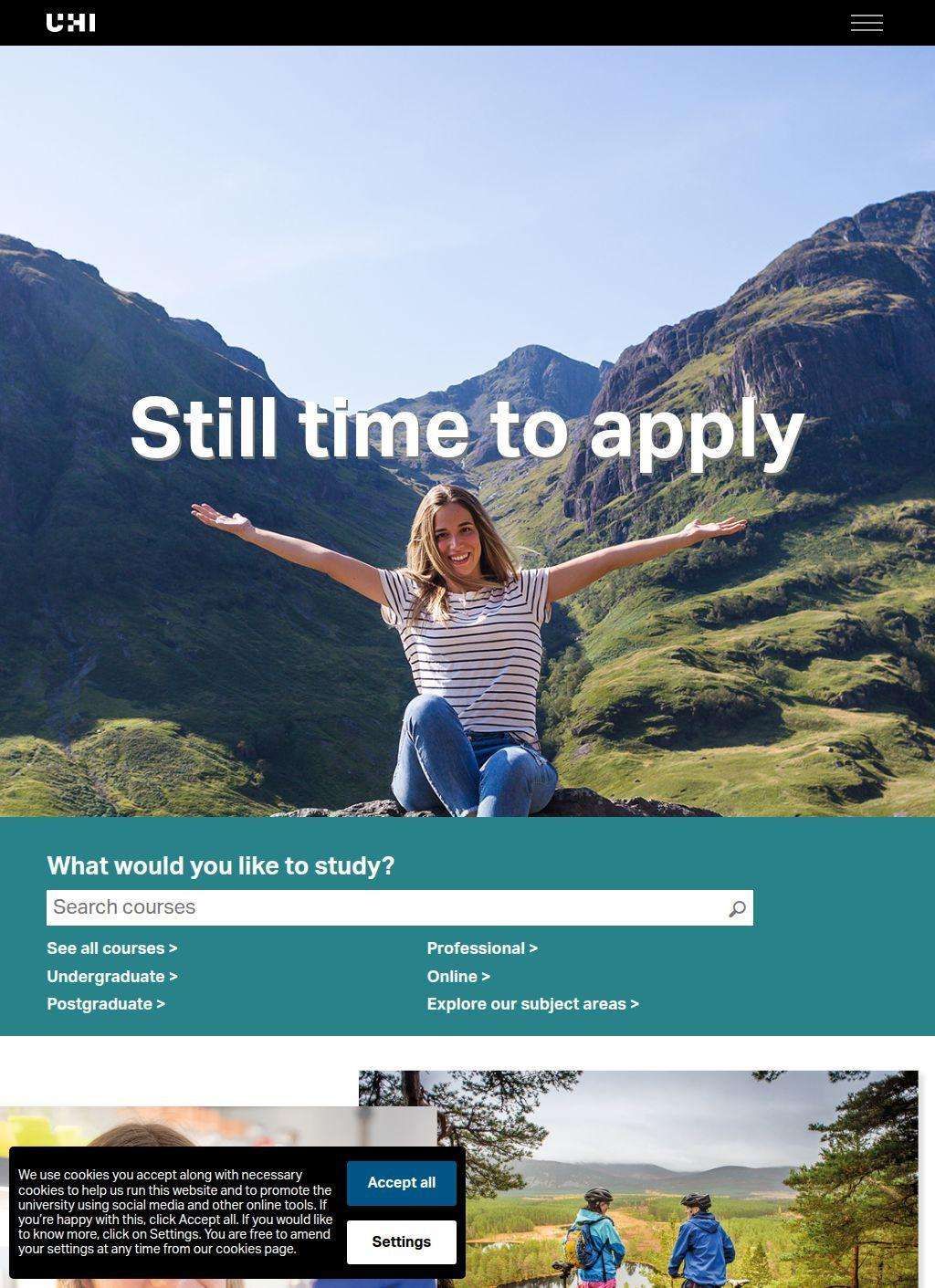
The website itself is organised the way you would expect from an institution serving many scattered sites, functioning almost like a business directory for its own partner colleges: find a course, then find which campus delivers it. That order of operations is the right one for a body this decentralised. A prospective student browsing the site is unlikely to be confused about whether the University of the Highlands and Islands offers what they want, though they might need a moment to work out where geographically the study would happen, since a single course title can attach to more than one location.
Geographic trade-offs for students
That geographic complexity cuts both ways. For someone in the far north, the University of the Highlands and Islands might be the only realistic route to a degree without leaving home, and the online and blended options make that plausible. For someone weighing it against a traditional single-campus university, the trade is a more dispersed experience, where cohort and facilities depend heavily on which partner a student joins. The site is upfront about the network, so nobody arrives expecting a compact campus and finds a region-wide web instead. The model simply asks more planning of a student.
What the University of the Highlands and Islands does unusually well, at least on the evidence of the site, is refuse to pretend it is something it is not. Inverness is the administrative centre, but the material never suggests the whole thing revolves around one city. The 48 locations are stated plainly, and the partner colleges keep their own names. A student in Stornoway or Kirkwall is treated as a full member of the same institution as one in Perth, and the structure is designed to make that true in everyday practice across the whole network. For a region that historically watched its young people leave for universities elsewhere, that design choice keeps a full degree within reach of the students who stay.
There are limits to what the public site reveals. The catalogue lists levels and subjects, but the depth of any single programme and the day-to-day feel of a particular partner campus need direct digging. A humanities course at one college and a marine science degree channelled through SAMS are very different propositions, and the top-level site flattens that variation. Anyone serious about applying should treat the main University of the Highlands and Islands pages as a map to the right partner, then judge that partner on its own terms.
Vocational and professional development
The vocational and CPD side deserves a mention because it is easy to overlook next to the degree programmes. Short courses and professional development sit alongside the academic ladder, fitting a regional remit that includes retraining, upskilling and part-time study for people already in work. In a rural economy, that flexibility often counts for as much as the undergraduate route. The University of the Highlands and Islands treats further and higher education as one continuum, and the site reflects that thinking without much fuss.
The likely audience is easy to sketch: students in and around the Highlands and Islands, Moray and Perthshire who want to study without moving to the central belt; anyone drawn to Gaelic studies, marine science, or research grounded in the culture and landscape of northern Scotland, where the University of the Highlands and Islands has a genuine claim to distinctiveness; and distance learners looking at the online strand.
The verdict is positive but qualified, and the qualification is structural rather than a criticism of quality. The University of the Highlands and Islands is a well-defined answer to a real problem: delivering a full range of further and higher education across a vast, thinly populated region without forcing everyone into one town. The federated model is its greatest strength and also the thing a student needs to understand early on, since actual experience is shaped far more by chosen partner and location than by the name over the door. For the right person in the right place, it is close to indispensable; for someone who could easily attend a conventional single campus elsewhere, it is worth weighing against how spread out the network really is. The site lays all of that out honestly, more than many institutions manage.
Business address
University of the Highlands and Islands
UHI House, Old Perth Road,
Inverness,
Highland
IV2 3JH
United Kingdom
Contact details
Phone: 01463 279000