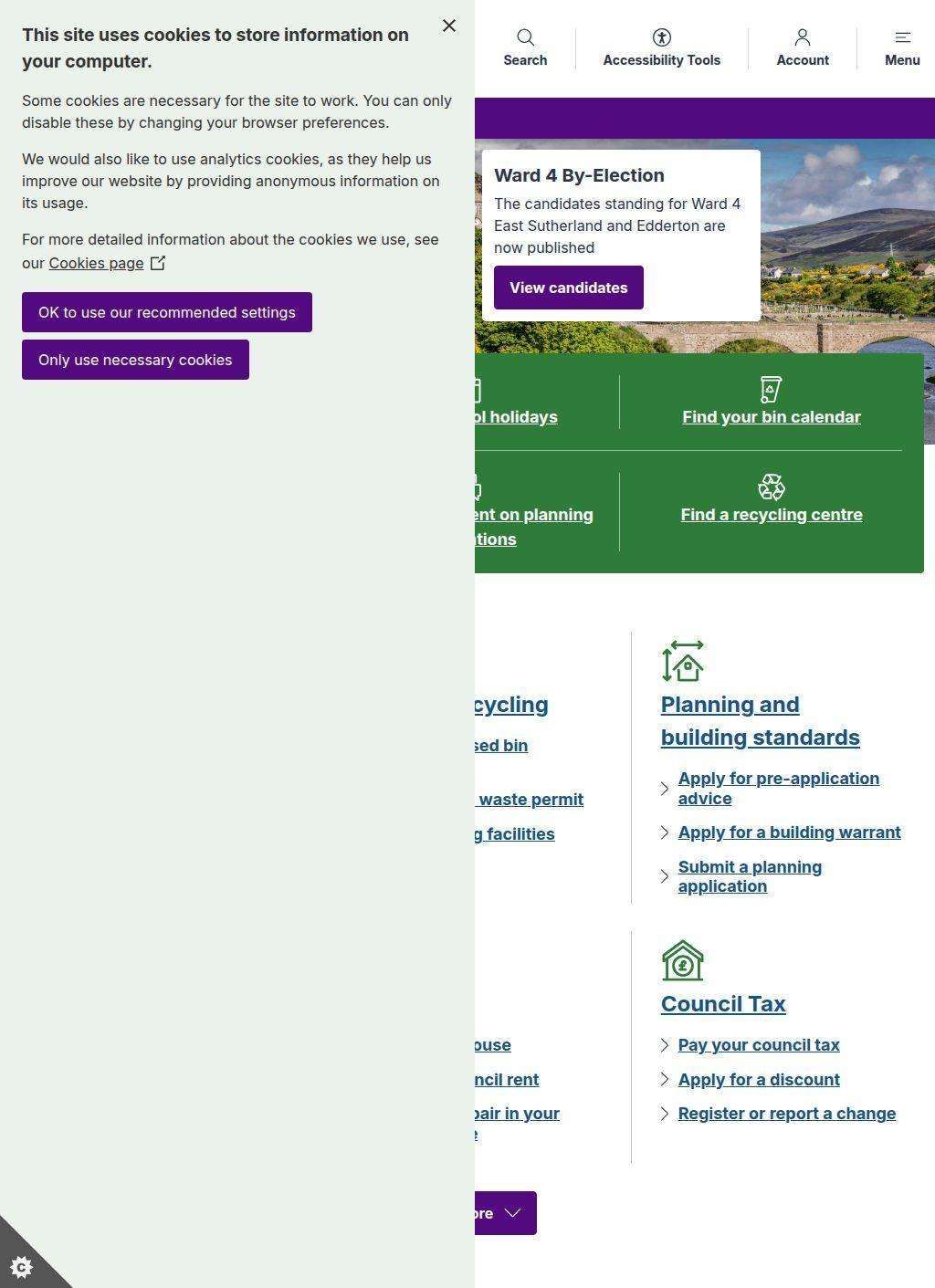
Scotland's Highland region stretches from Inverness north and west across some of the largest and most thinly populated terrain in the United Kingdom, and The Highland Council is the elected local authority responsible for all of it. Its website is the front door for everything that flows from that remit, and the spread of what sits behind it is genuinely wide. A resident can register a birth or a death, apply for a council tax discount, pay rent on a social tenancy, lodge a planning application, or report a pothole on a single-track road, all through the same portal. The site organises this into more than a dozen service categories, and to its credit the grouping mostly follows how people think about their problems rather than how the council is structured internally.
Everyday council services online
The day-to-day services are where most visitors will land. Bins and recycling get proper treatment: a collection-calendar finder keyed to your address, a recycling centre locator, missed-collection reporting, and garden waste permits all live together. Council tax has its own cluster covering registration, payment, and the discount and exemption applications that catch out so many households. Housing is handled in similar depth, with social housing applications, rent payments, and repair requests grouped so a tenant is not bounced between unrelated pages. Roads and parking sit alongside, taking in defect and pothole reports, parking fine payments, and blue badge applications. These are the unglamorous transactions that make up the bulk of any council's web traffic, and The Highland Council treats them accordingly.
Planning schools and business support
Beyond the routine, the breadth keeps going. Planning and building standards run through a searchable planning portal where you can submit warrant applications and track what neighbours have lodged. Benefits and welfare support covers Universal Credit guidance and eligibility checks. There is a registration service for marriages and civil partnerships, a full schools section dealing with enrolment, meal payments, and childcare funding, and a set of pages on adult and child protection and mental health referrals that route people toward the right help. Business users are not an afterthought either, with business rates, licensing, and startup support given their own space. The inclusion of Gaelic language education and cultural services is a meaningful touch: The Highland Council carries a statutory and cultural duty specific to this part of Scotland that a generic template would simply omit.
Self-service tools and payment gateway
The self-service infrastructure is what holds all of this together. A MyAccount portal lets residents manage their interactions in one place, and the online payment system threads through council tax, rent, parking, and the rest so that paying for something rarely requires hunting for a separate gateway. The standalone tools, the bin finder, the recycling locator, and the planning search, are the kind of small utilities that quietly save people a phone call, and they work as advertised. For an organisation covering this much ground, the decision to invest in proper lookup tools is the right one.
There is also a layer aimed at the civically engaged and at visitors. Beyond the routine services, The Highland Council publishes councillor and election information, committee agendas, climate action plans, and details of community grants, which is useful for anyone wanting to follow or influence local decisions. A tourism section covers visitor attractions and, more unusually, the Highland Motorhome and Campervan Scheme, a practical response to the volume of road-trip traffic the region now absorbs. At the time of review the front of the site was carrying timely material on Highland Power of Attorney Month, Education Maintenance Allowance applications, and a Short Term Let Control Area consultation. The homepage appears actively curated to surface what is current.
Finding your way around the site
If there is a fair criticism, it is the one common to every authority of this size: the sheer number of services means the site can feel like a lot to navigate when you are not certain which department owns your issue. The search and the task-based grouping help, but a first-time visitor with a vague question still has some orientation to do. That is a structural reality of a body whose responsibilities run from cemeteries to school dinners to wind-farm planning. The information is current, the transactional tools function, and the coverage genuinely matches the breadth of what The Highland Council is obliged to deliver.
Set against the obvious alternatives, the case for going straight to the source is strong. A central UK portal like GOV.UK will point you in the right direction for national matters, but it cannot pay your Highland council tax, book your recycling slot, or show you the planning history of a croft. For anything genuinely local it ultimately routes back to The Highland Council anyway. The site holds up on substance: the depth of coverage is real, the tools do what they claim, and The Highland Council's published commitments are here to read and assess.
Business address
The Highland Council
Council Headquarters, Glenurquhart Road,
Inverness,
Highland
IV3 5NX
United Kingdom
Contact details
Phone: 01463 702000