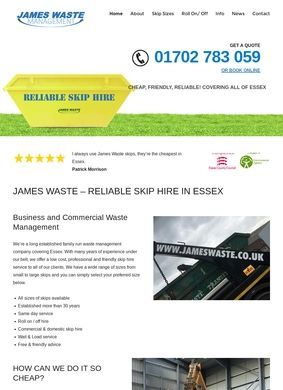
A builder finishes a job and leaves behind a heap of broken plasterboard, snapped timber, and half a skip's worth of packaging, and someone has to make it disappear before the next trade turns up. That is the ordinary, unglamorous problem that James Waste Management is set up to solve. James Waste Management works out of Rochford in Essex, covering the South East, and it splits its attention between households clearing out a garage and businesses with a loading bay full of waste at the end of every week.
The site lays out four ways in, and they map fairly cleanly onto four kinds of customer. There is a Man and Van collection for people who want rubbish gone quickly, sometimes the same day. There is Roll On/Roll Off skip hire in 20, 35, and 40 yard sizes for the larger clearances. James Waste Management also runs a commercial arm aimed at factories, retailers, construction firms, and local authorities. And there is plastic recycling, which is where the operation gets more interesting than the average clearance outfit.
How the collection and skip options stack up
The useful part is that the offer is sorted by the shape of the mess, not by some abstract tier list. A retailer with a steady weekly stream of cardboard has a different problem from a family emptying a house, and the two are handled by different arms of the same firm.
Man and van against the roll on, roll off skips
The Man and Van service is pitched at flexibility: scheduled or same day, a crew turns up and takes the load away, which suits anyone who cannot give over a driveway to a skip for a week or who simply has too little space for one. It is the light, fast option.
The Roll On/Roll Off skips are the opposite end of the same problem. Three sizes are on offer, from 20 through 35 to 40 yards, and those are large containers built for sustained volume: a demolition, a factory clear, an ongoing commercial contract. Putting both services under one roof means a customer does not have to guess wrong and get stuck with the mismatched product, and James Waste Management can steer a caller toward whichever one fits the actual job.
The Rochford recycling plant
The part that separates James Waste Management from a plain skip firm is that it runs its own recycling plant, which it describes as one of the largest in the South East. Rather than handing waste on to a third party and losing sight of it, James Waste Management processes mixed plastic, paper, aluminium, and steel baling on its own site. The headline claim is that over 99 percent of collected waste is recycled.
That figure deserves a small note of caution: it is the company's own number, and the site does not show independent verification for it. Still, owning the plant makes the claim more plausible than it would be coming from a middleman, because the firm controls what happens to the material after the lorry leaves. For a construction client or a local authority under pressure to show where its waste ends up, the setup at James Waste Management is the strongest part of the pitch, ahead of the pricing or the phone manner.
Plastic recycling gets its own listing on the site too, which reads as a business line in its own right and not a bolt on. Given how much of commercial waste is now packaging, that focus is sensible.
Weighing up the trust question
A waste firm asks you to trust it with a job that is easy to do badly, from fly tipping to vague pricing, so the softer promises matter. James Waste Management leans on a few: a dedicated account manager for each client, no call centres, free waste audits, and no rental or duty charges. Those are the sort of frustrations that push commercial customers away from bigger operators, and naming them directly suggests the company knows its market. There is also an online booking system, which spares you a phone call if you already know what you need.
None of that is verifiable from the outside, of course. It is what the business says about itself. The account manager pitch and the promise of no call centres are aimed squarely at buyers who have been passed around a switchboard before, and they are believable claims for a company the size of James Waste Management, but a first time customer is right to treat what James Waste Management says here as a starting position and not a guarantee.
Finding a person to call
On the practical question of reaching them, the site does well. Two phone numbers are published, a landline and a mobile, alongside an email and the full postal address at Purdeys Industrial Estate in Rochford. All of it is out in the open. For a service where you often need to talk to someone quickly, that openness counts, and it fits the no call centres line better than a lone contact form would.
Outside reputation is where the picture runs out. A search turns up very little that is specific to James Waste Management as an Essex firm: the name collides constantly with a large unrelated corporation and with an unrelated executive, and the genuine mentions that do surface, on a couple of business profile pages, carry no star ratings and no review counts.
There is, in short, no body of public feedback to weigh, positive or negative. That does not condemn the work, which may well be good, but it does mean a prospective customer cannot check the company against a run of past ones and has to judge it instead on the site, the pricing conversation, and the plant it can point to.
The offering itself is coherent, and the recycling angle is a real differentiator rather than decoration. Set against the published evidence, a firm that owns its own processing and puts two phone numbers, an email, and a full postal address on the page has done the basic legwork that a waste contract needs. What it has not done is give an outsider anything to check that claim against beyond the plant itself, so the recycling story carries the review, and the rest is ordinary good practice done properly.
Business address
James Waste Management LLP
2 Brickfields Way, Purdeys Industrial Estate,
Rochford,
Essex
SS4 1NB
United Kingdom
Contact details
Phone: 01702 542385