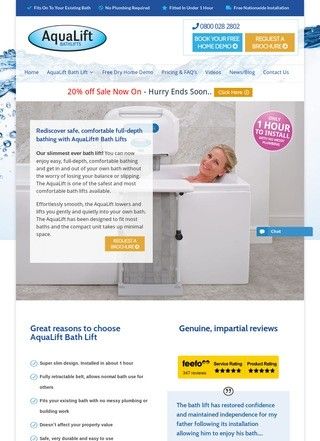
A bath lift that drops into an ordinary tub and raises someone back out of it, with no tiling ripped up and no plumbing moved, is the whole proposition, and it is a narrow one done with some focus. AquaLift makes and fits a mechanical seat that sits inside a standard bathtub, lowering a person down to bathe and lifting them clear again afterward. The seat retracts, the cushioning is non-slip, and there are handrails to grip on the way in and out. For an older person who still wants a proper soak but has lost the confidence to climb in and out unaided, AquaLift offers a specific answer to a specific daily problem, and the website does not overstate what the product is.
How installation and support work
The detail that installation is free, and that demonstrations happen in the home, tells you something about how the sale tends to go. This is not a self-assembly kit ordered off a shelf. Someone from AquaLift comes to the house, shows the device working in the customer's own bathroom, and fits it. That suits a buyer who is wary of disruption and wants to see the thing in place before any money changes hands, which is a sensible way to sell a product whose main selling point is that it changes nothing structural. AquaLift has been doing this since 2005 and puts the number of installed homes north of 14,000, a long enough run and a large enough count to suggest the model works in practice.
Pricing and booking process
The absence of a price anywhere up front is a little frustrating, since the free-demonstration and free-installation language naturally raises the question of what the unit itself costs, and that answer arrives only once someone is in the living room. Common enough in the mobility-aids trade, but it does mean a reader cannot weigh the spend against an alternative without booking a visit first.
Customer ratings across platforms
The outside reputation picture is reassuring and reasonably deep. On Reviews.co.uk, AquaLift sits at 4.57 out of 5 across 370 reviews, with 293 of those customers marking it as excellent. That is a strong distribution: a high average backed by a real volume of ratings, not a handful of glowing entries propping up the score. Feefo ratings appear on the site as well, and the comments there lean heavily toward five stars, with particular praise going to the sales staff and the installation teams.
Trustpilot and Which? accreditation
When the people doing the home visit and the fitting are the ones customers single out, that says something useful about a product sold in someone's bathroom by a person who turns up at the door. A Trustpilot page carrying 22 reviews does exist, but it is filed under aqualift.com, a different address from the aqualift.uk.com site under review, and the rating did not surface clearly. I would not lean on that one either way.
The Which? Trusted Trader accreditation counts for more in this country, since it involves an actual vetting process rather than open submissions, and it is the kind of mark elderly buyers and their families tend to look for. Taken together, the reputation evidence points the same direction: a company that delivers what it promises and is liked most for the human side of the transaction. That consistency across separate platforms lines up with the long operating history and is harder to engineer than a single high score on one site.
Contact options for older buyers
AquaLift displays a freephone number prominently, the full postal address in Droitwich Spa is there in plain sight, and there is a proper contact page alongside the brochure request and the home-demonstration booking. For a customer base of older people, many of whom will want to phone and speak to a person before anything else happens, a 0800 number on the page is exactly right. The willingness to post a physical brochure acknowledges that not everyone in this market lives entirely online.
Bathroom safety information
The site also carries educational material on bathroom safety, which reads as genuinely useful filler-free content. Bathroom falls are a real and serious risk for the elderly, and AquaLift explaining the risk honestly is doing the right thing even if the underlying purpose is to point readers toward its product. It at least gives a visitor context for why such a device might be worth considering before any sales conversation starts.
When to consider a walk-in bath instead
If there is a limit to AquaLift, it is the limit of the product itself and not any failing in how the company presents it. A bath lift keeps you in your existing bath, which is its strength on cost and disruption and its weakness if your needs are heading toward something more permanent. The honest comparison for a prospective buyer is a walk-in bath or a level-access shower from a firm such as Mobility Plus or one of the larger bathroom-conversion specialists. Those rip out the tub, cost far more, and take days of building work, but they suit someone who can no longer manage a seated bathe at all.
AquaLift sits below that tier deliberately. The company has built its 14,000-odd installations on the person who still wants and can use a bath but needs help getting in and out of it, and the cheaper and less invasive route is precisely what AquaLift delivers. On the evidence of the ratings across two platforms, the Which? accreditation, and the 20-year operating history, AquaLift is a credible option for that particular need, with enough public feedback to assess the quality of the service directly.