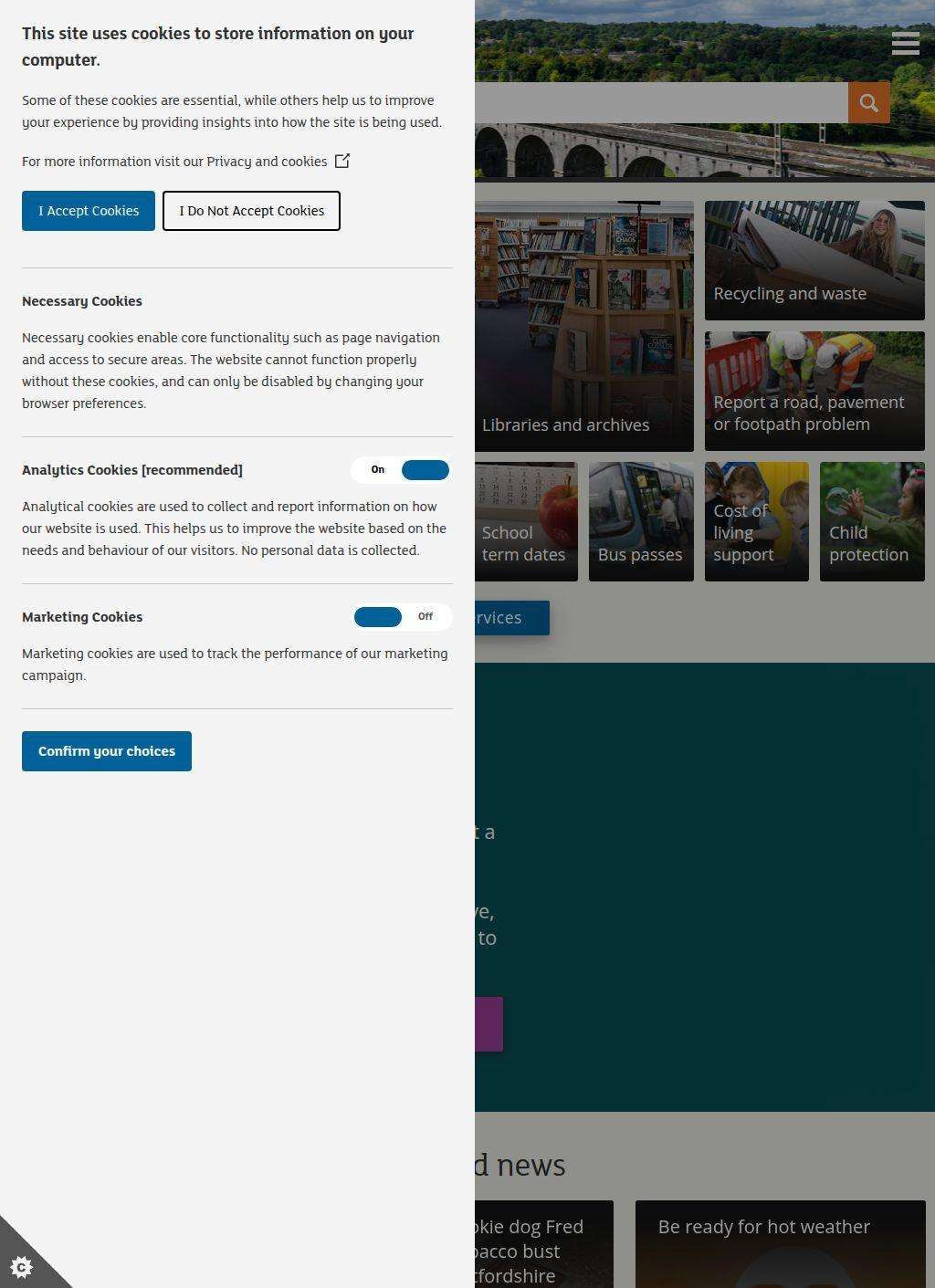
Hertfordshire County Council is the upper-tier local authority for Hertfordshire, the county that sits directly north of Greater London. Its website at hertfordshire.gov.uk is the front door to the services the council runs for roughly 1.2 million residents across ten district and borough areas, from Watford and Hemel Hempstead in the west to Bishop's Stortford in the east. The council is based at County Hall on Pegs Lane in Hertford, the county town, and the general enquiries line is 0300 123 4040.
How Hertfordshire's two-tier council system works
It helps to understand how local government is split here, because the website assumes you already know it and that trips some people up. Hertfordshire runs a two-tier system. The county council handles the larger, county-wide functions: adult social care, children's services and safeguarding, most state schools and special educational needs support, the main road network, public health, libraries, trading standards, the fire and rescue service, and the household waste recycling centres.
The ten district councils, which have their own separate sites, deal with bin collections, council tax billing, housing and benefits, planning applications and parking. So if a resident lands on hertfordshire.gov.uk looking to pay council tax or report a missed bin, they get redirected to their district. The site does signpost this, but a first-time visitor can spend a few minutes working out which body actually owns their problem.
Popular tasks on the council homepage
The homepage is built around the tasks people search for most often rather than around the council's internal structure, which is the right call for a public body. Prominent routes cover applying for a primary or secondary school place, reporting a pothole or broken streetlight, booking a slot at one of the recycling centres, finding library opening hours and renewing items, and arranging or paying for adult social care. Each of these leads into a set of online forms, and the council has clearly invested in moving transactions away from the phone lines. The school admissions section in particular is one of the busiest parts of the site every autumn and spring, when families across the county apply for and then accept or appeal places.
Social care duties and safeguarding support
Adult and children's social care is where the council carries its heaviest legal duties, and the site reflects that. There is detailed guidance on care needs assessments, support for unpaid carers, safeguarding referrals for vulnerable adults and children, fostering and adoption through the council's own service, and the financial assessment that determines what someone contributes toward their care. HertsHelp, a connected advice and signposting service, is promoted across these pages for residents who are not sure where to begin. The tone throughout is procedural rather than warm, which suits the subject, though families dealing with a crisis sometimes find the assessment pathways harder to follow than they would like.
Behind Hertfordshire's highways maintenance work
Highways is the other area that generates a lot of traffic, in both senses. Hertfordshire maintains thousands of miles of road, and the website hosts the fault-reporting tool, roadworks and closure information, the school crossing patrol service, and applications for things like dropped kerbs and skip permits. Residents can report a defect and, in many cases, track its reference number. As with most county highways teams in England, the volume of reported potholes runs ahead of the repair budget, and the published timescales are best read as a queue rather than a promise. The council is candid about prioritising defects by safety risk, which is a fair approach even if it is not always the answer a reporting resident wants.
Transparency in council decisions and procurement
For local democracy and transparency, the council publishes committee papers, cabinet decisions, councillor details by division, the annual budget and council tax precept, consultations that are open for public comment, and performance and spending data. Anyone wanting to understand how decisions are made, or to find and contact their elected county councillor, can do so from the about-the-council section. Procurement and tender opportunities are listed for suppliers, which is one reason the authority appears in a business directory: local firms and contractors track these notices, and a clear directory entry pointing to the official domain saves them landing on a lookalike site.
Inside Hertfordshire's library network
The library service deserves a mention because it is one of the council's most visible everyday offerings. Hertfordshire runs a network of branch libraries plus mobile and online services, with free e-books, e-audiobooks, newspapers and reference databases available to anyone with a library card. The libraries also host the registration service for births, deaths, marriages and civil partnerships, and Hertfordshire Archives and Local Studies, the county record office, sits within the same broader service at County Hall. Schools, students, family historians and ordinary borrowers all use these resources, and the opening-hours and event listings are kept reasonably current.
Household waste recycling centres explained
Waste and recycling is a good example of how the two-tier split confuses people, and the site has to work hard to explain it. The county council runs the seventeen or so household waste recycling centres dotted around Hertfordshire, where residents take garden waste, electricals, rubble, paint and the bulkier items that will not fit in a kerbside bin.
Those centres are booked or accessed through the county council's pages, and there are rules on vehicle sizes, permits for vans and trailers, and what each site will and will not accept. The weekly bin at the kerb, by contrast, belongs to the district council. So a resident clearing out a garage finds themselves dealing with the county for the tip and the district for the wheelie bin, and the website's job is to route them correctly. It mostly manages this, though the explanation has to be repeated in several places.
Who manages Hertfordshire's transport network?
The council also has a wider economic and transport role that shapes the county. It is the local transport authority, which means it plans bus services, subsidises some rural routes, runs concessionary travel for older and disabled residents, and works on major road and active-travel schemes alongside national bodies. Hertfordshire's position on the main corridors into London, including the A1(M), the M25 fringe and the East Coast and Thameslink rail lines, makes this work visible to commuters. The economic development pages cover support for businesses, skills and employment programmes, and the council's part in the local growth and infrastructure plans that decide where housing and employment land go. For local firms, these pages and the procurement notices are a practical reason to keep the council's official site bookmarked.
Public health and emergency planning round out the picture. The council leads on local health improvement work, stop-smoking and weight-management support, sexual health services and school nursing, and it coordinates with the NHS and district councils on wider wellbeing. Hertfordshire Fire and Rescue Service, which the county council runs, has its own area of the site covering safety advice, home fire safety visits and recruitment. During severe weather or other incidents, the council uses the website and its social channels to push out gritting routes, school closures and travel advice.
On usability, the site is competent and accessible rather than slick. It meets the accessibility standards expected of a UK public sector body, works on mobile, and offers a search box that mostly surfaces the right page. The sheer breadth of content means some sections are easier to reach by searching than by clicking through menus, and a handful of pages still read as though they were written for staff rather than residents. These are minor gripes against a site that has to document an enormous range of statutory services for a very mixed audience.
Within a business directory covering Hertfordshire, the county council is close to an essential entry. It is the authoritative source for anything residents and local organisations need from county-level government, and linking straight to the verified hertfordshire.gov.uk homepage is the safest way to point people there. Anyone using a business directory to research the county, whether a resident, a supplier chasing a tender, a journalist or a newcomer trying to make sense of how Hertfordshire is run, will find the council's own website the natural place to start. For the broad sweep of who-does-what in local government, and for the day-to-day transactions that keep the county functioning, this is the official record.
Business address
Hertfordshire County Council
County Hall, Pegs Lane,
Hertford,
Hertfordshire
SG13 8DQ
United Kingdom
Contact details
Phone: 0300 123 4040