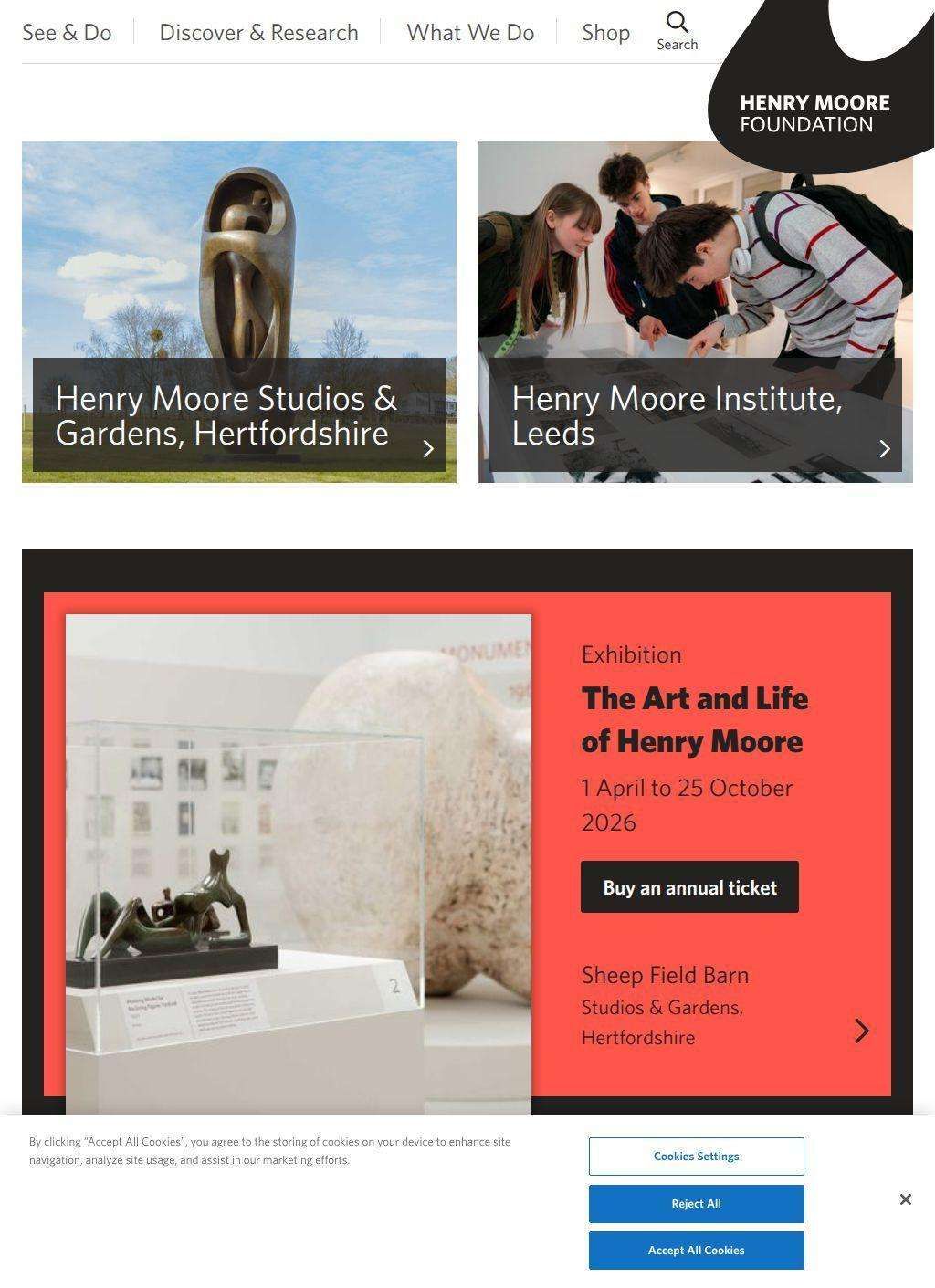
A visitor planning a day around Henry Moore's sculpture usually faces a simple question with a messy answer: where do you go to see the real thing in quantity, not one bronze marooned in a city square. The Henry Moore Foundation answers that directly. Its main site is Henry Moore Studios & Gardens at Perry Green in Hertfordshire, the place where Moore actually lived and worked, and where the sculptures now sit across indoor rooms and open lawns. Seeing the large outdoor pieces against grass and sky, roughly the setting Moore intended, is the reason this place exists and the reason it is worth the trip.
Two venues for different purposes
The Perry Green site runs on ticketed admission and is open to visitors during its season. Right now the headline show is "The Art and Life of Henry Moore", on from April through October 2026, which sets the work against the story of the man who made it. There is a second venue too: the Henry Moore Institute in Leeds, a research centre given over to sculpture in the broader sense. It is closed for the moment and due to reopen on 28 June 2026, with "Phantasmagoria: Folkloric Sculpture for the Digital Age" scheduled there from May to August 2026. So the offering splits cleanly. Perry Green is where you go to look. Leeds is where the study of sculpture happens.
Perry Green for viewing sculptures
That division is worth keeping straight when you decide what you want from the foundation. A family wanting an afternoon among large bronzes is served by one venue; a scholar chasing a specific question about twentieth-century sculpture is served by the other. The Bloomberg Connects app adds audio and visual material for exploring the Perry Green grounds, which is a sensible touch for anyone who would rather wander than read a printed guide. Venue hire, accessibility accommodations, and a volunteering programme round out what the place handles day to day.
Leeds as a research centre
The site is careful to set expectations on the practical side. Admission is ticketed, hours are seasonal, and the closure-and-reopening dates for Leeds are stated plainly instead of buried. For a visitor that honesty is useful. You can plan around it without arriving to a locked door.
Planning your visit
Behind the public galleries sits the part most casual visitors never see, and it is substantial. The Henry Moore Foundation keeps a working research library and archive open to scholars, runs a sculpture research programme, awards visiting research fellowships, and hands out dissertation prizes. This is not a gift shop bolted onto a tourist attraction. It is a working research operation with the artist's own archive at the centre of it.
Checking hours and closures
The funding reach goes wider still. The Henry Moore Foundation gives grants and fellowships to artists and researchers internationally, extending well past the circle of people studying Moore himself, which makes it a genuine patron of sculpture as a field. It also catalogues Moore's complete body of work and organises touring exhibitions that other institutions can borrow. A regional gallery that wants a Moore show without owning the pieces has a route to one through here, and that quietly extends the foundation's reach far past Hertfordshire and Leeds.
Research library, archive, fellowships
For anyone wondering whether the Henry Moore Foundation amounts to more than a house museum, the catalogue work and the international grants settle it. Preserving the legacy of one sculptor could easily shrink into a single house museum. Instead the Henry Moore Foundation funds new scholarship, supports living artists, and lends its holdings outward.
Grants and touring exhibitions
You can also support the work directly: the Henry Moore Foundation accepts donations and runs a mailing list for people who want to follow exhibitions and openings. Those are small things, but they signal an organisation that expects a continuing relationship with its public, not a one-off visit.
Supporting the foundation
One honest caveat: this is two venues with different rhythms, and the website asks you to pay attention to which one you mean. Confuse Perry Green with Leeds and you could plan a trip around a centre that is shut until late June 2026. The dates are all there; you just have to read them.
When to visit Perry Green or Leeds
If you are a sculpture enthusiast or an art teacher within reach of Hertfordshire, Perry Green during the run of "The Art and Life of Henry Moore" is the clear pick, so check the seasonal opening times and book a ticket before you set out. Researchers should instead note the 28 June 2026 reopening in Leeds and contact the foundation about library access or a fellowship. Either way, the Henry Moore Foundation gives both kinds of visitor a real reason to go.
Business address
The Henry Moore Foundation
Dane Tree House, Perry Green,
Much Hadham,
Hertfordshire
SG10 6EE
United Kingdom
Contact details
Phone: 01279 843333