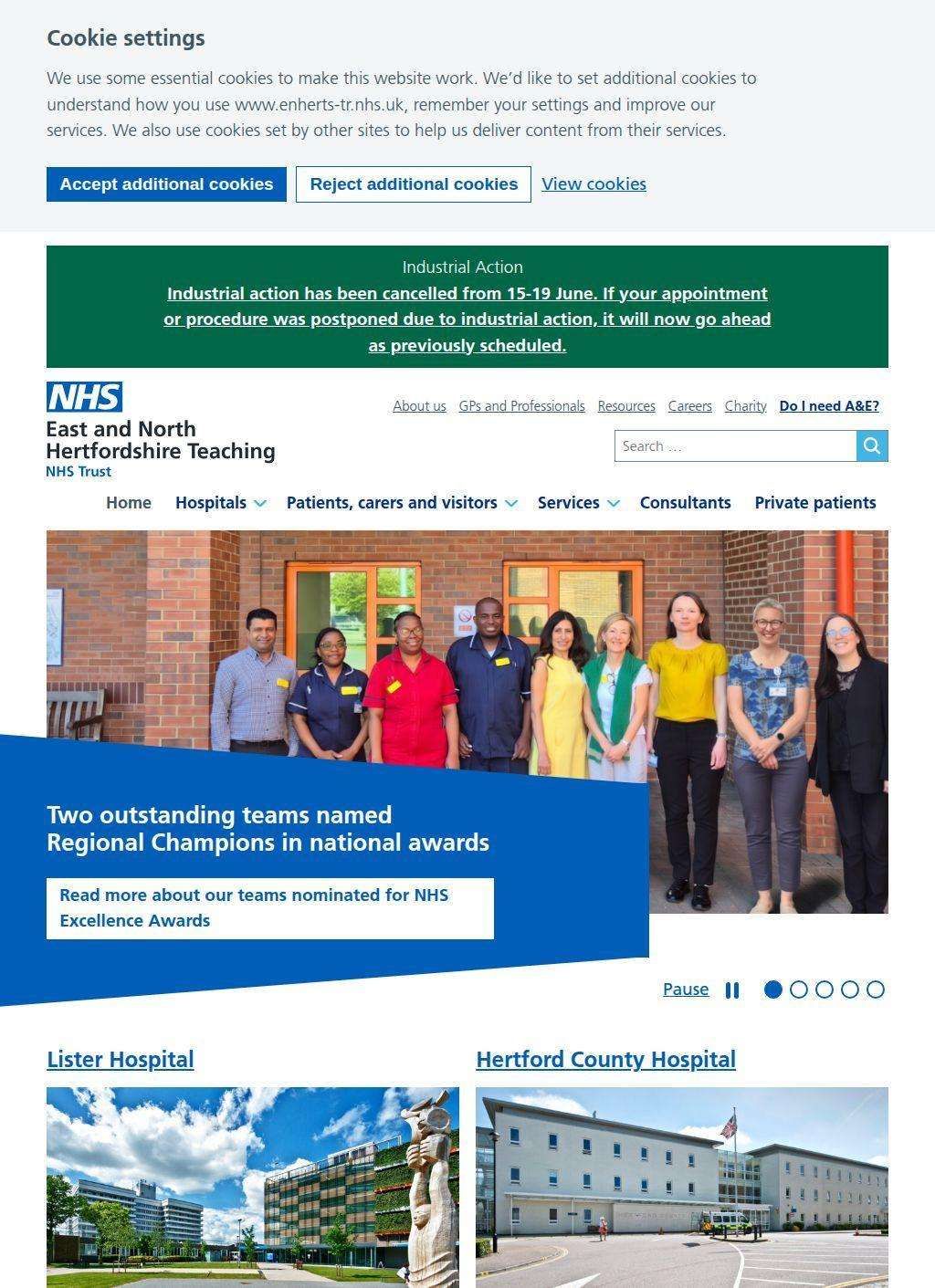
Five separate hospital sites sit under one organisation here, and that scale is the first thing worth understanding about East and North Hertfordshire Teaching NHS Trust. Lister Hospital in Stevenage runs as the headquarters, but East and North Hertfordshire Teaching NHS Trust also covers Hertford County Hospital, the New QEII, Mount Vernon Cancer Centre, and a set of dedicated Renal Units. For a patient or carer trying to work out where a particular appointment actually happens, that spread is the practical reality, and the website is built around making sense of it.
Five hospital sites under one organisation
What a multi-site trust has to do well is help people find the right department at the right building. East and North Hertfordshire Teaching NHS Trust handles that through an A to Z of services. The list is wide and concrete: accident and emergency, maternity care, blood tests, radiology, audiology, cancer services, chaplaincy, carers support, and disability services all sit in that index. A patient does not have to know the internal structure of the trust to reach the page they need. They look up the service by name and follow it from there, which is the correct instinct for a public hospital site where visitors arrive worried and in a hurry.
Finding services by name
Oncology gets its own centre of gravity. Mount Vernon Cancer Centre handles specialist cancer treatment, and pulling that under the East and North Hertfordshire Teaching NHS Trust umbrella makes clear that this is a named specialist facility drawing referrals, not simply a department inside a district general. That distinction matters to someone weighing where their treatment will be delivered, because a specialist centre and a district general department are different experiences, and the site does not blur the two.
Mount Vernon Cancer Centre
A fair amount. East and North Hertfordshire Teaching NHS Trust offers an online tool to change an appointment, which removes one of the most common reasons people end up stuck on hold. There is a symptom checker for the moment before someone decides whether a problem needs attention, and video consultation options for appointments that do not require an in-person visit. Each of these chips away at the friction that usually surrounds hospital admin, and together they point to a site that has thought about the patient's time, not the clinic's schedule alone.
Tools that reduce hospital admin friction
Then there is the "Stay in Touch" messaging service, which reads dull on a list and matters a great deal in practice. Keeping patients informed between appointments, by message, is exactly where large hospital systems tend to drop the ball, so building a named channel for it is a sensible move. Patient information leaflets round out the self-service side, giving people something to read about a procedure or condition before or after they speak to a clinician. The leaflets are the unglamorous backbone of patient communication, and their presence here says something about how seriously East and North Hertfordshire Teaching NHS Trust treats the gap between visits.
What happens between appointments?
Carers and people with disabilities are addressed directly, not folded silently into general patient pages. Carers support and disability services each appear as their own entries, and that visibility is meaningful for the families who rely on them. A carer who can see that someone has thought about their position before they walk through the door starts the relationship on better footing.
From carers to chaplaincy
Chaplaincy belongs to the same instinct. It is easy for a hospital to treat spiritual and pastoral care as an afterthought, and the fact that East and North Hertfordshire Teaching NHS Trust lists it alongside the clinical services says something about how the organisation sees the people it treats. A hospital is rarely a neutral place for the people inside it, and a chaplaincy line in the service index acknowledges that plainly.
The "teaching" in the name of East and North Hertfordshire Teaching NHS Trust is worth sitting with. A teaching trust trains clinical staff while it treats patients, which usually means a steady flow of trainees working under senior supervision and a closer tie to current practice. That status is a quiet reassurance about the depth of expertise on site, and it explains some of the breadth of the service list, since teaching hospitals tend to carry a wider range of specialties than a smaller unit would.
Geography shapes the whole thing. East and North Hertfordshire Teaching NHS Trust serves the population across East and North Hertfordshire, and the five-site model is how it reaches a spread-out area without forcing everyone toward a single building. Renal Units as a distinct part of that network point to the kind of ongoing, regular treatment, dialysis and related care, that patients need close to home. Placing those units in their own category, rather than burying them inside a generic medicine page, reflects how often those patients return.
A search for East and North Hertfordshire Teaching NHS Trust on the major review platforms turns up a limited number of ratings. The NHS itself publishes patient survey data separately, so the public picture leans more toward official report than aggregated star score. That pattern is common for NHS trusts, and it means a patient researching the organisation will learn more from the NHS England survey results than from consumer review counts.
If there is a limit to what the site can do, it is the one every large hospital trust faces: with so many services, the A to Z bears most of the navigational load, and the experience depends on that index staying accurate and well maintained. The structure is sound. The breadth covers the full clinical range a regional trust runs. The value to a visitor rests on each of those many entries leading somewhere current, which is an operational job as much as a web-design one.
Taken together, East and North Hertfordshire Teaching NHS Trust has mapped its own complexity onto a site a frightened or rushed visitor can still navigate. The A to Z, the appointment-change tool, the symptom checker, the video consultations, the messaging service, and the leaflets are not flashy additions. They are the practical scaffolding a regional hospital trust needs, and East and North Hertfordshire Teaching NHS Trust has put them where people can reach them. The published evidence is enough to form a reasonable view of what the organisation offers and how it has tried to organise access to it.
Business address
East and North Hertfordshire Teaching NHS Trust
Lister Hospital, Coreys Mill Lane,
Stevenage,
Hertfordshire
SG1 4AB
United Kingdom
Contact details
Phone: 01438 314333