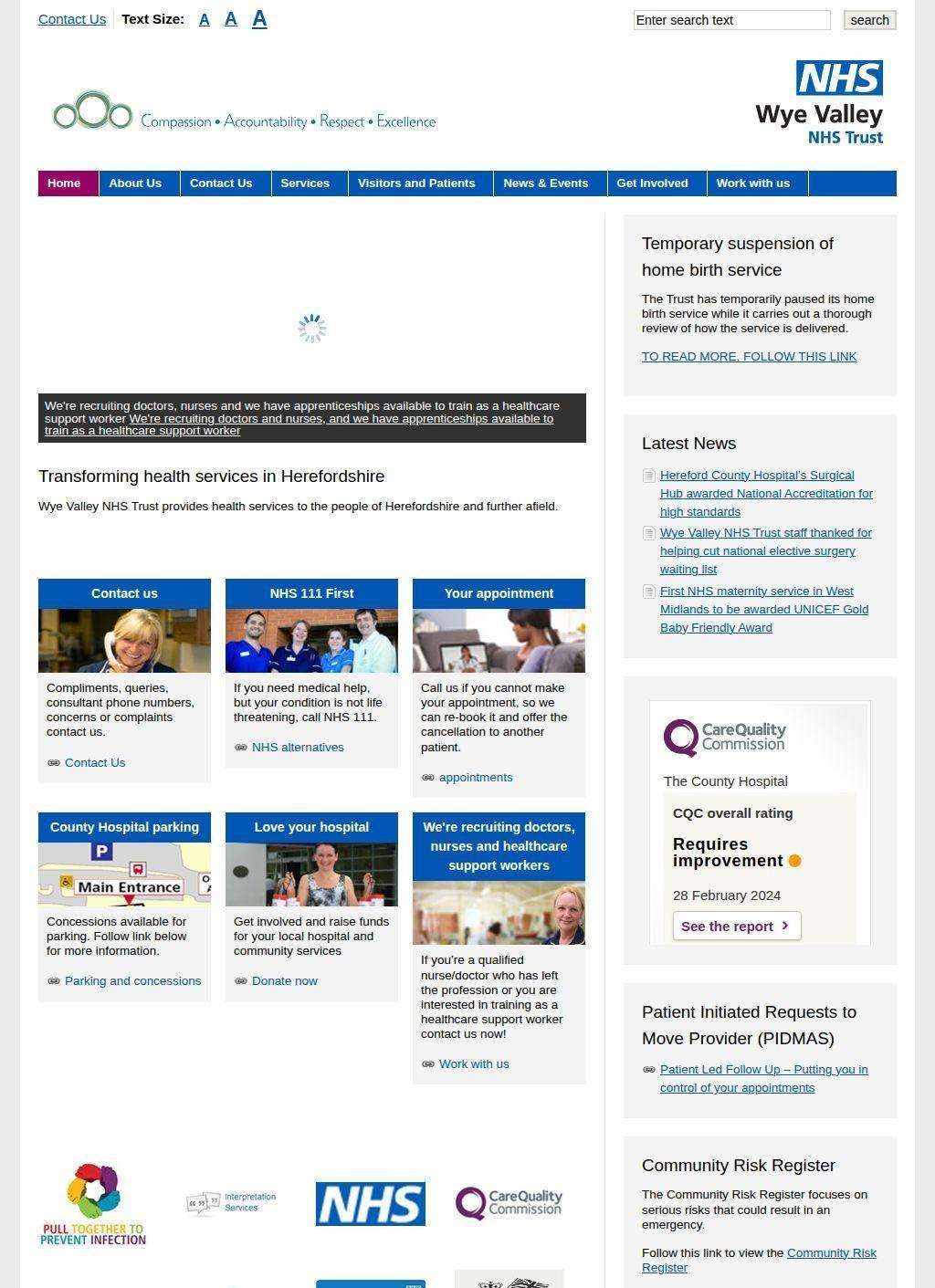
Someone in Hereford with chest pain at two in the morning, or a parent whose child has spiked a fever that paracetamol will not touch, needs to know exactly where to go and what will be waiting for them. That is the practical use of the Wye Valley NHS Trust website. It is the public front door to the County Hospital and the smaller community sites that serve the county, and it is built less to impress than to answer a question quickly: which department, which building, what hours, what to do next when something has gone wrong. Read that way, the site does its job, and it does it for the kind of person who has no patience for anything fancier when worry is the reason they have opened the page in the first place.
Hospital sites across Herefordshire
The County Hospital in Hereford is the acute centre, the place an ambulance heads for and where most of the serious medicine happens. Around it sits a network Wye Valley NHS Trust runs across Herefordshire: community hospitals, the Community Diagnostic and Treatment Centre, Dental Access Centres, Gaol Street Health Clinic, Belmont Clinic, and Sarum House. The geography matters here more than it would for a city trust. Herefordshire is rural and spread out, and a resident reading the site is often trying to work out whether they can be seen closer to home or whether the trip to Hereford is unavoidable. The site lays these locations out so the answer is findable, which in a county this size is not a small thing.
Clinical services and specialties
The clinical range covered by Wye Valley NHS Trust is broad for an organisation of its scale. Emergency care and surgical services sit at the core, and the surgical hub carries national accreditation, a detail that tells a patient awaiting an operation something concrete about the standards applied. Outpatient clinics handle the everyday flow of referrals and follow-ups. Maternity is here too, and the site is honest about the current state of it: home births are suspended at the moment, which is the sort of plain operational fact a pregnant woman planning her care genuinely needs, with no softening around it. The trust also picked up a UNICEF Gold Baby Friendly Award, a recognition tied specifically to how newborns and feeding are supported.
Finding consultant phone numbers
The answer turns out to be several different people at once, and Wye Valley NHS Trust has clearly thought about each. A patient wants opening details, department information, and patient information resources that explain a procedure or a condition before an appointment. The trust publishes consultant phone numbers and department contacts, which spares people the maze of a central switchboard when they already know which team they are dealing with. For non-emergency situations Wye Valley NHS Trust plugs into NHS 111 for referrals, the route designed to keep people out of A and E when A and E is not the right place for them.
Recruitment and research opportunities
Beyond patients, the site does real work for staff and would-be staff. Recruitment runs through it, with openings for doctors, nurses, and healthcare support workers posted directly. A rural trust competing for clinical staff against bigger cities has to make the case for itself online, and putting vacancies front and centre is part of that. There is an active research side as well, which tends to raise the quality of care in a place: trusts that run trials and studies attract clinicians who want to be near that work. Treating recruitment and research as part of its public face, not tucked away where most visitors would miss them, is a point in favour of Wye Valley NHS Trust.
Mental health support across the trust
The breadth does not stop at the obvious acute services. Mental health provision is part of the trust's remit, as is community nursing and the Allied Health Professionals who handle the long, unglamorous business of rehabilitation and ongoing care in people's homes. SEND services are covered, which speaks to families navigating support for children with special educational needs and disabilities, and dental access is listed plainly, an area where availability across England has been genuinely strained. I found the inclusion of interpreting services a telling detail, since it points to an organisation thinking about residents who would otherwise fall through the gaps. Taken together, the spread of services on offer from Wye Valley NHS Trust is a fair picture of what a modern district health system has to carry, far beyond the A and E doors most people picture first.
A public service without sales pitches
What ties all of this together is that the site behaves like the publicly funded body it is. There is no selling, no upgrade tier, no premium pathway. Wye Valley NHS Trust delivers care free at the point of use to a defined population, and the website reflects that mandate by prioritising clarity over polish. Information is organised by what a person genuinely needs to find, and the writing tends toward the functional. For a healthcare provider that is the right instinct. Nobody arriving in distress wants a paragraph of reassurance; they want to know where to park, which entrance, and who to ask for.
Checking reviews and CQC ratings
On outside reputation, a search across Google reviews and NHS Choices pages turns up a limited number of public ratings for Wye Valley NHS Trust, not enough to draw firm conclusions. That is common for district NHS trusts, where most structured patient feedback goes through NHS Friends and Family returns and CQC inspection reports rather than public review platforms. The CQC rating is the more useful yardstick here, and it is worth checking the current inspection report directly at cqc.org.uk for an independent read on quality and safety.
A lot to take in at first
If there is a limitation, it is the one common to large NHS trust websites generally: the sheer volume of services and sites can make the first few clicks feel like a lot to take in, and a newcomer may need a moment to orient themselves. That is a consequence of how much the trust does rather than a flaw in intent. The depth of patient information and the directness of the department and consultant listings do most of the work once you know roughly where you are headed.
How does this site compare to nhs.uk?
Set against the obvious alternative a Herefordshire resident might reach for, the broad national NHS website at nhs.uk, the value of Wye Valley NHS Trust's own pages becomes clear. The national site is excellent for symptom checking, general guidance, and finding services across the whole country, but it cannot tell you that home births are currently paused at this particular trust, give you a named consultant's department line, or map the specific community sites scattered across this county.
The value of local knowledge
For anything genuinely local, anything tied to the County Hospital or the clinics around it, this is the source that knows the ground. The national site tells you what an NHS service is; this one tells you where yours is and how to reach it. That distinction is the whole point for someone based in Herefordshire, and it is enough to make the site worth bookmarking.
Business address
Wye Valley NHS Trust
The County Hospital, Union Walk,
Hereford,
Herefordshire
HR1 2ER
United Kingdom
Contact details
Phone: 01432 355444