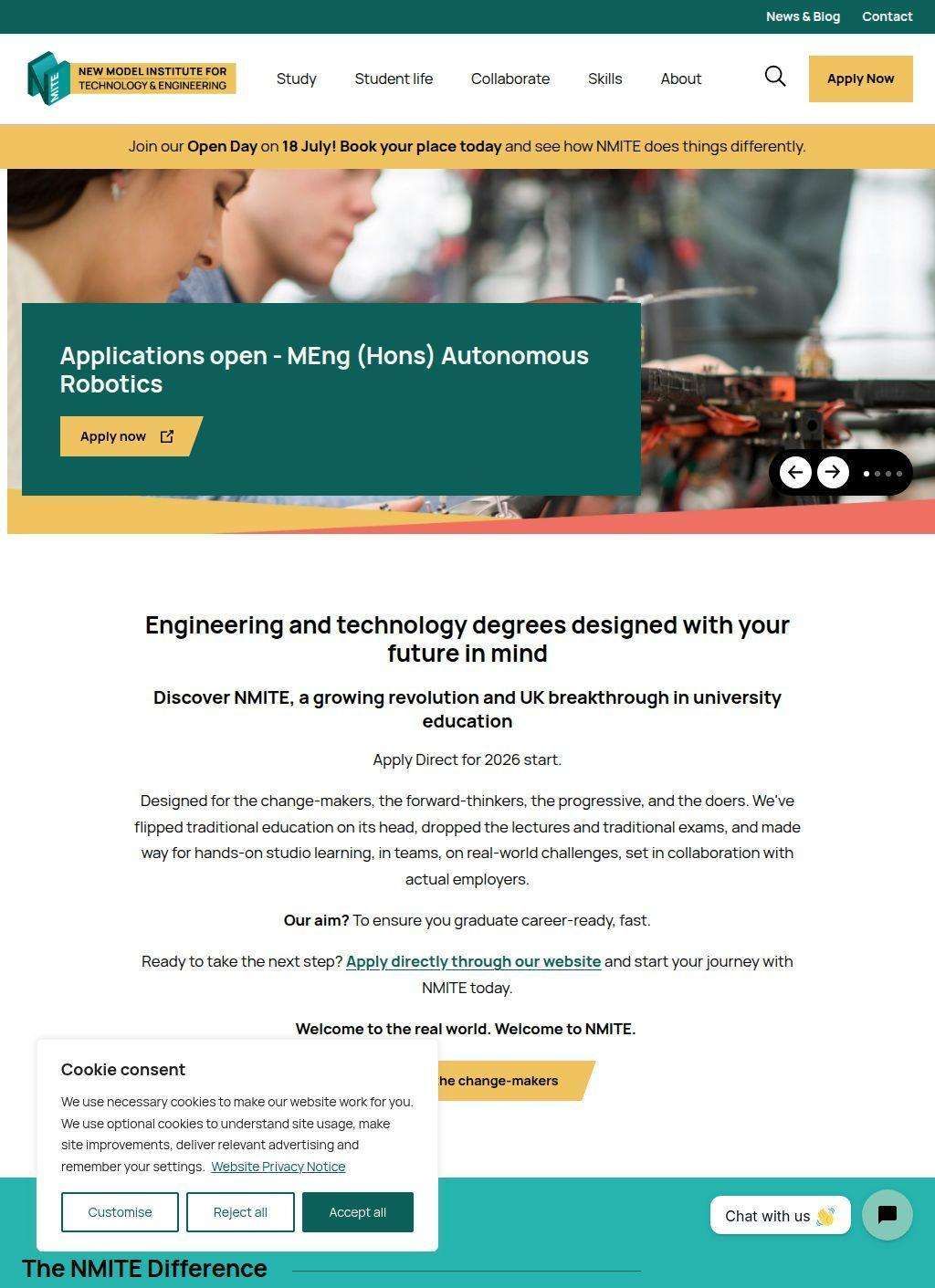
Engineering and technology, and nothing else. That is the whole scope of NMITE (New Model Institute for Technology and Engineering), a higher education institution based in Hereford, England. There is no sprawling faculty list, no arts wing, no hedging across a dozen disciplines. The degrees on offer run from a BEng (Hons) Integrated Engineering through several accelerated master's routes, including MEng (Hons) Integrated Engineering, MEng (Hons) Mechanical Engineering, and MEng (Hons) Autonomous Robotics, plus a BSc (Hons) Construction Management. For anyone weighing where to study engineering in the west of England, that narrowness is the point worth understanding first.
Studio learning replaces lectures
The teaching model is where this place diverges sharply from a conventional engineering school. NMITE (New Model Institute for Technology and Engineering) has dropped the lecture hall and the formal exam altogether. In their place sits studio-based, team project work tied to real challenges that industry partners help set.
The institution says it works with over 80 such partners, and that figure does a lot of explaining: a curriculum built around live problems needs a steady supply of those problems, and a long partner roster is how a school keeps them coming. Whether the absence of exams suits a given student is a genuine question, and one that depends heavily on how someone learns. Some people thrive when assessment is continuous and collaborative. Others find they need the structure of an exam season to consolidate what they know, and for them this format may feel unmoored.
Accreditation gives the model a backstop. The engineering degrees carry IET (Institution of Engineering Technology) recognition, because it means the unconventional pedagogy still lands graduates on a path that the wider profession accepts. A school can experiment with how it teaches, but the credential at the end has to be legible to employers and to the chartership route. The IET stamp is the bridge between NMITE (New Model Institute for Technology and Engineering)'s departure from tradition and the practical reality that graduates need a qualification the industry reads without hesitation.
Foundation Year and non-traditional entry
A large part of what NMITE (New Model Institute for Technology and Engineering) is trying to do becomes clear in its admissions design. There is a Foundation Year pathway aimed squarely at applicants who do not meet standard entry requirements, expressly including those who arrive without A-level Mathematics and Physics. That is an unusual door to leave open in engineering, a field that more often treats those two subjects as non-negotiable gatekeepers. The institution frames this as a deliberate push on inclusion and diversity, welcoming people from non-traditional academic backgrounds into a profession that has long struggled to broaden who enters it.
It is worth being clear-eyed about what a Foundation Year does and does not promise. It widens access in a meaningful way, and it gives a route to people who were sorted out of engineering at sixteen for reasons that often had little to do with their actual aptitude. The harder thing to judge from the outside is how well the bridge holds when load increases: whether students who start without that mathematical grounding finish the degree on equal footing, and how the accelerated master's routes in particular accommodate someone who came in through the longer door. The ambition is sound. The execution is the part a prospective student would want to probe directly with the admissions team.
Accelerated master's programmes
The accelerated framing recurs across the master's offerings, and it deserves a moment of its own. Three of the MEng programmes carry the "Accelerated" label, which compresses the timeline against a standard course. Compression can be a genuine advantage, getting a qualified engineer into work sooner and trimming the cost of living through a long degree. It also raises an obvious tension when paired with project-based, studio learning, which is not the fastest way to cover ground. How NMITE (New Model Institute for Technology and Engineering) squares an intensive calendar with a pedagogy that leans on iteration and teamwork is something worth pressing on in an open day conversation rather than taking on faith from a prospectus.
Short courses and professional development
NMITE (New Model Institute for Technology and Engineering) does not stop at full degrees. NMITE (New Model Institute for Technology and Engineering) runs Continuing Professional Development courses and a set of short courses with a practical, almost vocational flavour. The named ones give a fair sense of the spread: Timber Technology, Engineering and Design, known as Timber TED; Manufacturing Systems Optimisation; and an Introduction to Robotic Operating Systems built on ROS2. Some of these are funded through the UK Shared Prosperity Fund, pointing to a brief that includes regional skills development alongside degree education.
That CPD layer tells you something about how the school sees itself. A working engineer who wants to pick up timber-frame design or get a foothold in robotic operating systems is a different customer from an eighteen-year-old choosing an undergraduate course, and the short-course catalogue confirms NMITE (New Model Institute for Technology and Engineering) wants to serve both. The Timber TED line in particular reads like a genuine specialism rather than a box-ticking offering, and timber engineering is an area with real momentum as construction looks for lower-carbon materials. For a small institution, picking a few distinctive niches and going deep on them is a more defensible strategy than trying to mirror a large university's breadth.
From public funding to programme stability
The UKSPF funding on some courses is a double-edged detail. It lowers the barrier for local people to retrain, which fits the inclusion mission cleanly. It also ties part of the short-course programme to a public funding stream, and funded courses tend to come and go with the money behind them. A prospective learner should treat the current short-course list as a snapshot of what is available now, not a permanent fixture.
What gives NMITE (New Model Institute for Technology and Engineering) its coherence is the through-line connecting all of this: a refusal to teach engineering the way it has usually been taught. The studio model, the dropped exams, the open entry routes, the industry-set briefs, the niche short courses all point in one direction. The school is small and young, and it is making a bet that a different format produces engineers who are readier for actual work. Plenty of that bet looks reasonable on paper, and the IET accreditation suggests the profession is willing to take it seriously.
The doubt that lingers is whether the model survives the gap between its promise and a graduate's first job. A new institution can articulate a compelling philosophy long before it has the cohorts of alumni and the track record that would prove the philosophy works. Project-based learning with no exams is appealing in theory; what it produces over a full degree, especially an accelerated one taken by a student who entered through the Foundation Year without A-level maths, is the thing that cannot yet be read off the page. NMITE (New Model Institute for Technology and Engineering) is asking applicants to trust a system that is still establishing whether its outcomes match its intentions, and published graduate outcome data, when it becomes available in volume, will settle that question far better than any prospectus can.
Business address
New Model Institute for Technology and Engineering
Blackfriars Street,
Hereford,
Herefordshire
HR4 9HS
United Kingdom
Contact details
Phone: 01432 371111