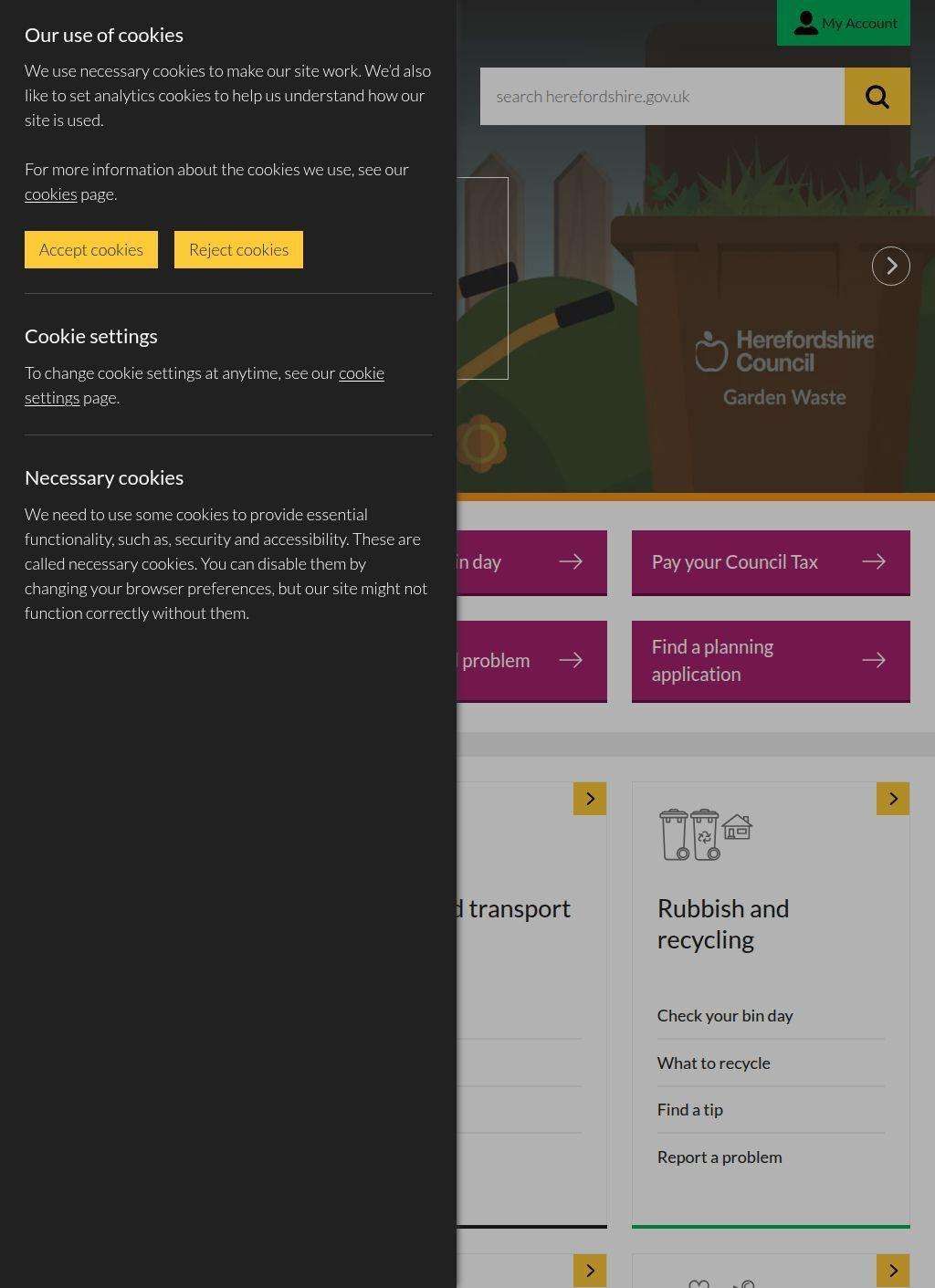
Bin collection dates and adult social care assessments live on the same website, which tells you most of what there is to know about the scope here. Herefordshire Council is the statutory authority for a largely rural county in the West Midlands, and its site is the place where that machinery meets the people who pay for it. The range is wide because the remit is wide: one minute a resident is checking when the recycling lorry comes, the next they are submitting a planning application or arranging care for an elderly parent.
Waste collection and household services
The everyday stuff is given proper room. Herefordshire Council publishes bin collection schedules, locations for household waste recycling centres, and a paid garden waste subscription for people who want green bins emptied through the growing season. None of this is glamorous and none of it pretends to be, but it is the kind of service that residents use far more often than they ever expect to. Getting it findable and accurate is half the job of a council website, and the structure suggests someone understood that.
Bin schedules, recycling centres, garden waste
Planning and building control sit alongside the waste pages and are important for anyone buying, selling, or altering property. You can search existing planning applications, submit new ones, and read about building control and neighbourhood planning. For a county that mixes market towns with a lot of open agricultural land, the planning function matters to farmers, developers, and homeowners in roughly equal measure, and Herefordshire Council treats it as a workflow to complete rather than a leaflet to read.
Planning applications for property matters
Schools and education form another solid block. The site lists term dates, a school locator, and information on school transport, plus support for special educational needs and disabilities. SEND provision in particular is one of those areas where families often have to chase information across several places, so having it gathered under one roof is genuinely useful. Plenty of local authority sites bury this material in a downloadable PDF, and the fact that it surfaces here as a named service is worth noting.
Schools, term dates, special educational needs
Money is handled through the council tax and business rates pages. Residents can pay online, check what discounts or reductions they qualify for, and businesses can register commercial premises and sort out rates. The online payment route removes one of the more tedious obligations of living somewhere. Travel and transport gets similar treatment: bus service details, cycling routes, parking, a tool for reporting road problems, and updates on the transport investment going into Hereford itself.
Council tax, business rates, transport
Then there is the heavier end of what Herefordshire Council does. Social care covers children's services, adult care assessments, and support for people with disabilities, which are the responsibilities that rarely make headlines but absorb a large share of the budget and carry real consequences when they go wrong. Community services round things out with libraries, museums, archives, support for parish councils, and climate action work. The site also points people toward job vacancies, apprenticeships, and adult learning, so it doubles as a recruitment channel for the organisation itself.
Social care and community services
Holding all of this together is an online user account portal, which is where a council site either retains a resident's patience or loses it. The portal idea is sensible: one login to the Herefordshire Council account, several services, a record of what has been submitted. There is also a news and consultations section, an events listing, and a feedback route. Consultations in particular are the formal way residents get a say on decisions that affect them, and putting them where people already go to pay their council tax is a reasonable bet on actually being seen.
Account portal and consultations
What Herefordshire Council does well, on balance, is breadth without obvious abandonment. A lot of public sector portals grow by accretion until half the pages are stale and the other half contradict each other. The grouping here, waste and money and planning and care and community and jobs, follows the way people actually think about their obligations to and from the authority instead of the way internal departments are organised. That is a harder design choice than it looks, and it pays off when someone arrives stressed and needing one specific thing.
Does the site work for residents?
None of this makes the experience effortless. Statutory functions are complicated by nature, and no amount of clean navigation turns a SEND application or a care assessment into a quick task. The site can only point the way and reduce friction, which is roughly what it sets out to do. Anyone expecting a council portal to feel like a polished consumer app will be disappointed, but that was never the right yardstick for measuring whether Herefordshire Council is doing its core job through this channel.
Finding the right page quickly
For residents, local businesses, and the occasional visitor trying to find a museum or a car park, the site works as the front door it is meant to be. It gathers the obligations and entitlements of living in the county into one place and lets most of them be handled without a phone call or a trip to an office. Herefordshire Council has clearly invested in making the digital route the default rather than the fallback, and the spread of services backs that up. Whether it gets you to the right page quickly or sends you hunting depends partly on how you approach the navigation and partly on what you came for, but most journeys end where they should.
Business address
Herefordshire Council
Plough Lane,
Hereford,
Herefordshire
HR4 0LE
United Kingdom
Contact details
Phone: 01432 260000