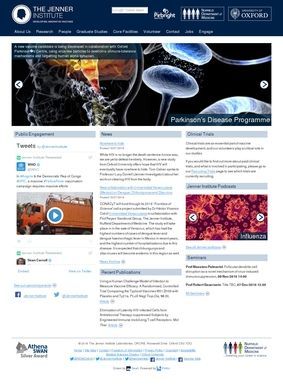
Oxford's vaccine research centre has a short answer to the question of whether it is serious: the COVID-19 vaccine that, by the institute's own published reckoning, has protected more than six million lives came out of this building. The Jenner Institute is also behind R21/Matrix-M, the malaria vaccine the World Health Organization recommended and that is now being rolled out across several African nations. Two diseases with enormous death tolls, two vaccines, one centre. That record shapes every reasonable reading of the site.
Research programmes across infectious diseases
The website lays out a programme that spans early laboratory work through to late-stage clinical trials. The infectious-disease list is long and specific: malaria, tuberculosis, HIV, hepatitis B and C, rabies, Epstein-Barr virus, gonorrhea, Ebola, Rift Valley Fever, coronavirus, and a range of arthropod-borne arboviruses. Less expected is that the work extends beyond infections altogether. The Jenner Institute runs programmes aimed at prostate cancer, Parkinson's disease, and chronic pain, which means the vaccine and immunology platforms here are being pushed into territory most people would not associate with the word "vaccine" at all. The site makes no particular fuss about this; it is simply listed alongside everything else, which is probably the right call given the catalogue is already substantial.
Cancer and neurological immunology work
The development side is described in enough detail to be useful. The Jenner Institute runs trials from Phase I through to later stages, and it operates its own Clinical BioManufacturing Facility, where investigational vaccines are produced under GMP conditions. The consequence of that arrangement is that the path from a laboratory idea to a vial that can go into a volunteer's arm sits largely under one roof, with no dependence on external manufacturers who may have competing priorities. Core laboratory capabilities listed include flow cytometry, bioprocess development, and nucleic acid extraction. These specifics give a concrete sense of technical capacity instead of a vague claim of being well equipped, and for anyone deciding whether an institution is worth following, that level of detail is more informative than summary statements.
Laboratory capacity and manufacturing
Several distinct audiences are served here, and the content is organised with that in mind. Early-career researchers will find the DPhil graduate programmes and the vaccinology training courses. A centre that trains the next cohort of vaccinologists is building capacity in a way that pure research output does not, and The Jenner Institute makes this function visible instead of burying it in a footnote.
Training the next generation
Clinical trial volunteers are another group the site addresses directly. The Jenner Institute recruits both healthy volunteers and NHS patients for its vaccine studies, with work supported through NIHR funding partnerships. The relevant pages are clear about what participation involves, which is more than the minimum. For the general public, there are educational materials, virtual tours, and podcasts. The virtual tours do something concrete: they let an outsider see what a working vaccine facility looks like instead of imagining something generic. Not every research centre bothers with this, and The Jenner Institute's investment in public accessibility is noticeable.
Recruitment and public engagement
The partnership picture is worth attention separately. The Jenner Institute works with African health ministries and global public health bodies, and the R21 deployment is proof that those relationships produce vaccines reaching populations rather than staying in an Oxford freezer. Research that ends at publication and research that ends with a child protected against malaria are different achievements, and the record here points clearly toward the latter. That distinction is worth drawing out because institutional websites frequently describe collaboration in language that could mean almost anything.
Global health partnerships
If the site has a limit for a casual visitor, it is that the depth is squarely aimed at scientists, trial participants, and students. Pages covering the laboratory methods and trial protocols are dense, and a reader without an immunology background will find some sections slow going. The public resources reduce that friction considerably, but this is a working research centre's website and it reads like one. That is not really a criticism; it is a description of what The Jenner Institute has chosen to prioritise.
Technical depth for specialists
Set against comparable institutions, what distinguishes The Jenner Institute is the directness of the line from bench to deployed product at global scale. Plenty of research groups do serious immunology; fewer can point to two vaccines that have measurably reduced mortality across multiple continents within recent memory. A student weighing where to pursue a doctorate, a clinician tracking malaria or coronavirus research, or anyone trying to understand how the Oxford vaccine was made will find the site worth the time. The Jenner Institute's published record is the strongest argument for the resource, and the website largely lets that record speak.