DEXA LONDON does one thing and charges a flat price for it, which is either a strong sign of focus or a sign that the clinic has not grown much past its launch.
Two scans at fixed pricing
The address is 86 Harley Street, Marylebone, operated under 3Beam Diagnostic Imaging Centre. Two scans are on offer at DEXA LONDON: body composition and bone density, both priced at 150 pounds each, no GP referral required. Nothing else is listed. No wellness add-ons, no tiered memberships, no pricing grid that shifts depending on which box you tick. At a Harley Street address, that restraint is noticeable; most private clinics at that postcode build their revenue on bundled packages and layered tiers.
Verified Google reviews via Trustindex
DEXA LONDON embeds Google reviews through Trustindex, which pulls testimonials from verified Google Business Profile entries rather than displaying self-submitted text. Individual positive comments appear across several pages of the DEXA LONDON site. What you will not find anywhere is a total count, a star average or a public rating on Trustpilot, Yelp or any other independent aggregator. Trustindex confirms that the review source is verified Google data; it does not tell you how many entries exist in total or over what period they were posted. For a clinic operating at one of London's best-known medical addresses, the absence of any visible public rating count is the most genuinely awkward feature of the listing.
That is not a reason to rule DEXA LONDON out, but it does mean you are working with no volume data at all from outside the clinic's own pages. The testimonials visible on-site are positive, and the Trustindex integration confirms they are not fabricated; the problem is simply that you cannot tell whether there are eight of them or eighty.
Body composition measurement by DEXA
Body composition via DEXA measures body fat percentage, lean muscle mass, visceral adipose tissue and limb symmetry. That last figure is where DEXA LONDON diverges from the gym InBody machines or consumer bioimpedance scales that dominate the walk-in "body analysis" market in London: limb symmetry produces a left-versus-right muscle distribution number that a physiotherapy patient or a strength athlete can use to identify and correct a side imbalance. Bioimpedance approximates total body composition from electrical resistance; DEXA measures tissue density directly. The two outputs are not comparable in precision, and for anyone using the figure to make a clinical or training decision, the gap between them becomes evident quickly.
Bone density assessment with rheumatologist review
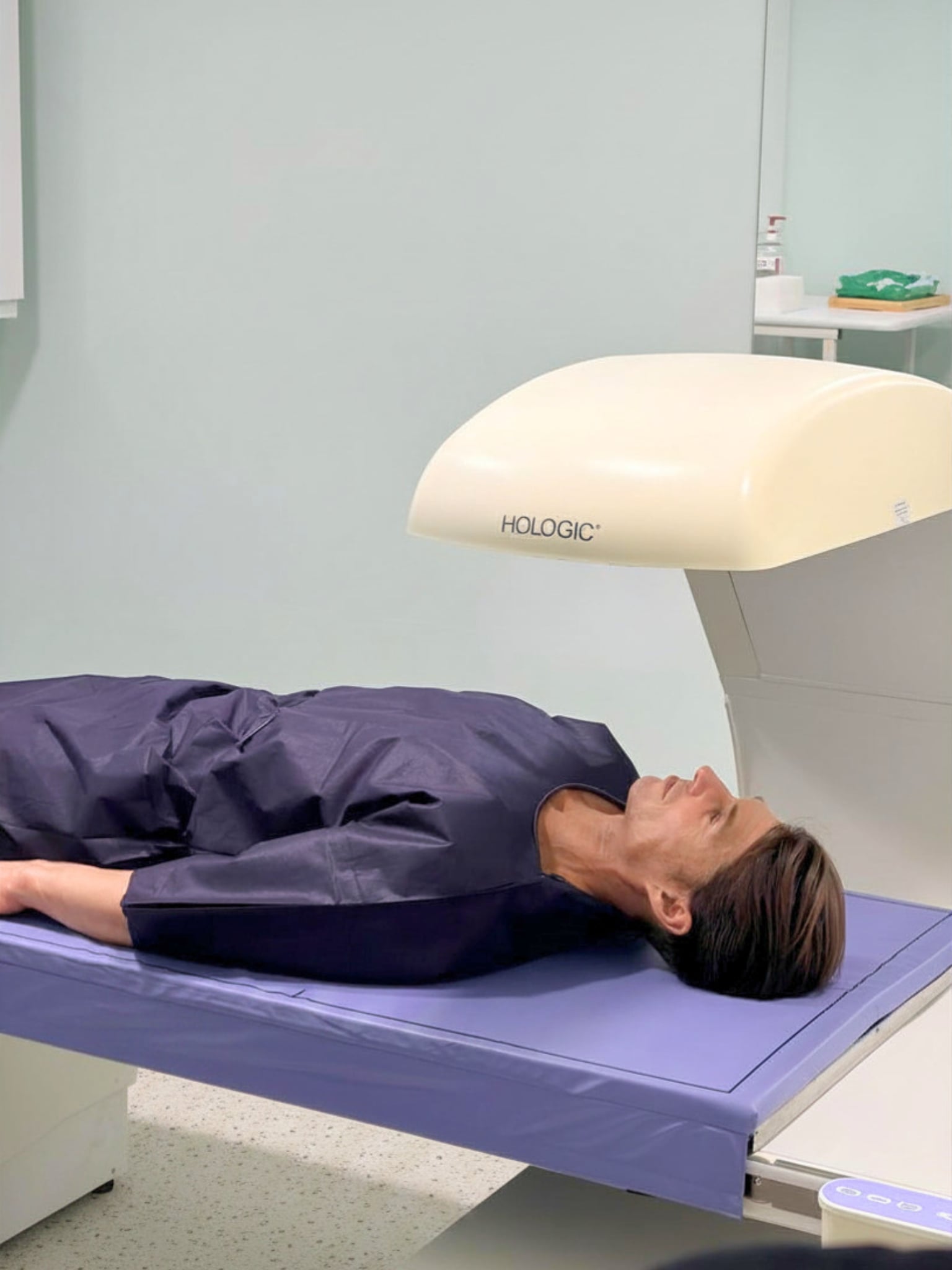
The bone density scan measures mineral density to assess osteoporosis risk and fracture probability. DEXA LONDON states that results are reviewed by UK consultant rheumatologists before the PDF report is issued. A raw T-score without specialist interpretation is of limited clinical use to most patients, so the rheumatologist review step is not decorative. Procedures are carried out by trained radiographers. The body composition scan at DEXA LONDON runs approximately ten minutes. Results leave the clinic as a PDF. The no-referral policy removes what is typically a multi-week delay for privately accessed NHS-adjacent testing, where a GP letter is usually required before a slot is offered.
DEXA LONDON also lists a commercial partnership with CutKilo, a medical weight-loss service, positioning the body composition scan as a starting-point measurement for that pathway. The arrangement is disclosed openly on the site. A body composition baseline is a sensible anchor for a weight-loss programme, and someone coming to DEXA LONDON purely for an independent health snapshot should simply know the commercial relationship exists before booking.
The DEXA LONDON website gives each scan its own dedicated page and includes a plain-language "What is DEXA?" explainer aimed at someone who has just encountered the technology and does not want to decode imaging jargon before booking. An informational blog extends that approach, staying narrow and clinical, never drifting into general wellness content. That editorial choice fits the service: DEXA LONDON is not presenting itself as a lifestyle brand, and the copy does not try to be one.
Booking and contact information
Booking at DEXA LONDON runs through Acuity Scheduling: pick a slot, confirm, done. No phone call is required to reach an appointment. A phone number, email address and the full Harley Street postcode sit on the main site alongside the booking link, visible without navigating to a separate section.
The clinical case for DEXA LONDON rests on a set of credentials that are straightforward to assess: radiographer-led procedures, consultant rheumatologist review on bone scans, a technology that produces more precise tissue-composition data than the alternatives at this price point, a fixed 150-pound fee with no hidden tiers, and a disclosed commercial partnership with a named weight-loss provider. None of those claims are difficult to verify independently, and none of them contradict each other.
What remains genuinely uncertain is how much patient volume DEXA LONDON has accumulated. The public review record gives you almost nothing to work with: no aggregate count, no platform-level rating, only a stream of positive individual comments whose total number is never stated. For a body composition scan, where the clinical stakes are modest and the technology credentials are self-evidently sound, that uncertainty is probably not disqualifying. For a bone density scan, where the result might inform a decision about fracture risk management or medication, the consultant rheumatologist review step and the documented Harley Street address form a reasonable clinical foundation, even without the review volume you would expect from a practice that has been running long enough to build one.
Business address
DEXA LONDON
86 Harley Street,
London,
London
W1G 7HP
United Kingdom
Contact details
Phone: 0207 637 8227