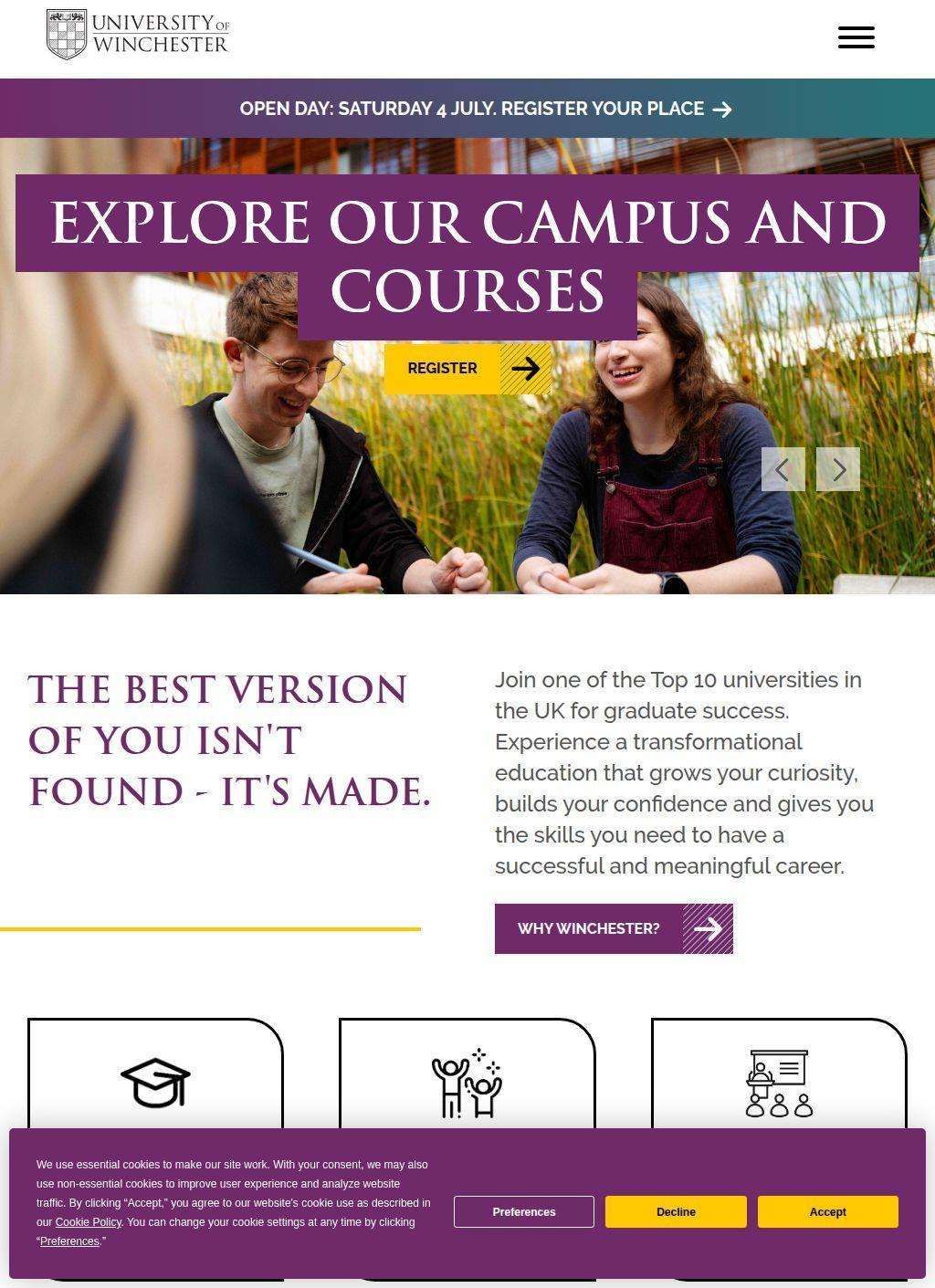
Someone weighing up where to spend three or more years studying usually arrives with a short list of practical worries: will the teaching be any good, will there be a roof over their head in first year, and will the degree lead anywhere afterwards. The University of Winchester answers those questions more directly than many institutions of its size.
Based in Hampshire, the University of Winchester is a mid-sized public university with a distinct identity built around education, the arts, and applied social science. It guarantees accommodation to first-year students, which removes one of the bigger sources of stress for anyone moving away from home, and it backs its teaching claims with an Ofsted Outstanding Provider rating for initial teacher training. Ofsted does not hand out Outstanding lightly, and teacher education is one of the things Winchester has built a long reputation around.
Five faculties and subject range
The academic side is organised into five faculties: Education and the Arts; Business and Digital Technologies; Humanities and Social Sciences; Health and Wellbeing; and Law, Crime and Justice. That spread tells you a lot about who the place is for. Someone drawn to creative work will find drama, film, music and the wider creative arts. Someone with a more applied bent has business management, digital technologies, psychology, sociology and criminology to pick from. Nursing, health and social care sit alongside law and history, so the institution is not narrowly specialised the way some smaller universities are. It covers a genuinely broad sweep of subjects while keeping a recognisable identity around teaching, the arts, and social science.
Qualifications beyond undergraduate degrees
The range of qualifications goes well beyond the standard three-year undergraduate degree. At the University of Winchester, postgraduate taught programmes including MA, MSc and MBA awards, and research degrees up to MPhil and PhD. For people who do not arrive with the usual entry grades, there are foundation years that build up to a full degree. There are also degree apprenticeships, which let someone earn while they study, and flexible or distance learning options for those who cannot commit to being on campus full time. That breadth of entry routes is telling, because the place is clearly trying to admit people from more than one starting point in life.
To help applicants navigate all of this, the site carries a course search tool, a prospectus to download, and open day booking. Those are the three things a prospective student actually uses when deciding, and Winchester puts them within easy reach rather than burying them. The course search in particular saves a good afternoon of clicking around, since the catalogue here is large.
Beyond the lecture timetable, the University of Winchester provides the facilities you would expect of an established campus institution: a library, student accommodation, a sports centre and gym, food outlets, and a Students' Union running clubs and societies. The Students' Union side is worth flagging because it tends to shape how a place feels day to day, and an active one points to a real community rather than a commuter site that empties at five o'clock.
Student support and inclusion
Support services are spelled out clearly. Academic skills help, wellbeing provision, careers advice and disability support all get their own attention, which is the sort of scaffolding that makes the difference between a student who struggles quietly and one who gets through. The University of Winchester also carries a Stonewall Diversity Champion designation, a marker that it takes inclusion seriously enough to be measured on it. Research runs across all five faculty areas, so undergraduates are taught in departments where staff are also producing new work in the field.
Inside a historic cathedral city
The city itself feeds into the case for the University of Winchester. Winchester was rated the safest area to live and work in the UK by Anubis in 2025, which is no small consideration for parents and for students living away from home for the first time. A historic cathedral city in Hampshire, it is compact and walkable, the kind of place where the campus and the town are not two separate worlds.
Employability and student satisfaction rankings
On outcomes, the University of Winchester reports a top 10 UK placing for employability in the UniCompare 2026 ranking, and 17th for student satisfaction in the UniFresher Guide 2026. A strong employability placing is exactly the figure that can tip a decision when two or three universities are otherwise neck and neck. Student satisfaction at 17th is a respectable showing, not the very top of the table, but solid. The University of Winchester is also part of the University Alliance group, which links it to other institutions with a similar applied, professionally focused outlook.
What you end up with is a mid-sized public university that knows what it is good at. The teacher training pedigree is externally validated, the subject mix is broad without being scattered, and the practical promises, a first-year bed, a clear course search, named support services, are the ones that prospective students weigh most heavily.
The University of Winchester does not try to be all things to all people, and the focus on education, the arts, health, law and social science gives it a coherent shape. The course catalogue is large, the entry routes are varied, and the city wrapped around the University of Winchester scores well on the one measure that quietly reassures a lot of families. That combination of validated teaching quality, genuine subject range, and a liveable city makes the University of Winchester a coherent choice worth investigating properly.
Business address
University of Winchester
Sparkford Road,
Winchester,
Hampshire
SO22 4NR
United Kingdom
Contact details
Phone: +44 1962 841515