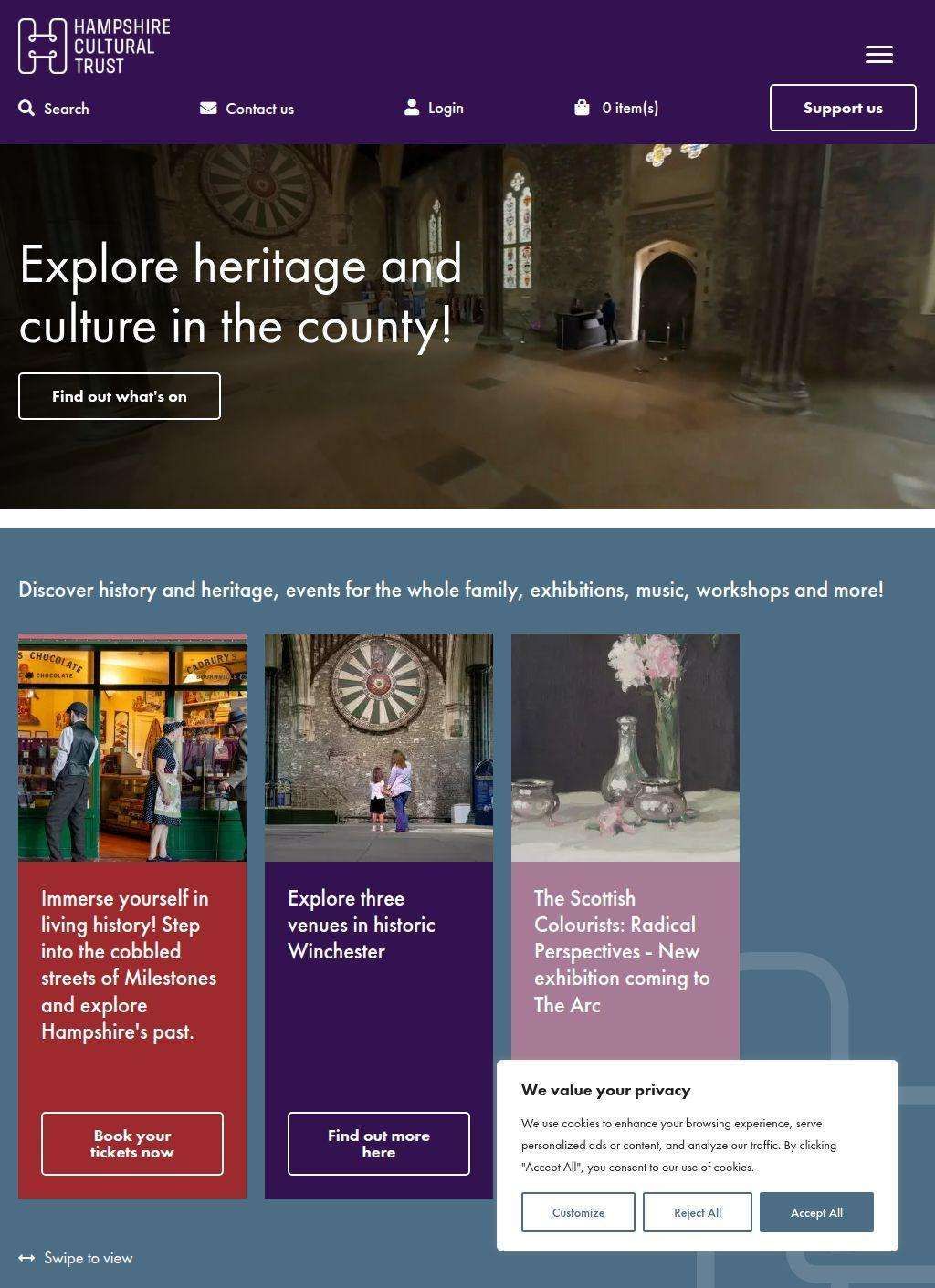
More than 2.5 million objects sit under the care of one charity running over 20 venues across a single English county. That figure reframes how the site should be read: Hampshire Cultural Trust is a county-wide network of museums, galleries, arts centres and historic sites, managed on behalf of Hampshire County Council. The collection spans thousands of years of local history, from Roman remains to industrial machinery, and the website functions as the front door to all of it.
Museums, galleries, arts centres across Hampshire
The venue list does most of the talking. Among the sites Hampshire Cultural Trust runs, Milestones Museum leans into working steam engines and industrial history, with hands-on period-street presentation that tends to land well with children and older visitors alike. Basing House offers Tudor ruins, Rockbourne brings a Roman villa, the Red House Museum sits in Christchurch, and the Willis Museum anchors Basingstoke. The Arc in Winchester and various town galleries round out the spread. Because each site has its own character, Hampshire Cultural Trust carries the awkward job of representing a comedy night, a Roman archaeological dig and a children's craft session under one roof, and it largely manages that by keeping the venues distinct.
Industrial history at Milestones Museum
The breadth here is the strongest argument for the site's usefulness. A visitor planning a day out can compare what is on at several locations in one place, and the geographic spread means most people in Hampshire have something within reach. The 2.5 million object figure underpins the online archive access offered by Hampshire Cultural Trust, which lets people look into collection material without a physical visit. For researchers, teachers or the simply curious, that digital layer is one of the more substantial things on offer.
Digital archive access
What the site does well is treat the collection as a living programme rather than a static vault. The same organisation that holds the objects also stages performing arts at its arts centres, which means music, theatre and comedy sit alongside the heritage material. That mix is unusual for a body whose core remit is conservation, and it gives Hampshire Cultural Trust a wider audience than a museum portal would normally reach. Someone arriving for a gig may never have set foot in a county museum, and the structure quietly nudges them toward one.
Performance arts alongside heritage material
There is a practical edge to all of this too. Hampshire Cultural Trust runs a costume hire service, Hampshire Wardrobe, drawing on the textile and period material a heritage body accumulates over decades. It is a small detail, but it shows an organisation putting its assets to active use. The site lists it plainly, which is the right call.
Hampshire Wardrobe costume hire
A good portion of the offering points at schools and learning. Educational programmes and structured school workshops are part of the core, and the site frames them as something teachers can build a visit around. For a county trust, this is more than a nice extra: it is how the collection justifies itself as a public resource and how a generation of local children first encounters Hampshire's own history.
Education, families, volunteers
The reach goes beyond classrooms. Hampshire Cultural Trust aims programmes at families, young people, older adults and vulnerable communities, which points to outreach work that does not always show up on a glossy events calendar. Family events, volunteering routes and targeted sessions all feature. The website does a reasonable job of conveying that this is a charity with a social brief well beyond ticket sales, though some of that work is the sort that is easier to do than to describe on a homepage.
Outreach to vulnerable communities
Volunteering is given real space, which fits an organisation of this scale: running 20-plus venues on public-sector backing almost certainly depends on it. The site treats volunteers as participants in the work, not an afterthought, and anyone weighing up how to get involved with Hampshire Cultural Trust will find the route reasonably clear.
Navigating a site that has to cover this much is never effortless. With venues scattered across the county and programming that ranges from Tudor ruins to stand-up comedy, the information architecture has a lot to hold together, and at times the sheer variety can make it harder to find a single specific event than it would be on a one-venue site. That is the trade-off for ambition at this scale. The pages for individual venues tend to be clearer than the broad landing sections, so visitors with a destination in mind will do better than browsers with none.
On outside reputation, a search turns up no aggregated public ratings for Hampshire Cultural Trust on the main review platforms, which is common for county heritage bodies. The absence does not mean much either way; this is a publicly funded charity whose accountability runs through council oversight and charity commission filings, not aggregated star counts. The published record, the breadth of the collection, and the scale of the programme are the real indicators here.
The verdict is mostly positive. Hampshire Cultural Trust is doing genuinely substantial work: a vast collection, real geographic coverage, a programme that bridges heritage and live performance, and an education and community remit that goes well past the usual museum brochure. The main limitation is one of breadth rather than substance, since a network this wide can make the website feel like a hub of hubs, and a first-time visitor may need patience to land on the exact thing they came for. That patience is generally rewarded. Hampshire Cultural Trust holds a lot, does a lot with it, and the site reflects that honestly.
Business address
Hampshire Cultural Trust
Chilcomb House, Chilcomb Lane,
Winchester,
Hampshire
SO23 8RB
United Kingdom
Contact details
Phone: 01962 398412