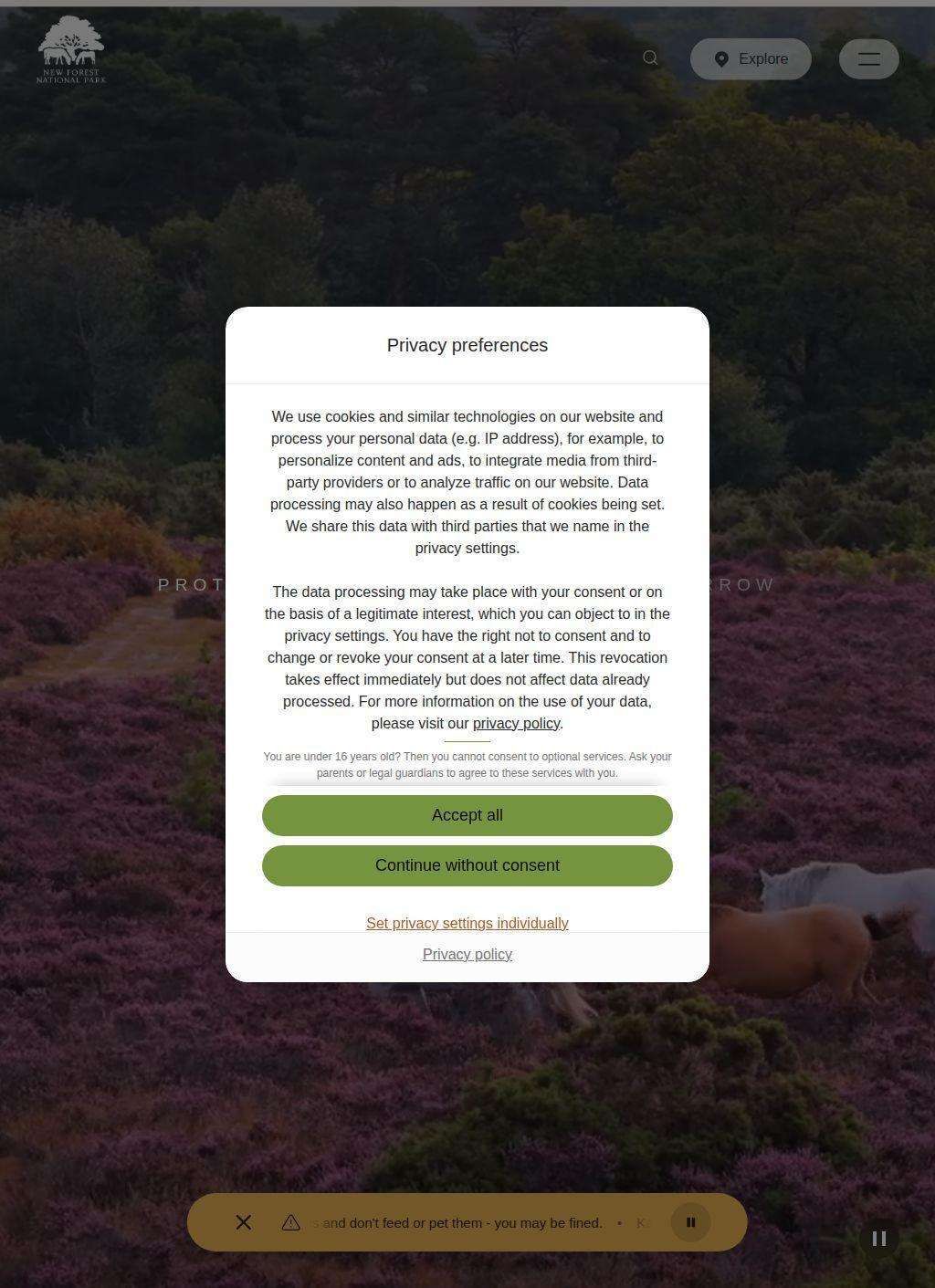
A single public body looks after roughly 566 square kilometres of heathland, ancient woodland and wetland in Hampshire, plus the 34,000 or so people who live inside its boundaries. That is the scale the New Forest National Park Authority works at, and the website is the front door to almost everything it does, from approving (or refusing) a house extension to telling a visitor where the ponies graze and why feeding them draws a fine.
The content sorts itself into five plain strands, and they do not pretend to serve the same person. One side is for residents, landowners and developers. The other is for the day visitor who has never been before. Trying to fold those audiences into a single tone usually produces mush, so it is worth noticing that the New Forest National Park Authority keeps them apart instead of blending them.
Planning applications and permissions
The planning material is the part I kept coming back to, because it is the part most sites in this space treat as an afterthought. There is a searchable planning application tool that lets a resident or a developer find a specific proposal, follow where it has got to, and leave a comment on it. Alongside that sits guidance on the more ordinary question of whether a given piece of work even needs permission, which saves people a phone call and a wasted form. There is also a route to report development that looks unauthorised, or land being used in a way it should not be. For a statutory authority, that combination is where the digital side either matches the legal duty or falls short, and here it broadly does.
Habitat management across landscapes
Conservation, gathered under the protecting heading, is the work the park exists to carry out. The New Forest National Park Authority lays out habitat management across the heath, the woods and the wetlands, along with climate and nature programmes and biodiversity projects tied to the particular character of the New Forest. None of this is dressed up as a list of achievements. It reads as a record of ongoing duty, which suits a body whose first job in law is to conserve and enhance the place.
Walking routes and visitor guidance
The enjoying section carries walking routes, cycling trails, a wildlife-spotting steer and an events calendar, with repeated, unsentimental reminders about how to behave around livestock and free-roaming ponies. The mix of welcome and warning is honest. A national park that depends on visitors still has to protect what those visitors come to see, and the New Forest National Park Authority does not soften that line to seem friendlier.
Getting involved in conservation
Then there is get involved, which is broader than the usual volunteer sign-up. Yes, there are conservation and community volunteering routes, but the same area reaches into sustainable-living advice, youth engagement, environmental career pathways and grant or partnership information aimed at community organisations. A small local group looking for funding or a formal partnership has somewhere concrete to start, which is more than a lot of public-sector sites manage to offer in practice.
Governance and statutory information
The about and governance material rounds it out with the structure of the New Forest National Park Authority, its statutory remit and the organisational detail you would expect from a public body answerable for how it spends and decides. Board meeting records, members, and the authority's published plans are all here. There is a newsletter sign-up too, and the small carrot of free walking guides for doing it, which is a fair trade for an email address.
What I find genuinely useful here is the refusal to flatten everything into visitor-friendly cheer. A planning applicant, a volunteer and a tourist all need different things from the New Forest National Park Authority, and the site treats them as different. The structure follows the work, so the parts with legal force (the planning search and the reporting tools) are given room instead of being buried under photography of the forest. That is a real editorial choice, and not an obvious one when funding for public-sector sites often depends on making them feel welcoming to the broadest audience.
If there is a fair criticism, it is one of breadth. Spreading across protection, planning, recreation, community grants and governance is a lot of ground for one site to hold without some corners feeling underdeveloped, and a visitor arriving for the walking routes might not immediately grasp how much of the New Forest National Park Authority is taken up with regulation and land management. That is the nature of the remit, not a flaw in the presentation. The New Forest National Park Authority cannot choose to be only the parts that photograph well.
Taken together, the website does the thing a national park authority ought to do online: it lets a developer track an application, a resident query a planning rule, a visitor plan a walk that respects the animals, and a community group chase a grant, all under one roof. The New Forest National Park Authority covers its statutory duties and its public-facing role without letting either crowd the other out. The published evidence is enough to go on: this is a well-organised public resource, and the side of it a person needs is accessible without having to dig through the parts that are not relevant to them.
Business address
New Forest National Park Authority
Lymington Town Hall, Avenue Road,
Lymington,
Hampshire
SO41 9ZG
United Kingdom
Contact details
Phone: +44 1590 646600