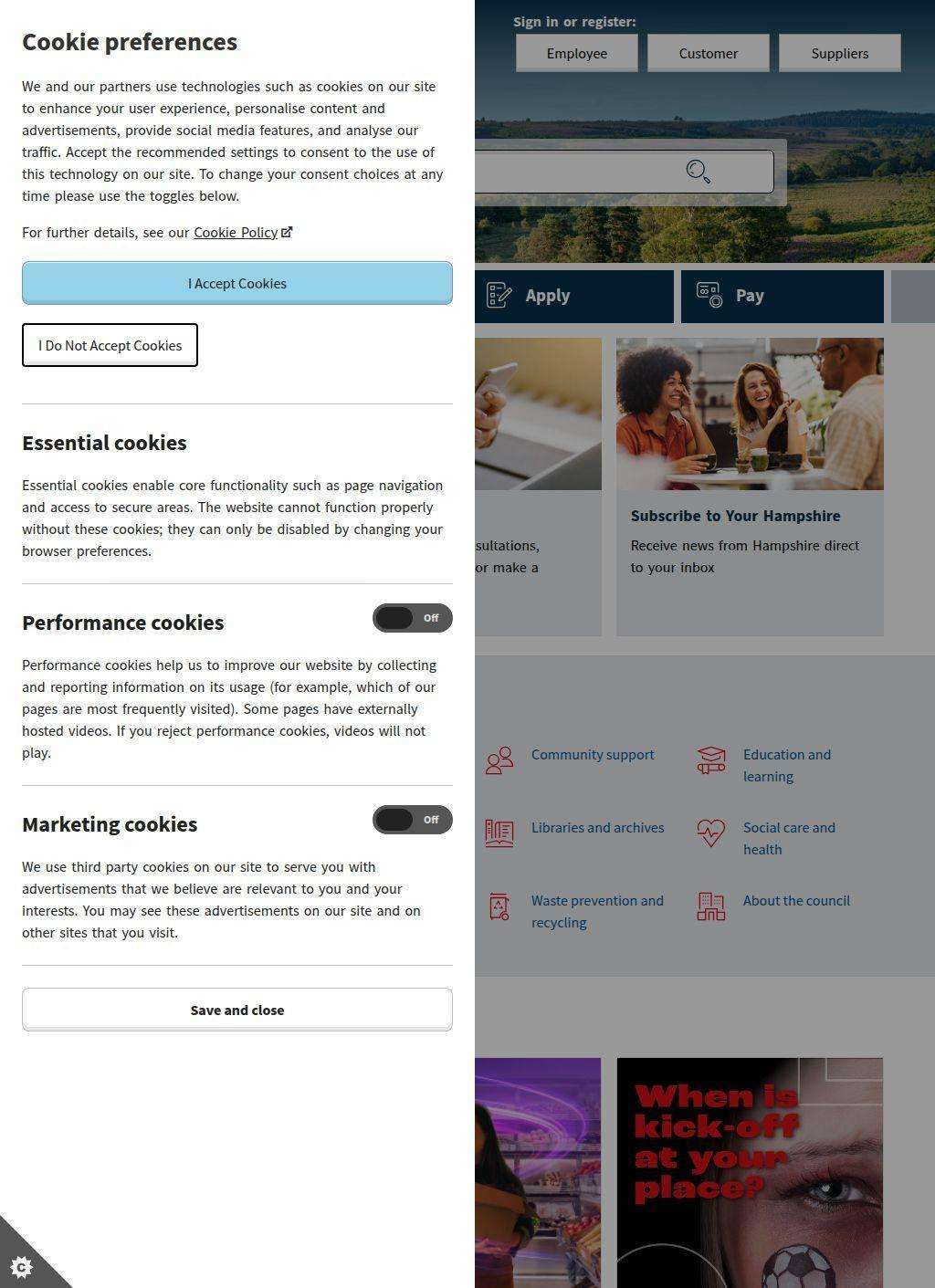
Hampshire County Council runs a commercial trading operation that sells pensions administration, catering, legal advice and audit services to schools and other public bodies, which is not what most people expect when they open a council website. That side of the organisation, branded Hampshire Services, sits alongside the everyday statutory work a county authority handles. The site at hants.gov.uk is the portal for both, covering a population of more than 1.4 million people across the county once Southampton and Portsmouth, which run their own unitary authorities, are set aside. As the upper-tier authority for the area, Hampshire County Council carries the duties a county handles for the towns and villages outside those two cities, and the homepage tries to hold all of them in one frame.
Resident services and statutory duties
The bulk of the site does the plain work a resident needs. School admissions and transport eligibility, library and archive access, social care for adults and children, planning policy and land use, and a jobs and volunteering portal are all here. Applying for a concessionary bus pass or checking whether a child qualifies for school transport, visitors will find a path to each. The breadth is wide enough that the homepage leans heavily on signposting, and that is the right call for an organisation with this many separate duties. Land, planning and environmental services share the same shelf, which shows how much of daily life in the county touches one Hampshire County Council function or another.
Transport planning and infrastructure
Transport is one of the deeper sections. Hampshire County Council publishes its Local Transport Plan 4, adopted in early 2024, along with local cycling and walking infrastructure plans, school travel planning, the SEND post-16 transport offer and a school minibus scheme. Road maintenance and strategic planning are documented here too. Residents trying to understand why a route is being changed or how to challenge a transport decision benefit from having the formal plans available openly rather than buried behind a request form. That transparency is a practical asset for Hampshire County Council, not a given among county authorities.
Social care, public health, hardship support
Social care and public health get comparable depth on the site. Hampshire County Council points residents toward Connect to Support Hampshire, a self-managed care portal, and runs public health programmes covering weight management, smoking cessation, and drug and alcohol misuse support. Adult and children's social care both have a presence. These are the services people reach for under pressure, so the value lies in whether the information is current and the routes are clear. The site treats them as core work, not as an afterthought.
There is also a hardship strand that is easy to miss. The Crisis Relief Fund offers direct payments and longer-term financial resilience programmes, and Hampshire County Council promotes free summer holiday activities for children. For a household in difficulty, that is concrete help, not a leaflet, and it sits within the same site as the routine forms.
Hampshire Services commercial operation
The commercial arm deserves a closer look because it changes how you read the whole operation. Hampshire County Council spends public money on residents, and it also earns revenue by selling back-office expertise. Pensions administration, catering, transport, legal advice and audit are packaged and sold to schools and other public sector clients. For a school business manager or another council weighing whether to buy in services, this part of the site works as a supplier catalogue, and it is unusual enough to be worth knowing about before you assume hants.gov.uk is purely a service-delivery portal.
How the dual purpose works
That dual purpose is handled without much fuss. The trading side is clearly separated from the resident-facing pages, so someone looking for a library card is not dropped into a procurement pitch. Whether the commercial offer is competitive is not something the site itself can answer, and a prospective buyer would still need to compare options, but the existence of a structured public sector services arm is a genuine point of difference for Hampshire County Council against a council that simply administers and nothing more.
Business and economic development
Business and economy resources round out the picture, aimed at the local economic development side of the council's remit. They are lighter than the transport or social care material, which is reasonable given that economic support is a smaller slice of what Hampshire County Council does day to day.
Navigation challenges on the homepage
A fair criticism is that the homepage asks a lot of the visitor. With this many service areas competing for space, the front page is a directory of directories, and a first-time user who does not already know which department owns their problem can spend a while narrowing down. That is a structural problem common to large authorities, and Hampshire County Council has not fully solved it, though the search and category routing soften the worst of it.
Does the site serve its users well?
Overall the verdict is positive with a caveat about navigation. As a reference for anyone living or working in the county, the site does the job: the statutory services are present, the formal plans are published rather than hidden, and the hardship support is specific and concrete. The commercial Hampshire Services strand adds something most council sites lack. What holds it back from a clean recommendation is the density of the entry points. The depth is there, but a resident in a hurry may feel the breadth before they feel the help. Repeated use over months is where Hampshire County Council rewards the patience the layout demands.
Business address
Hampshire County Council
The Castle,
Winchester,
Hampshire
SO23 8UJ
United Kingdom
Contact details
Phone: +44 1962 841841