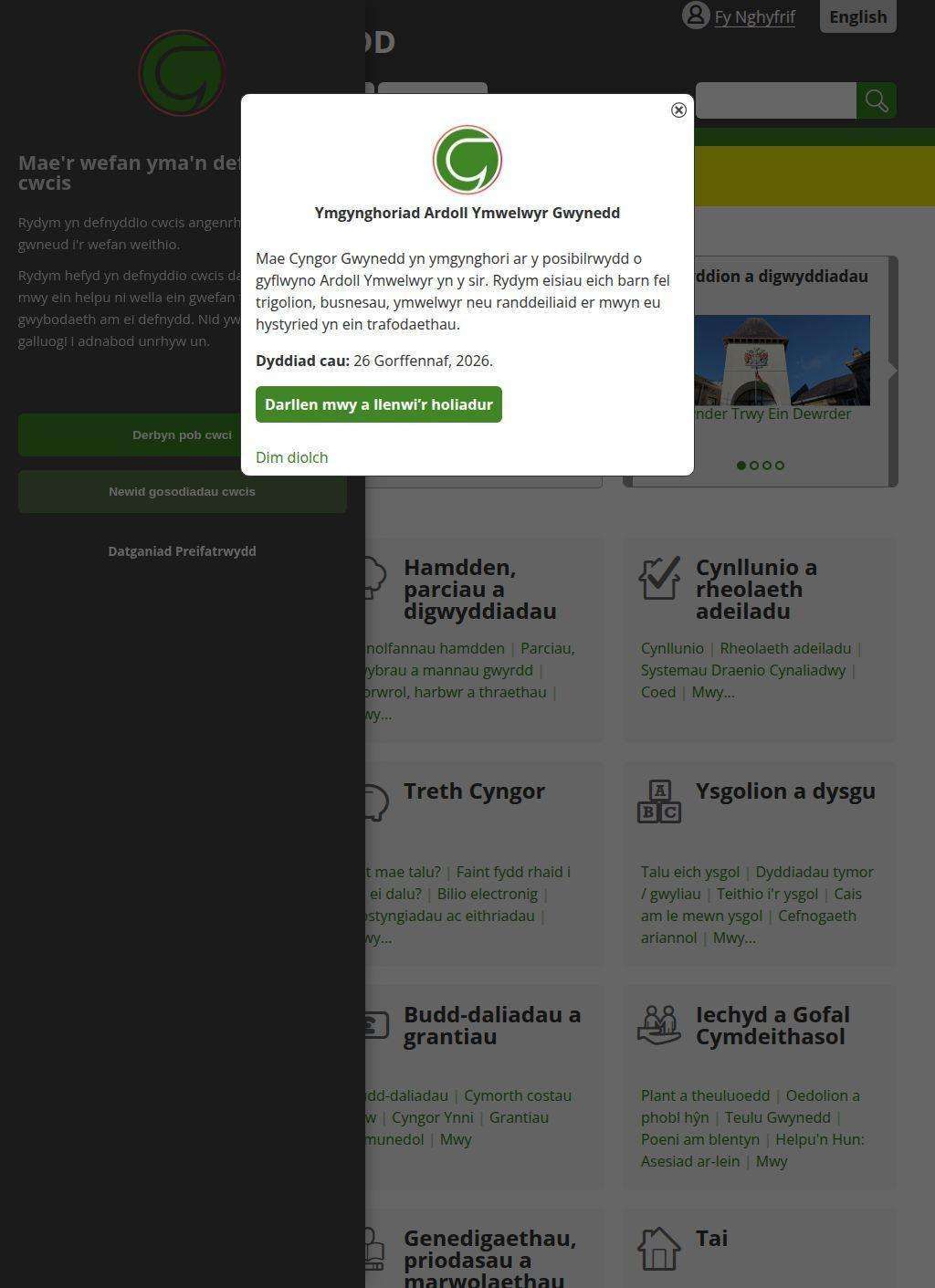
Cyngor Gwynedd is the unitary local authority responsible for one of the largest counties in Wales by land area, stretching from the Llyn Peninsula in the west across to the high ground of Eryri and up to the city of Bangor. Its website is the front door to the everyday services that residents, businesses and visitors rely on, and it runs as a fully bilingual operation, with Welsh and English given equal standing throughout. For a county where Welsh is the first language of a large share of the population, that bilingual presentation is not a nicety but a statutory expectation, and the council treats it that way.
Council tax and waste collection
The home page organises itself around the things people actually come looking for. Council tax sits near the top: bands, payment by direct debit, the single person discount, and the various reductions and exemptions that apply to students, carers and empty properties. Waste and recycling is the other heavyweight, with the rolling collection calendar, rules on what goes in which bin or bag, garden waste subscriptions, and booking slots for the household waste and recycling centres scattered across the county. Anyone who has tried to work out a bin day after a bank holiday will appreciate that the calendar is searchable by postcode rather than buried in a downloadable leaflet.
Planning across the national park boundary
Planning is handled through the same portal, and this is where the council's responsibilities get more interesting given the geography. Large parts of Gwynedd lie inside the Eryri National Park, where planning is the remit of the park authority rather than the council, so the site has to be clear about where one boundary ends and another begins. For land outside the park, residents can view applications, comment on proposals affecting their street, check the local development plan and download the policies that govern householder extensions, agricultural buildings and second-home conversions. Second homes and holiday lets have become a charged subject across coastal and rural Gwynedd, and the council uses the site to publish its council tax premium decisions and the consultations that feed into them.
Schools and social care services
Education takes up a substantial section, reflecting the authority's role as the largest provider of Welsh-medium schooling in the country. Parents use the pages to apply for primary and secondary places, check catchment areas, arrange school transport across long rural distances, and read admission appeals guidance. The council also runs adult learning and works closely with the further and higher education providers in the area, so the education pages link outward as well as inward. Social services for adults and children sit alongside, covering safeguarding, care assessments, support for carers, and the fostering and adoption routes, with clear contact points for anyone who needs to raise a concern urgently.
Public meetings and councillor records
Beyond the personal services, the site doubles as a hub for civic and democratic life. Committee agendas, cabinet decisions, councillor details and the schedule of meetings are published in a structured way, and many meetings are now streamed, which matters in a county where getting to Caernarfon for a Tuesday morning session is a real undertaking from the southern valleys or the Llyn. There are pages on jobs with the council, which is one of the larger employers in the region, plus tenders and procurement notices that local firms watch closely. A business directory entry like this one tends to be the first stop for someone who knows the council exists but has never needed to find its actual web address, and the council's own search tools take over from there.
Inside the council offices in Caernarfon
The authority's headquarters are the Council Offices on Shirehall Street in Caernarfon, a building that has served county administration in various guises for well over a century. Telephone contact runs through a single main switchboard during weekday office hours, and the site is candid that phone lines are busiest first thing in the morning and that many requests are dealt with faster online. There are area offices and one-stop shops elsewhere in the county, including arrangements in Dolgellau that reflect the historic split of the old county administration, and the contact pages list these rather than pretending everything happens in one place.
Practical design of the website
Tone and design are practical rather than flashy. This is a public-sector site built for breadth of function, not for visual polish, and it shows in places. The underlying platform is the shared template used by several Welsh local authorities, which gives it a familiar structure if you have used another council's site, but also means some deeper pages carry a lot of text and a fair number of PDFs. Search generally works, though as with most large council sites the results can surface archived documents alongside current ones, so it pays to check the date on anything official before relying on it. None of this is unusual for a body of this size, and the core transactional journeys, paying, reporting and applying, are kept reasonably direct.
Reporting local infrastructure problems
One genuine strength worth flagging is the reporting function. Potholes, fly-tipping, broken streetlights, blocked drains and abandoned vehicles can all be reported online with a location pin and a photograph, and the system issues a reference so the report can be tracked. For a rural authority maintaining a huge network of minor roads and mountain passes, much of it exposed to harsh winters, that channel does real work. Visitors planning a trip into the mountains or along the coast also find practical material here, from car park information to seasonal advice, though anyone heading specifically into the national park will usually want the park authority's own pages too.
Libraries, leisure centres, business grants
The council's wider cultural and economic role surfaces across the site too. Libraries, leisure centres, country parks and the county's arts and heritage offer are all represented, with details on opening hours, memberships and events that change with the seasons. Economic development pages set out the grants and business support the authority administers, often alongside Welsh Government and regional growth-deal funding, which local firms and start-ups watch for.
Housing, registrars, trading standards
There is material on the Welsh language standards the council operates under, on housing and homelessness support, on registrars for births, marriages and deaths, and on trading standards and environmental health for businesses that need licences or inspections. Taken together these sections show an authority doing far more than the headline services of tax and refuse suggest, and the directory listing here is a reminder that a single official site sits behind a remarkably broad portfolio.
It is also worth being honest about the limits of what a council website can do. Some specialist functions are delivered through partner bodies or shared regional arrangements, so a query about, say, certain health-related social care matters may route a resident toward the local health board rather than the council itself. The site is reasonably good at signposting these handovers, but the very breadth of local government means a first-time visitor occasionally has to follow a link or two before landing in the right place. Setting expectations that way is fair: this is the administrative centre of a county, not a single-purpose service.
For a business directory aiming to point people toward authoritative local institutions, Cyngor Gwynedd is close to essential. It is the definitive source for anything to do with local taxation, refuse, planning outside the park, schooling, social care and local democracy across north-west Wales, and it is run with a clear bilingual commitment that reflects the community it serves. Residents, prospective movers, second-home owners weighing the premium, contractors chasing council work and visitors planning a stay will all find what they need here, provided they are ready to do a little reading. As the official municipal presence for Gwynedd, it carries an authority that no commercial or third-party site can match, which is exactly why a directory should send people to the source rather than a substitute.
Business address
Cyngor Gwynedd
Council Offices, Shirehall Street,
Caernarfon,
Gwynedd
LL55 1SH
United Kingdom
Contact details
Phone: 01766 771000