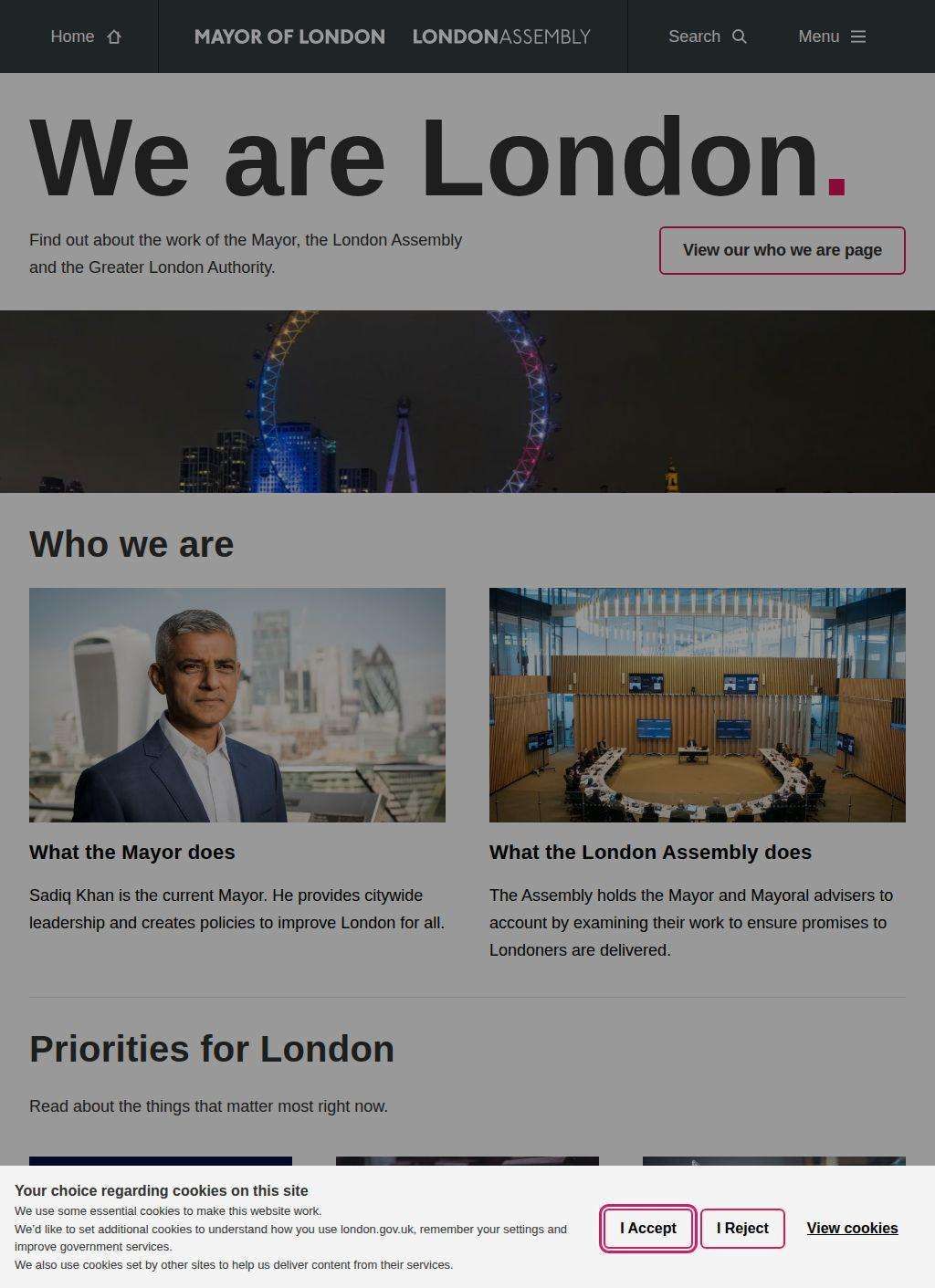
London's top-tier regional government pairs a directly elected Mayor with a 25-member Assembly, and london.gov.uk is the public front door to both. The Greater London Authority keeps those two functions clearly separated rather than blurring them into a single ministerial voice, which makes it easier to tell who decides what and where to push back. The Mayor sets strategy; the Assembly scrutinises it and publishes what it finds.
Policy priorities for London
Most of the page weight goes to policy that touches daily life across the capital. The London Growth Plan sets out a ten-year economic strategy, and the London Plan sits alongside it as the statutory spatial development framework that governs how and where building happens. Housing and land policy runs through both. There is a programme to cut rough sleeping with a stated aim of ending it by 2030, plus cost-of-living support pages that mostly point to where help can be found. Transport policy is coordinated here in tandem with TfL, so the strategic direction lives on this site even though the operational network sits elsewhere.
Sector policies from environment to culture
Environment and climate work gets real space too, including air quality monitoring updates refreshed often enough to be worth checking if you live near a busy corridor. Education and youth initiatives, jobs and skills programmes, health and wellbeing policy, and arts and culture funding each have their own strands. That last strand is more practical than it sounds: the Greater London Authority hosts a searchable funding database covering grants and investment open to organisations and, in some cases, individuals. Anyone hunting for a cultural or community grant should check there before assuming nothing is available.
Ways to engage with the GLA
There is also a fair amount of machinery you can engage with directly. Talk London is the consultation platform where Londoners can respond to live policy questions and join discussion threads, and it is the cleanest route into shaping a decision before it is fixed. An events calendar, current job listings within the Greater London Authority and its related bodies, and venue hire for City Hall and other premises round out the practical layer. Schools can book visits to City Hall, which is a genuinely useful resource for teachers planning a civics trip. Topic-based newsletters let you follow one subject without drowning in everything else, and each strand keeps its own archive so an older response or report is still reachable months later.
Inside the Assembly's scrutiny work
The Assembly section is more substantial than these portals usually manage. Scrutiny reports, question time transcripts, and committee proceedings are published and accessible, so you can read what was asked and what was answered instead of relying on a summary. The pages also explain how to reach individual Assembly Members, which is useful if you want a specific concern raised by someone with a formal channel to the Mayor. For anyone tracking a planning fight or a budget line, this is the part of the Greater London Authority site that repays a slow read, because the working out is left in instead of tidied away. It is also the section that makes the rest of the site easier to trust, since the body publishing the policy is the same body letting you check how it was challenged.
London's data and research resources
Underneath the policy is a steady supply of evidence. Planning and development decision documents are available, and the site publishes its own research, data, and statistics on London's economy, population, and infrastructure. That data is the quiet workhorse here. Journalists, researchers, councillors, and people writing funding bids all draw on it, and having the source numbers in one place saves a lot of second-hand guessing. The figures are presented as the Greater London Authority's own work, with the dataset attached instead of a headline pulled out of context, which is the right standard for material this many people cite.
Why is the site hard to navigate?
The breadth does come with a cost. A Greater London Authority site that holds spatial strategy, grant databases, scrutiny archives, consultation tools, and statistical research is never going to feel light, and finding one specific document sometimes means a few wrong turns through overlapping sections. Search helps, but the structure assumes you already know roughly which body owns the thing you want, so a first visit can feel like learning the building before you can use it. That is the trade-off for putting this much in one place, and on balance the depth earns the occasional detour.
Practical starting points for visitors
Go straight to the funding database if money is the question, open Talk London to be heard on live policy, and read the Assembly's scrutiny reports to understand who is being held to account and how. The Greater London Authority does not hide its reasoning, and for a body of this size and reach that openness counts for something.






Business address
Greater London Authority
Kamal Chunchie Way,
London,
Greater London
E16 1ZE
United Kingdom
Contact details
Phone: +44 20 7983 4000