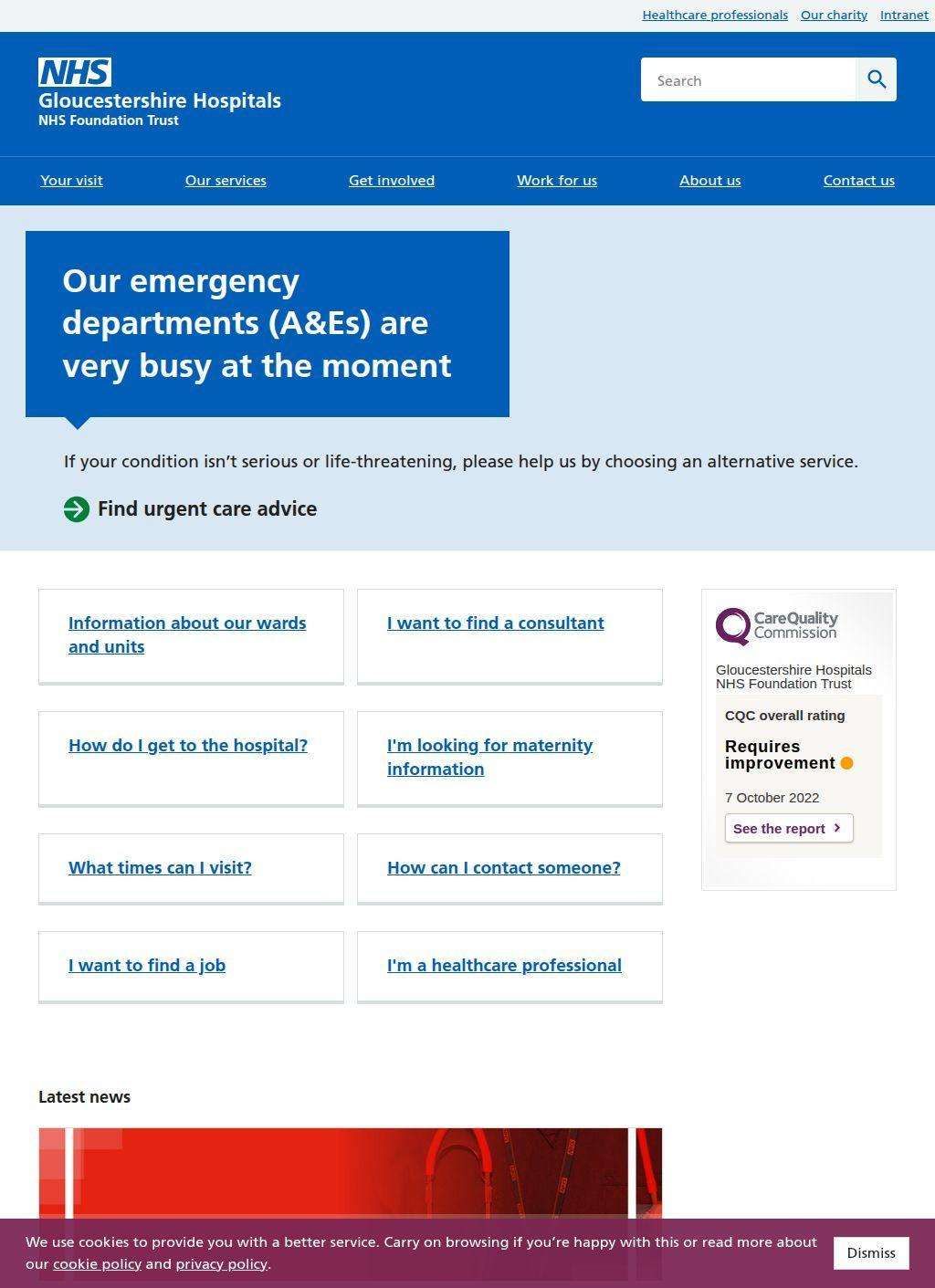
Hospital care in Gloucestershire runs through two main acute sites: Gloucestershire Royal Hospital in Gloucester and Cheltenham General Hospital in Cheltenham. Gloucestershire Hospitals NHS Foundation Trust operates both, employing roughly 9,000 staff across them. That staffing figure alone tells you something about the scale of what is covered here. This is the main provider of hospital medicine for the county, and the website is the front door to nearly everything those two buildings handle.
Two hospital sites across Gloucestershire
The service list is wide and, refreshingly, specific. Cancer services and oncology sit alongside cardiology, paediatrics, audiology, maternity, pathology and physiotherapy. Emergency departments operate at both Gloucestershire Royal and Cheltenham General, with the site giving clear public guidance to consider alternative urgent care routes when demand peaks. That last point reads like genuine operational advice from people who watch their own waiting rooms fill up, and it is exactly the sort of thing a reader checking before a late-night trip will want to find quickly. Gloucestershire Hospitals NHS Foundation Trust also runs NHS video consulting and keeps appointment management tools available, which spares some patients a journey for matters that can be handled remotely.
Emergency departments and remote consulting
One detail worth noting is how practical wayfinding sits next to the clinical content. The site carries ward and unit phone directories, which is the unglamorous information families dig for when someone is admitted and they need to reach a specific ward. A Patient Advice and Support service is signposted too, along with patient feedback mechanisms. These are not headline features, but they are the parts of a hospital site that get used under stress, and Gloucestershire Hospitals NHS Foundation Trust putting them where people can find them matters.
Ward directories and patient support
The trust holds NHS Foundation Trust status, which is a specific governance arrangement: it lets members of the public and staff become members and gives them a route into how the organisation is run. For most patients that structure stays in the background, but it does mean decisions are subject to a layer of local accountability that an ordinary NHS hospital does not carry in the same way. Anyone interested in how their local healthcare is governed can find a real path to involvement, with standing to participate in governance decisions.
Capital investment in acute services
There is also money on the ground to back the descriptions. Between 2021 and 2025 Gloucestershire Hospitals NHS Foundation Trust put around 30 million pounds into emergency and acute medical upgrades at Gloucestershire Royal, and about 14.5 million pounds into expanding surgical facilities at Cheltenham General. Capital figures like these are worth more than glossy promises because they map directly onto the departments patients pass through. The investment at Gloucestershire Royal targets exactly the pressure point most hospitals struggle with, and the Cheltenham spend points to a deliberate split in how the two sites are used: surgical capacity being built up at one while emergency and acute medicine is reinforced at the other.
That division of labour is one of the more useful things to grasp from the site. Gloucestershire Hospitals NHS Foundation Trust does not pretend both hospitals are identical. The content makes it possible to work out which site handles what, and for a patient with a referral letter naming a department, knowing whether to head to Gloucester or Cheltenham is the immediate practical question.
Surgical expansion at Cheltenham General
Alongside the core NHS offering, Gloucestershire Hospitals NHS Foundation Trust runs a private patient service. It is mentioned plainly and sits as one option among many rather than dominating the picture, which fits the proportion you would expect from an organisation whose main job is public healthcare. Specialist provision is the real strength on display: cancer care, cardiology and maternity are the kinds of services people will travel for and rely on for years, and the site gives each its own section of information, with real depth behind the service name.
If there is a limit to what the website can do, it is the one every large hospital site shares. The sheer number of departments, wards and services means a first-time visitor has to do some hunting to land on the exact page they need, and the breadth that makes Gloucestershire Hospitals NHS Foundation Trust comprehensive also makes it dense. The phone directories and the support service help bridge that, and the inclusion of appointment management and feedback routes shows awareness that a hospital website is something people use in a hurry and often in distress.
Geographically Gloucestershire Hospitals NHS Foundation Trust serves Gloucestershire and the surrounding areas, so the audience is well defined: residents of the county and people referred into specialist services from nearby. There is no attempt to be all things to all regions, and the focus shows in how the two named hospitals anchor everything. This is the organisation a Gloucester or Cheltenham resident will deal with for anything beyond a GP visit, and the site reflects that reality without overselling it.
Reading through the range of services, what lingers is how much of it is genuine acute and specialist medicine rather than administrative scaffolding. Oncology, cardiology, paediatrics, maternity and pathology are real clinical engines, and pairing them with audiology and physiotherapy fills out the everyday side of hospital care that keeps people functioning between the bigger crises. Gloucestershire Hospitals NHS Foundation Trust covers both ends of that spectrum, from a routine hearing test to cancer treatment, and the website carries information on each without flattening them into a single generic page.
The NHS video consulting option deserves a second mention because it changes the shape of access. For patients who would otherwise need transport to one of the two sites, a remote appointment removes a real barrier, and Gloucestershire Hospitals NHS Foundation Trust offering it as a standard channel points to it having become part of normal practice. Combined with the appointment management tools, it reflects an organisation trying to handle volume sensibly across two busy hospitals.
What remains after going through the site is a reasonably clear map of where county healthcare happens. Gloucestershire Hospitals NHS Foundation Trust splits its work deliberately between Gloucestershire Royal and Cheltenham General, has put tens of millions of pounds into the departments that feel the sharpest pressure, and provides the governance structure that connects public members to how decisions are made. The 30 million pounds at Gloucestershire Royal and the 14.5 million at Cheltenham General are recent, specific, and sit exactly where patient demand is heaviest. For a county resident trying to understand the system before they need it urgently, the Gloucestershire Hospitals NHS Foundation Trust site does most of what it needs to.
Business address
Gloucestershire Hospitals NHS Foundation Trust
Great Western Road,
Gloucester,
Gloucestershire
GL1 3NN
United Kingdom
Contact details
Phone: 0300 422 2222