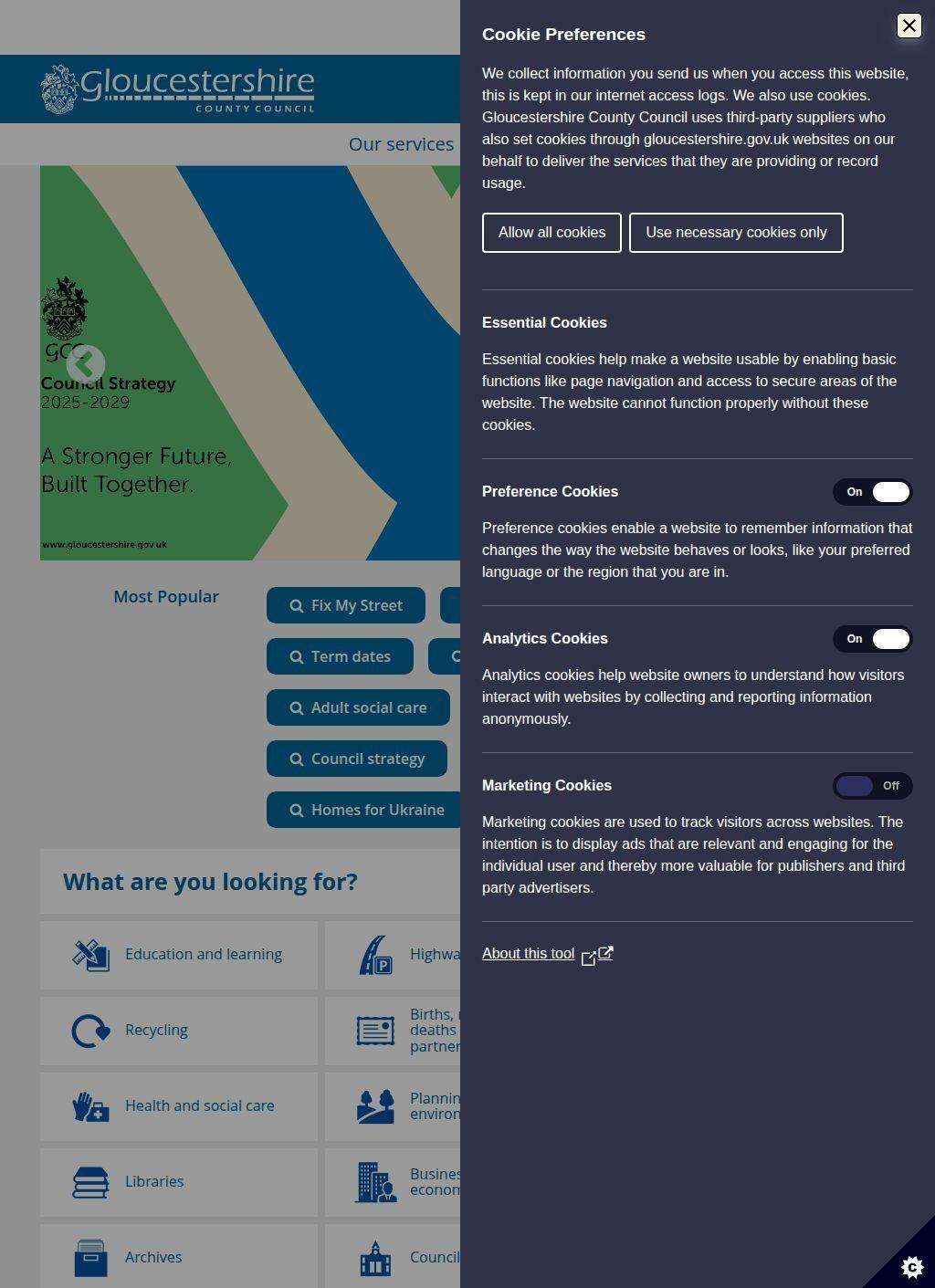
Fix My Street, a tool on Gloucestershire County Council's website, lets a resident drop a pin on a pothole, a broken street light, or a blocked drain and send it straight to the people who fix it. That single feature says a lot about how the site is put together: it is built around the things people in the county actually need to do, not around describing what the council is. A visitor arrives with a problem, and the layout points them at the section that handles it.
Site sections cover core council services
The spread of what sits behind the Gloucestershire County Council homepage is wide. Education and learning covers schools and the practical side of getting a child into one. Highways and roads maintenance is its own area, sitting close to the reporting tools. Recycling and waste management explains collections and what goes where. There are large sections for adult and children's health and social care, which tend to be the heaviest and most consequential pages a council runs, and they are given real room here instead of being buried. Planning and environment, libraries, archives, and transport each get their own space too.
Growth Hub aids thousands of local businesses
One part that stands out is the Growth Hub, a business-support service run under the Gloucestershire County Council umbrella. The figure attached to it is concrete: it is reported to have helped over 16,000 businesses across the county. That is the sort of number a site can point to and stand behind, and it turns an abstract promise of support into something measurable. Alongside it sits the Employment and Skills Hub, aimed at job seekers and people trying to build up their skills, which pairs naturally with the business side. A resident out of work and a firm trying to hire are, in effect, being served from two ends of the same page structure.
Where can residents find hardship support?
The Support Hub is another section worth spending time in. It gathers financial assistance, mental health resources, and energy-saving advice into one place. Councils often scatter this material across half a dozen departments, so pulling it under a single Gloucestershire County Council heading helps someone in a difficult stretch who does not have the patience to hunt through an org chart. Money worries, mental health, and heating bills are the kinds of pressures that arrive together, and grouping them reflects that.
District pages for Gloucester and beyond
For people who identify more with their town than with the county as a whole, the "Your Gloucestershire" pages break information down by district. That is a sensible touch. Gloucester, Cheltenham, the Forest of Dean, and the rural areas do not all have the same concerns, and a district-level view saves a reader from wading through material that does not apply where they live. It also quietly reinforces that Gloucestershire County Council sits above a set of smaller local bodies and has to speak to all of them at once.
Public decisions and council meetings
The council and democracy area is the part that separates a genuine public body from a service portal. It carries information on councillors, meetings, and decisions, which is the machinery that lets a resident see who represents them and how choices get made. This is not glamorous content and few people visit it on a quiet day, but its presence is the difference between a site that just delivers services and one that also answers to the public. Anyone wanting to check how a decision on a local road or a planning matter was reached can trace it here, which is exactly the kind of openness a body the size of Gloucestershire County Council owes the people it governs.
A task-first approach to the site
What holds the whole thing together is that Gloucestershire County Council has organised the site around tasks. Report a problem, apply for something, find advice, check a decision. The Fix My Street integration is the clearest example, because reporting a pothole is one of the most common reasons a person touches a council website at all, and making that fast removes a lot of friction. When the front door is a set of jobs to be done, most people get where they are going without needing to understand how the organisation is structured internally.
Trade-offs of serving many audiences
It is worth being clear-eyed about the limits of a site like this. The breadth is a strength and also a burden: a body responsible for social care, roads, waste, libraries, planning, and skills is trying to serve very different audiences from one place, and some pages will inevitably feel denser or more dated than others. Statutory information has to be present whether or not it reads smoothly, and that is the nature of local government online. Gloucestershire County Council carries the same load every county authority does, and the site's job is to make that load navigable rather than to disguise it.
Real-world value for residents and businesses
The value here is practical and easy to state. For a resident, the site is the route to services that are hard to get any other way: a school place, a care assessment, a bin collection query, a report of a hazard on the road. For a business owner, the Growth Hub is a real point of contact with support that has a track record behind it. For someone job hunting or retraining, the Employment and Skills Hub is a starting point that ties into the wider economic work the council does.
And for anyone under financial or personal strain, the Support Hub collects help that would otherwise take several searches to assemble. Taken together, these are the reasons Gloucestershire County Council keeps a place in the daily habits of people who use it, not as a page to admire but as one to return to when something needs doing.
Shared duties with district councils
A few things could be checked before assuming everything applies. County councils in England share responsibilities with district and borough councils, so a task like council tax or bin collection may in practice belong to a district body even though a resident starts their search at the county site. The "Your Gloucestershire" district pages help with this, but a visitor should be ready to be handed onward for certain matters. That is not a fault of Gloucestershire County Council so much as a feature of how English local government is layered, and the site does a reasonable job of signposting where one authority ends and another begins.
Bookmarking the county council site
Anyone who lives, works, or runs a business in the county should keep this site bookmarked. A resident with a broken street light should go straight to Fix My Street and file it there. A small business owner who has never used the Growth Hub should look it up and ask what support is on offer, given the number of firms it has already worked with. Someone caring for an ageing parent should head to the adult social care pages early rather than waiting for a crisis, because that is where an assessment starts. The Gloucestershire County Council site rewards a visitor who knows what they came for, and it is built to get them there.
Business address
Gloucestershire County Council
Shire Hall, Westgate Street,
Gloucester,
Gloucestershire
GL1 2TG
United Kingdom
Contact details
Phone: 01452 425000