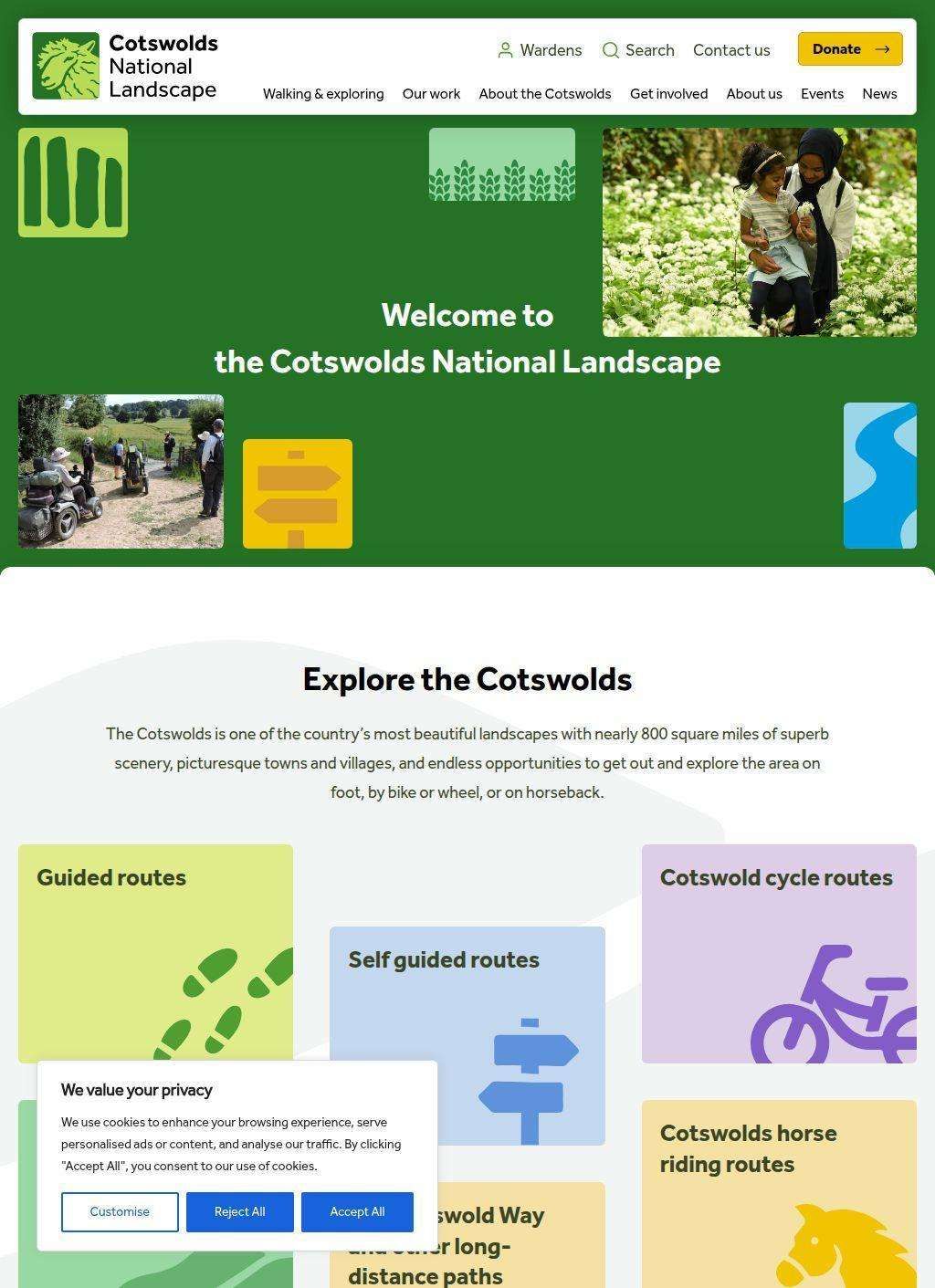
What does it take to look after nearly 800 square miles of protected English countryside, and who actually does it? That is the question this site answers, and the scope is broader than the picture-postcard idea of the Cotswolds as a pretty place to drive through. Cotswolds National Landscape is the statutory body responsible for the designated area that stretches across parts of Gloucestershire, Oxfordshire, Warwickshire, Wiltshire, and Worcestershire. The name changed from Cotswolds AONB, but the remit is the same one it has carried as a public conservation authority: managing how this landscape is protected, used, and farmed.
Walking routes, cycling paths, horse trails
For a visitor, the practical pull of the site is the route material. Cotswolds National Landscape publishes guided and self-guided walking routes, cycling paths, trails for horse riders, and the long-distance paths that thread the region together. Downloadable maps mean you can plan before you leave home. The accessibility guides are worth singling out, because plenty of countryside organisations treat access as an afterthought and this one builds it into the offering directly. Someone deciding whether a particular path suits a wheelchair user or a family with a buggy can find that out here, which is more useful than a gallery of scenic photographs would be.
Accessibility guides for different abilities
Underneath the visitor layer sits the work that justifies the organisation existing at all. Cotswolds National Landscape runs conservation and land-management programmes, including nature recovery initiatives and climate change projects. It also gives planning and development advice to local authorities and to developers, which is the less glamorous, more consequential side of protecting a designated landscape. A decision about where a new building goes, or whether a hedgerow survives, tends to shape the long-term character of the place more than any single walking trail. Putting that advisory function on the same site as the leisure content gives a fuller picture of what the body is for.
Conservation programmes, planning advice, land management
Farming gets its own dedicated strand, and that makes sense given how much of the Cotswolds is working agricultural land. Cotswolds National Landscape runs a farming support programme that offers grants and advice to landowners and farmers, which is the kind of thing that quietly shapes what the countryside looks like a decade from now. Land managers are the people who maintain or erode the features that make the area distinctive, so an authority that engages them with practical support is doing something more durable than signage. There is education provision too, with outdoor learning resources aimed at schools, so the audience runs from a class on a field trip up to a developer's planning consultant.
Farming grants, support for land managers
The volunteer side deserves a mention because it is unusually concrete. A warden network of more than 400 members supports on-the-ground management, the physical work of keeping paths, habitats, and access points in usable condition. Numbers like that tell you Cotswolds National Landscape is a coordinating hub for a real body of people out in the field, not a small office issuing guidance at a distance. For anyone thinking about giving time to landscape work in the region, that network is the obvious entry point, and the site treats volunteering as a genuine programme rather than a token invitation.
Volunteer wardens network across the region
Publishing rounds it out. Cotswolds National Landscape produces the Cotswold Lion magazine twice a year, alongside a public newsletter. Regular publications are a small signal that the body communicates with its public on an ongoing basis instead of going quiet between formal reports. The magazine also gives the casual reader a way in: you do not have to be a farmer or a planner to follow what Cotswolds National Landscape is doing across the area.
Magazine, newsletter, public communications
Set against each other, the strands cohere. A visitor planning a weekend walk, a farmer weighing up a grant, a teacher booking an outdoor session, and a planning officer checking guidance are all served from the same place, each with material pitched at their actual need. Cotswolds National Landscape covers the leisure face of the Cotswolds and the administrative spine that keeps the designation meaningful, and the site does not pretend the two are separable. The countryside people enjoy on a Sunday is the same countryside that requires nature recovery work, climate projects, and careful planning input to stay the way it is.
One caveat is worth naming plainly. Cotswolds National Landscape has no Google or Trustpilot review profile in the conventional sense; a public statutory body of this kind does not attract that sort of consumer rating. A search finds no independent review count to cite. The absence is not surprising and does not change how useful the site is.
How the Cotswolds stays actively managed
If there is a thread running through the whole operation, it is that Cotswolds National Landscape treats the area as a place that has to be actively managed, not simply admired. Conservation, farming support, planning advice, and the volunteer wardens all point the same direction: a landscape under continuous, deliberate care. The visitor resources are the friendly front door, and they are genuinely usable, but they sit on top of a remit that covers five counties and a working agricultural economy. One detail stays with me after going through it: the same body that hands you a downloadable trail map is the one advising a council on whether a development gets built, and both functions live a click apart on the page.
Business address
Cotswolds Conservation Board
The Old Prison, Fosse Way,
Northleach,
Gloucestershire
GL54 3JH
United Kingdom
Contact details
Phone: 01451 862000