Coleg Cambria is one of the largest further-education colleges in Wales and the main provider of post-16 education and training across north-east Wales. It was formed on 1 August 2013 through the merger of Deeside College and Yale College in Wrexham, bringing together several established institutions under a single name. The college now teaches tens of thousands of students each year across full-time courses, part-time study, apprenticeships and higher-education programmes, and it has become a fixture of the regional economy as both an educator and a sizeable employer.
Five campuses across north Wales
The college operates from five main sites spread across Flintshire, Wrexham and Denbighshire. In Flintshire the principal campus is Deeside, on Kelsterton Road in Connah's Quay, which sits close to the Deeside Industrial Park and has a strong engineering, aerospace and manufacturing focus reflecting the heavy industry of the surrounding area. The Northop campus, set in countryside near Mold, concentrates on land-based and animal subjects including agriculture, equine studies, animal care, horticulture and sport. Across the border in Wrexham, the Yale and Wrexham sites cover a broad general curriculum and sixth-form provision, while Llysfasi near Ruthin in Denbighshire is a further land-based centre. This spread means the college can offer specialist facilities that a single-site institution could not justify.
Deeside, Northop, Yale, Wrexham, Llysfasi
Coleg Cambria's curriculum is one of the widest of any college in Wales, running from pre-entry level right up to Level 7. School leavers can take A levels and GCSEs, vocational diplomas in areas such as health and social care, construction, hairdressing and beauty, catering, creative arts, business and IT, or a place in one of the sixth-form centres. The college is a major deliverer of apprenticeships, working with employers across the region to train apprentices in engineering, automotive, construction trades, digital, accountancy, childcare and many other fields. For adults there are part-time and evening courses, professional qualifications, Access to Higher Education diplomas for people returning to study, and Welsh-for-adults provision. Higher-education courses, including foundation degrees and degree-level study, are run in partnership with universities so that students can progress to degree-level qualifications without leaving the area.
Curriculum from pre-entry to Level 7
The people who use the college are a varied group. There are 16-to-18-year-olds taking their first qualifications after school, apprentices splitting their week between the workplace and the classroom, adults retraining or upskilling, and employers commissioning bespoke training for their workforce. Local manufacturers and engineering firms in particular have a close relationship with the Deeside campus, which has invested in industry-standard workshops, and the college positions itself as a pipeline of skilled labour for the Deeside economy. That employer focus is one reason a college like this sits naturally alongside a business directory: companies searching for local training partners, apprenticeship providers or commercial facilities are exactly the audience that uses both a college and a business directory such as Jasmine Directory.
A levels, vocational diplomas, apprenticeships
Facilities across the campuses are a genuine strength. The college has put significant capital into commercial-standard training environments, including engineering and aerospace workshops, motor-vehicle bays, construction halls, professional kitchens and training restaurants, hair and beauty salons open to the public, sports facilities, and an equestrian centre and working farm at the land-based sites. Several of these double as commercial outlets, so members of the public can book a restaurant meal, a salon treatment or a venue for an event, with the income supporting student training. Many of the spaces are also available for room and conference hire, which is one of the ways the college engages with local businesses beyond pure education.
Commercial facilities supporting student training
Coleg Cambria has a strong track record in inspection terms and has been regarded as one of the better-performing colleges in the Welsh further-education sector, with Estyn, the education and training inspectorate for Wales, reporting positively on its provision over the years. It has also collected sector awards and apprenticeship accolades. Prospective students and parents should, as always, check the most recent inspection reports and outcome data directly rather than relying on reputation alone, since performance can shift year to year and varies between subject areas and campuses.
Funding for the college comes largely through the Welsh Government and Medr, the body now responsible for funding tertiary education and research in Wales, alongside apprenticeship contracts and commercial income. As a large public-sector employer the college is not immune to the budget pressures affecting the whole sector, and like other colleges it has to balance its curriculum offer against funding allocations, which can mean some courses are reshaped or withdrawn from one year to the next. A fair-minded reviewer would note that course availability at a particular campus is therefore best confirmed directly with the college rather than assumed, and that the central enquiry line on 0300 30 30 007 or the student-services email is the quickest way to check whether a specific programme is running.
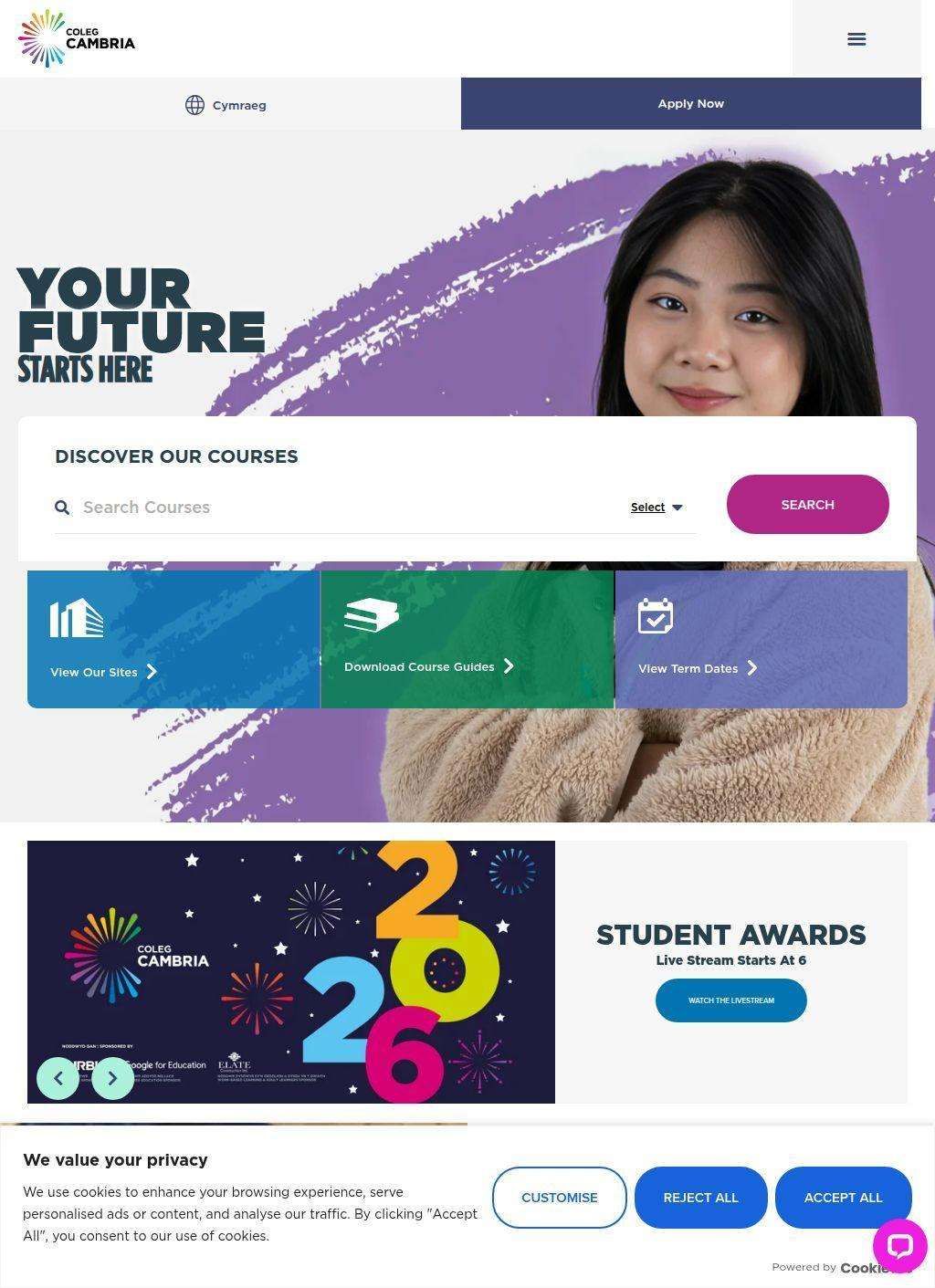
The website at cambria.ac.uk is the college's shop window and application portal. It lets prospective students browse courses by subject and level, filter by campus, read entry requirements and apply online, and it carries the apprenticeship vacancies, adult-learning catalogue and employer-services information. The site is generally clear and task-focused, though the breadth of provision across five campuses means visitors sometimes need to use the course search rather than browsing menus to pin down exactly what is offered where. Information for employers, including how to take on an apprentice or commission training, sits in its own section.
Support services and partnerships
Student support sits behind the curriculum and is part of what distinguishes a college from a sixth form attached to a school. Coleg Cambria provides learning support and additional learning needs provision for students who need it, careers advice and guidance, counselling and well-being services, financial-support funds such as the Welsh Government Learning Grant and education maintenance allowance for eligible learners, and help with the transition from school. There are students' union activities, sport and enrichment, and dedicated arrangements for younger learners and for those at the sixth-form centres. For parents in particular this pastoral side is often as important as the course itself, and the college publishes information on how support is accessed, though as with any large institution the level of one-to-one attention will depend on individual circumstances and should be discussed directly when applying.
Learning support and well-being provision
The bilingual character of the college reflects its setting in Wales. Welsh-medium and bilingual study is available in parts of the curriculum, the college supports learners who want to develop their Welsh, and it runs Welsh-for-adults courses for the wider community, working within the national framework for promoting the language in education. Beyond language, the college maintains a web of partnerships: with universities for the progression of higher-education students, with employers and sector bodies for apprenticeships and commercial training, and with schools across the region for post-16 transition. These relationships are part of why the institution functions as a hub for skills in north-east Wales rather than an isolated provider, and they make it a useful first point of contact for local organisations that are looking to recruit, train or upskill staff.
Bilingual provision and regional partnerships
For north-east Wales the college matters well beyond its classrooms. It is one of the larger employers in the area, a significant contributor to local skills and productivity, and a route by which young people from Flintshire and the surrounding counties gain qualifications and move into work or higher study. Its land-based campuses also play a part in the rural economy and in conservation and animal-welfare training. The combination of academic, vocational and apprenticeship routes under one institution gives the region a single, recognisable destination for post-16 learning.
Within this business directory, Coleg Cambria is listed as the principal further-education and training institution serving Flintshire, with its main local campus at Deeside in Connah's Quay. The entry is likely to be useful to school leavers and parents weighing up post-16 options, to adults considering retraining, and to employers looking for an apprenticeship or training partner in the area. The official website remains the authoritative source for current course listings, campus details, open-event dates and application deadlines, and anyone making a decision should confirm the specifics there, since the offer changes with each academic year.
Business address
Coleg Cambria
Kelsterton Road, Connah's Quay,
Deeside,
Flintshire
CH5 4BR
United Kingdom
Contact details
Phone: 0300 30 30 007