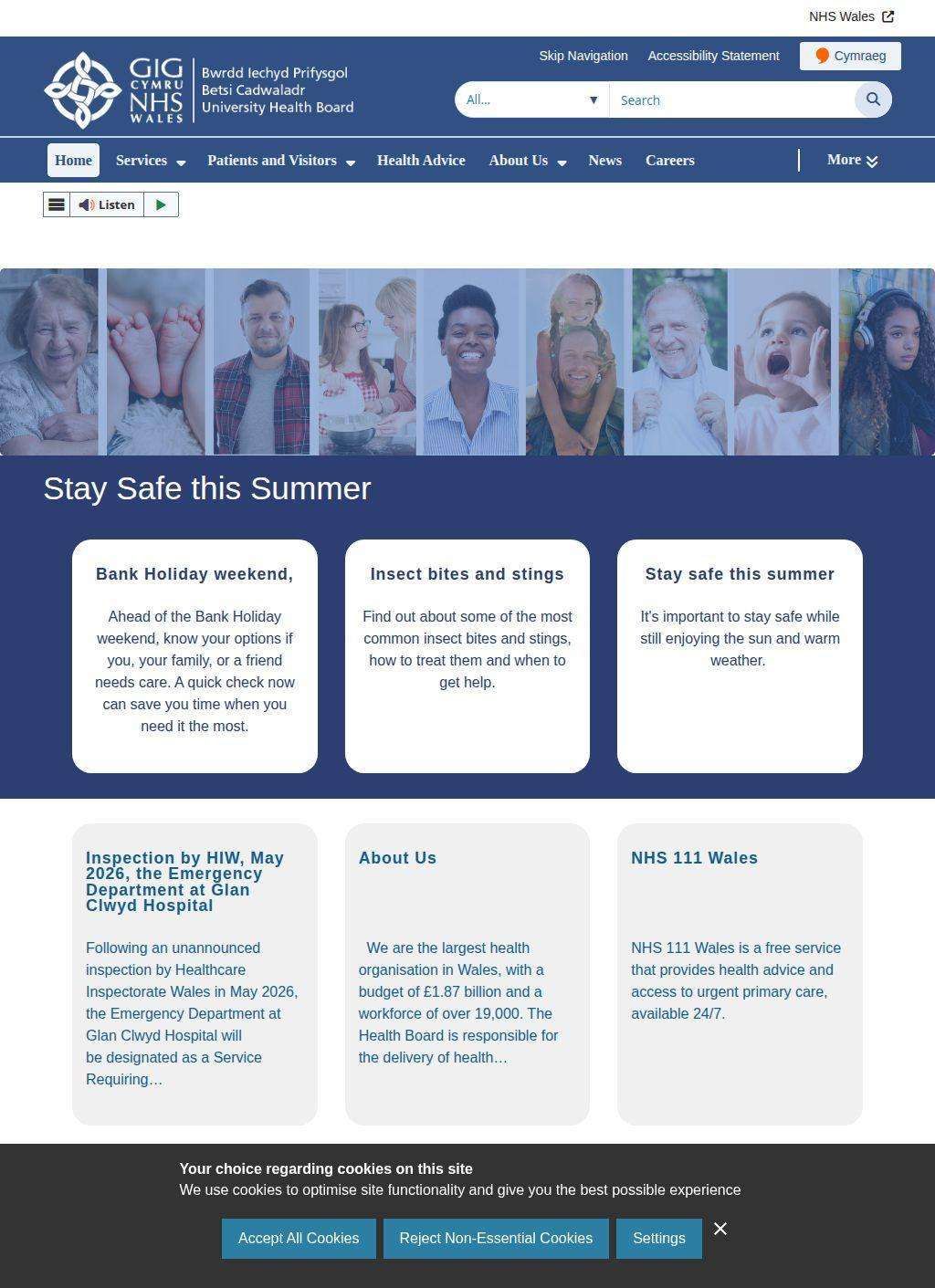
Who actually runs the hospitals and NHS services across North Wales? For the six counties stretching from Anglesey down to Flintshire, that responsibility belongs to Betsi Cadwaladr University Health Board, the statutory NHS Wales body that oversees healthcare across the whole region. Its website at bcuhb.nhs.wales is the front door to that work, and the scope it covers is genuinely large: Betsi Cadwaladr University Health Board is the biggest health board in Wales, serving a population of roughly 700,000 people spread across Gwynedd, Conwy, Denbighshire, Flintshire, Wrexham, and Anglesey.
Three hospitals serving North Wales
The clinical reach is the first thing worth understanding. Betsi Cadwaladr University Health Board operates three district general hospitals: Ysbyty Gwynedd in Bangor, Glan Clwyd Hospital near Rhyl, and Wrexham Maelor Hospital, alongside a network of community hospitals and mental health facilities. The services running through them cover emergency and acute care, elective surgery, maternity, paediatrics, mental health, community nursing, and a range of specialist clinical work. If you live anywhere in the north of the country, the odds are high that any serious medical episode in your family eventually passes through one of these sites, which makes the practical information on the website more than a formality. Betsi Cadwaladr University Health Board is also a major employer across the region, and the website reflects that by carrying NHS vacancies alongside patient-facing content.
Online booking for appointments and tests
More than most NHS body sites manage. The site is built to handle a fair amount of routine interaction, going well beyond publishing opening hours and leaving it there. There is online appointment booking, a separate scheduling tool for blood test appointments, and virtual clinic access, which together cover a good slice of the contact most people have with the health service in a normal year. For anyone who has spent a morning trying to get through on a busy line, having these tasks moved to a web page is a meaningful difference.
Patient feedback through PEARS
There is also a patient enquiry and resolution service, PEARS, which gives people a structured route to raise questions or concerns about their care. That feedback channel says something about how the organisation handles the gap between what patients expect and what they receive. Betsi Cadwaladr University Health Board has had its share of public scrutiny over the years, and in that context a visible mechanism for enquiries and resolution is exactly the kind of thing that belongs on a body of this size. It is one of several places where Betsi Cadwaladr University Health Board communicates accountability alongside service information. The visiting information for every hospital site is laid out plainly too, which sounds minor until you are trying to find out whether you can see a relative on a given afternoon.
Health advice resources sit alongside the transactional tools, giving readers somewhere to start before deciding whether they need a GP, a pharmacy, or an emergency department. None of this is flashy, and it should not be. A health board website that tried to be clever would be a worse website. The job here is to be clear, current, and reachable, and the layout of services makes clear that is the priority.
Governance materials made accessible
One feature worth a specific mention is the publication of board governance materials. Betsi Cadwaladr University Health Board puts its meeting minutes, agendas, and board papers on the site in a way that is genuinely findable, not buried in a document archive. which means the decisions shaping healthcare across North Wales are open to anyone who wants to read them. For a public body spending public money, that transparency is the expected standard, but plenty of large organisations bury this material or make it hard to locate. Having it accessible matters to journalists, councillors, patient groups, and ordinary residents who want to understand why a service changed or a target was missed.
It also changes how you read the rest of the site. A reader can move from a patient-facing service page to the governance documents explaining the strategy behind it, which is a level of openness worth noting. The careers section follows the same logic of putting things in plain sight: it lists NHS job vacancies directly, which is useful given how much of the region's employment is tied to the health service.
Bilingual service across English and Welsh
The bilingual approach reinforces who the site is built for. Betsi Cadwaladr University Health Board operates in both English and Welsh, which for a North Wales public body is a legal and cultural obligation. In counties such as Gwynedd and Anglesey where Welsh is widely spoken, a genuinely bilingual service is part of treating patients with respect, and Betsi Cadwaladr University Health Board carries that through the site rather than offering Welsh as a token toggle.
Mobile app extends access beyond desktop
There is also an NHS Wales mobile app, available for both iOS and Android, extending some of this access beyond the desktop. The app sits within the wider NHS Wales infrastructure rather than being a product of Betsi Cadwaladr University Health Board alone, but pointing patients toward it makes sense for a region where rural travel and unreliable scheduling make a phone-based route to services genuinely valuable.
Taken as a whole, the website does the job a body of this scale needs it to do. Betsi Cadwaladr University Health Board is responsible for the health of close to three quarters of a million people, and the site reads like it understands the weight of that. Running healthcare at that scale across a largely rural, bilingual region is its own kind of challenge, and Betsi Cadwaladr University Health Board makes the entry points as clear as the site can reasonably make them. The mix of bookable services, hospital information, governance transparency, and bilingual delivery covers the obvious needs of patients, families, and the wider community, and it does so without the clutter that often creeps into large institutional sites.
From blood test scheduling to hospital visiting hours
The trust here is built on unglamorous detail: the blood test scheduler, the PEARS enquiry route, the visiting information for each site, the published board minutes. These are the things people actually need from a health authority, and they are present and findable. No website erases the real-world pressures on hospital capacity or waiting times, and Betsi Cadwaladr University Health Board has faced considerable scrutiny on both counts. What the site does is give residents accurate information and direct routes to the services they are entitled to, and on that measure it performs. That may not sound like much, but for a public body this size it is not a given.
No third-party review platforms carry a meaningful profile for Betsi Cadwaladr University Health Board in the way a commercial service might attract ratings. The organisation's reputation is tracked through Healthcare Inspectorate Wales reports, Welsh Government performance reviews, and parliamentary scrutiny, all a matter of public record. Those formal processes produce a fuller picture than consumer ratings ever could. For anyone in the region trying to understand who provides their care, Betsi Cadwaladr University Health Board is the central point, and bcuhb.nhs.wales treats that responsibility seriously.
Business address
Betsi Cadwaladr University Health Board
Block 5, Carlton Court, St Asaph Business Park,
St Asaph,
Denbighshire
LL17 0JG
United Kingdom
Contact details
Phone: 03000 851 234